On May 4, the BJP clinched 207 of 294 seats in West Bengal. It was historic. So was what preceded it.
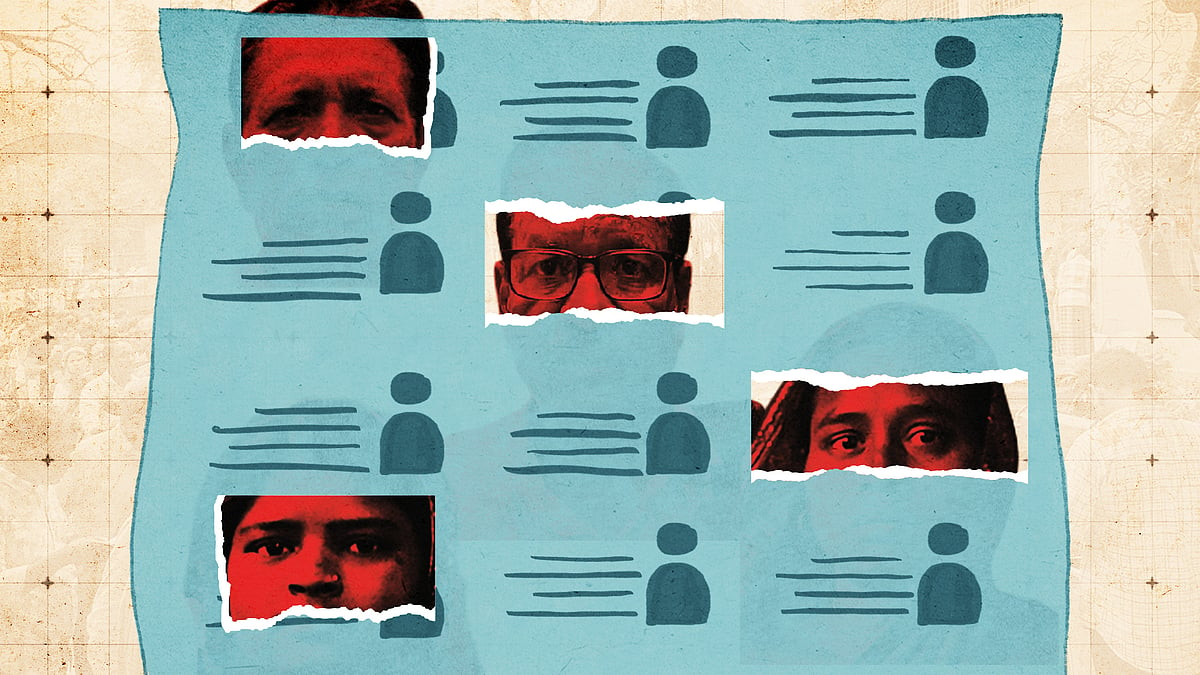
In the months before polling, a Special Intensive Revision (SIR) of electoral rolls quietly reshaped the voter landscape across the state. By the time the final rolls were published in February, 27.16 lakh electors – voters whose names the Election Commission placed under adjudication – had been deleted. The election went ahead even as lakhs of appeals from those deleted remain pending before 19 appellate tribunals, appointed on the Supreme Court’s directions.
The BJP’s sweep has had many explanations – such as anti-incumbency, a fractured opposition vote, Hindu consolidation – but most of them were uncontroversial unlike the SIR. So we looked at the roll revision’s relationship with the results.
We carried out four tests, each stricter than the last, to find exactly where the relationship between deletions and election results holds, and where it breaks down.
What this analysis is and isn’t
The answers are not what partisans on either side will want to hear.
Because this is not an attempt to explain why BJP won or why TMC lost. That would require data that doesn’t exist in public form: booth-level results, a full accounting of additions alongside deletions, and clarity on who was removed, why, and how they would have voted.
The assumption most commonly made – that the deleted voters were TMC’s – deserves particular scepticism. The 27.16 lakh under adjudication were not a homogenous bloc. They could have been Congress voters, Left voters, BJP voters. The BJP’s counter-argument, that the SIR was simply correcting rolls that had been inflated for years, cannot be dismissed either. Both things can be true simultaneously: a revision can be administratively legitimate and electorally consequential, correcting ghost voters in one constituency and erasing real ones in the next.
Irrespective of what the math eventually shows, the SIR made this an abnormal election — one in which lakhs of voters were pushed into uncertainty over a basic democratic right: the right to vote.
Now, let’s get into what the data says.
Test 1: The net deletions vs margins
From West Bengal’s electorate, the Election Commission (EC) first deleted 58,19,653 absent, shifted, dead, or duplicate (ASDD) voters.
Then, 5,46,053 voters were deleted from the draft rolls. Supplementary deletions amounted to 27,16,393, taking the total to 90,82,099 gross deleted.
Now, remove the dead voters (24,20,089) from the total, and you get the first big number – 66,62,010 – the net deletions.
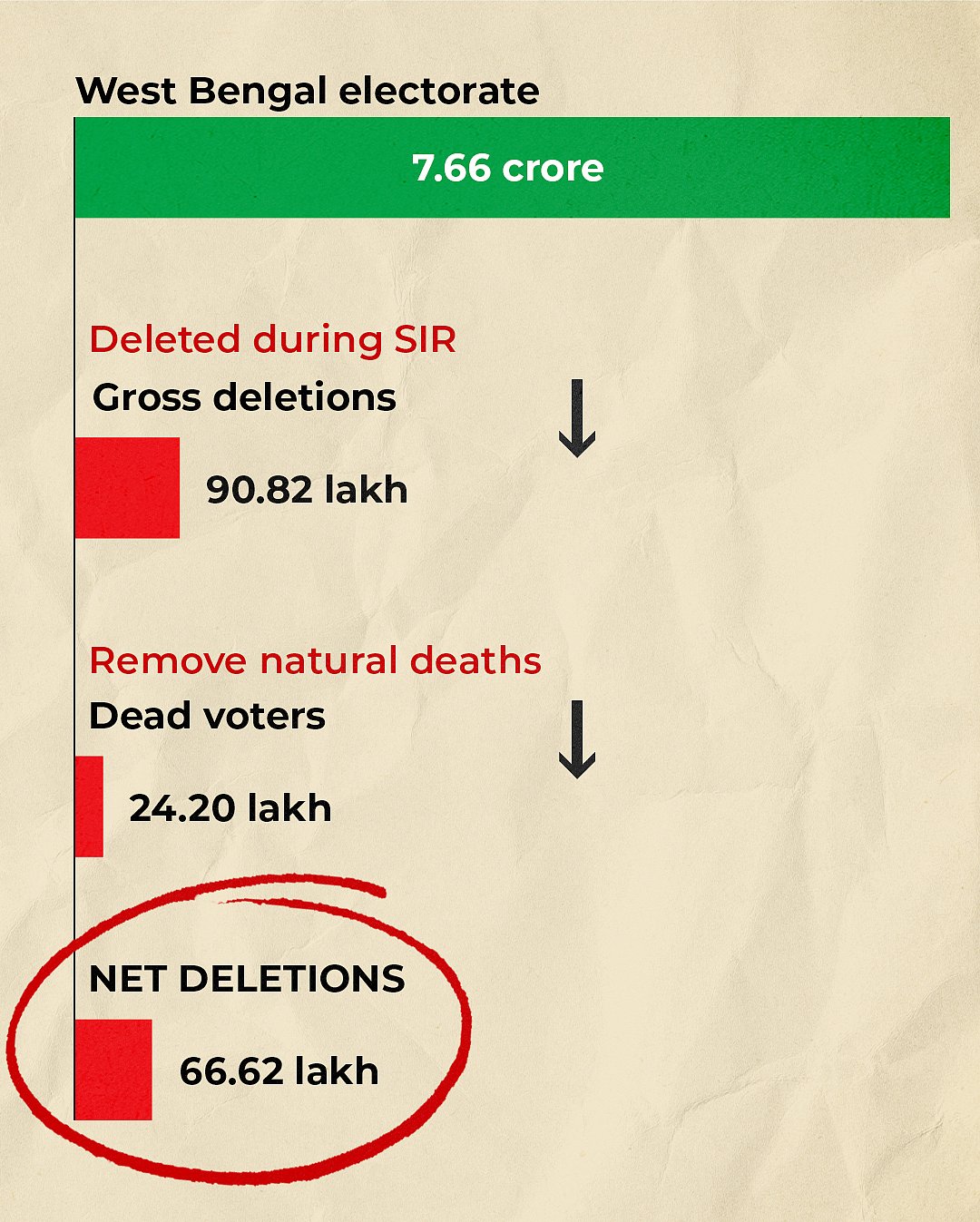
Net deletions, as used in this analysis, cover everyone removed from the rolls for reasons other than death – those flagged for logical discrepancy, listed as unmapped or permanently shifted, marked untraceable or absent, or found to be already enrolled elsewhere.
If we compare the 2026 winning margins to the net deletions in each constituency, we get 82 BJP-won constituencies where deletions exceeded the party’s victory margin. Of these, 70 were seats that flipped from TMC to BJP.
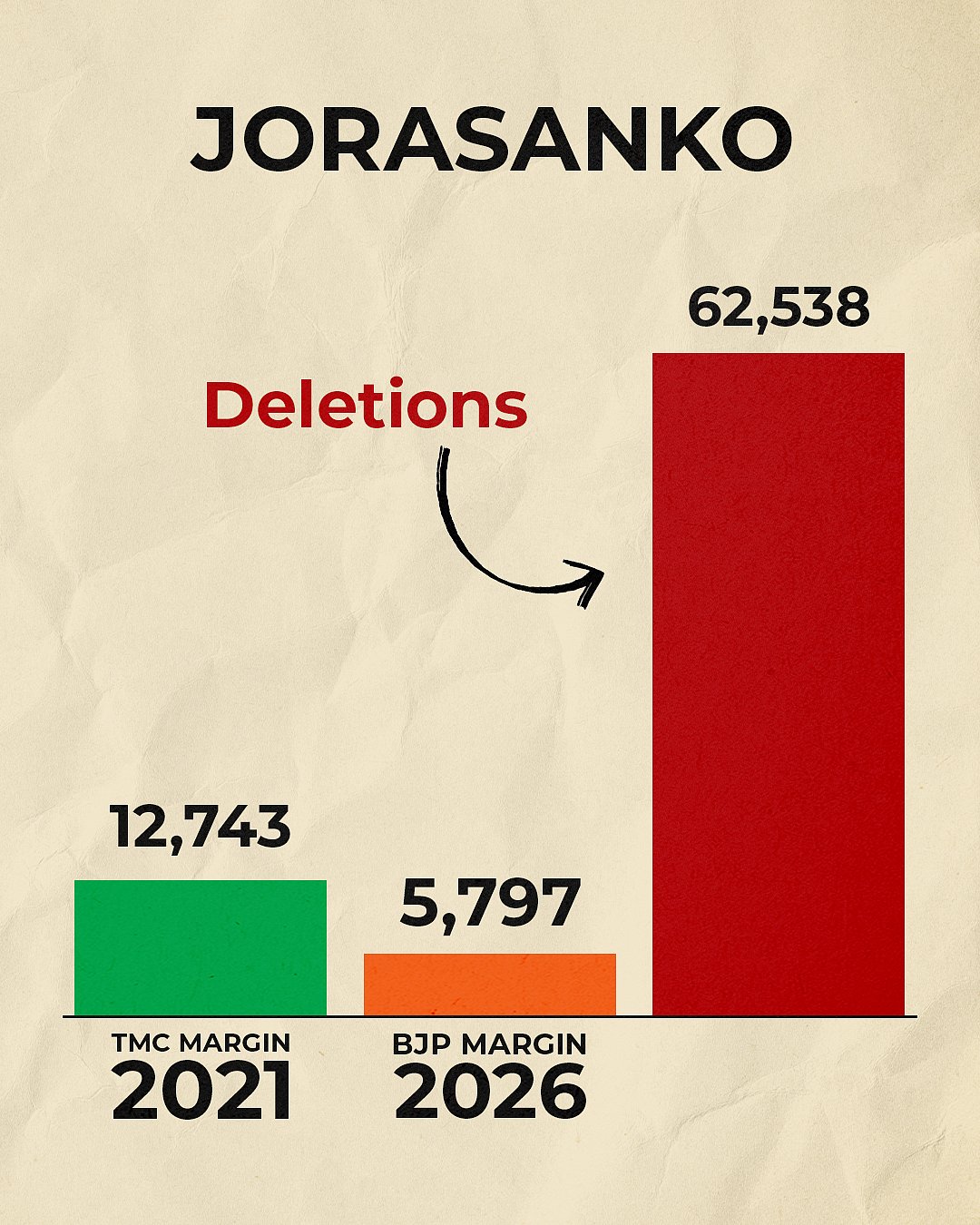
For example, in the Jorasanko constituency, the BJP won with a margin of 5,797. TMC won the same seat with a margin of 12,743 in 2021. Net deletions in the seat were 10 times higher than the winning margin at 62,538.
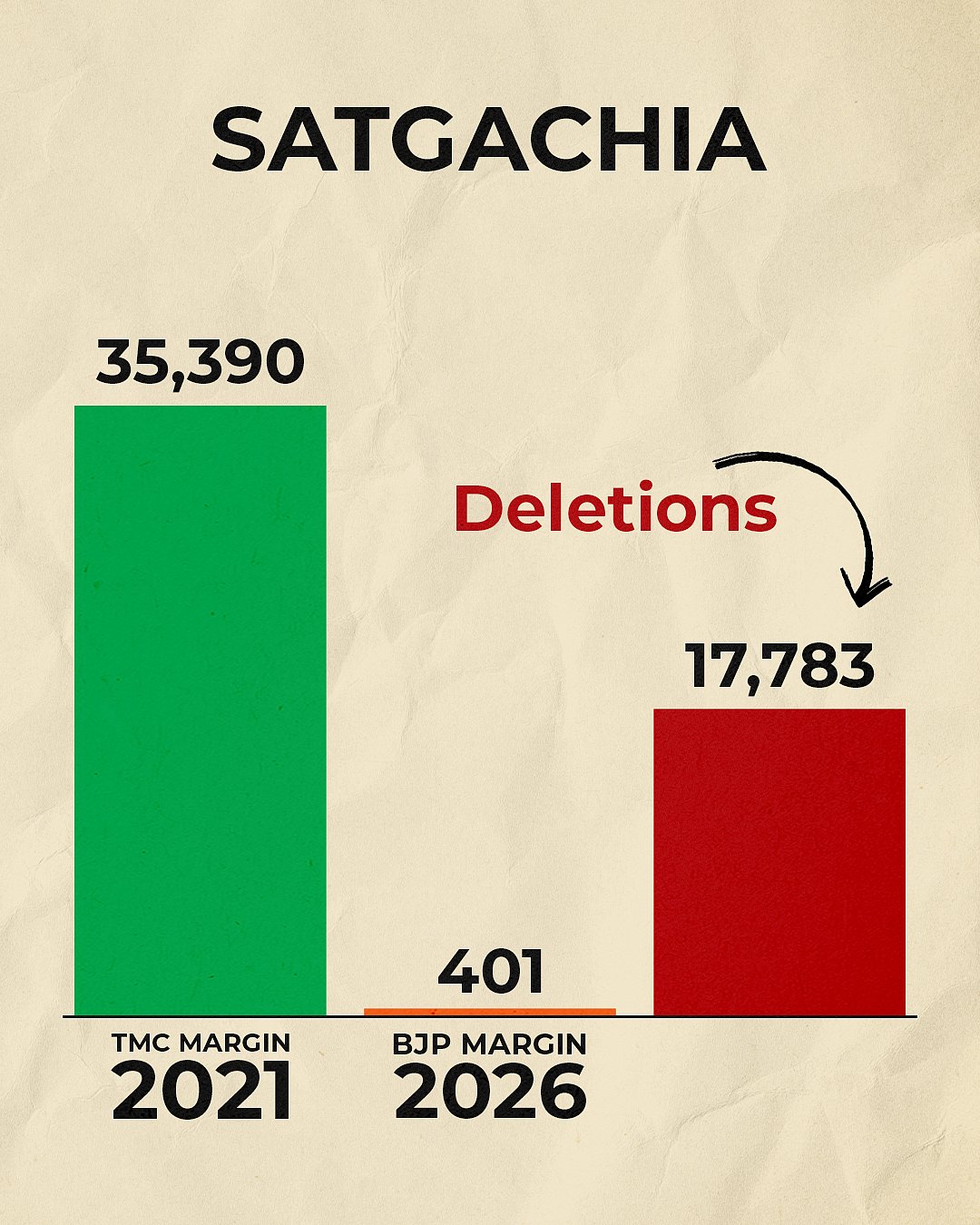
Similarly, in Satgachia, the BJP won with a margin of 401. TMC won the same seat with a margin of 35,390 in 2021. Net deletions in the seat were 44 times higher than the winning margin at 17,783.
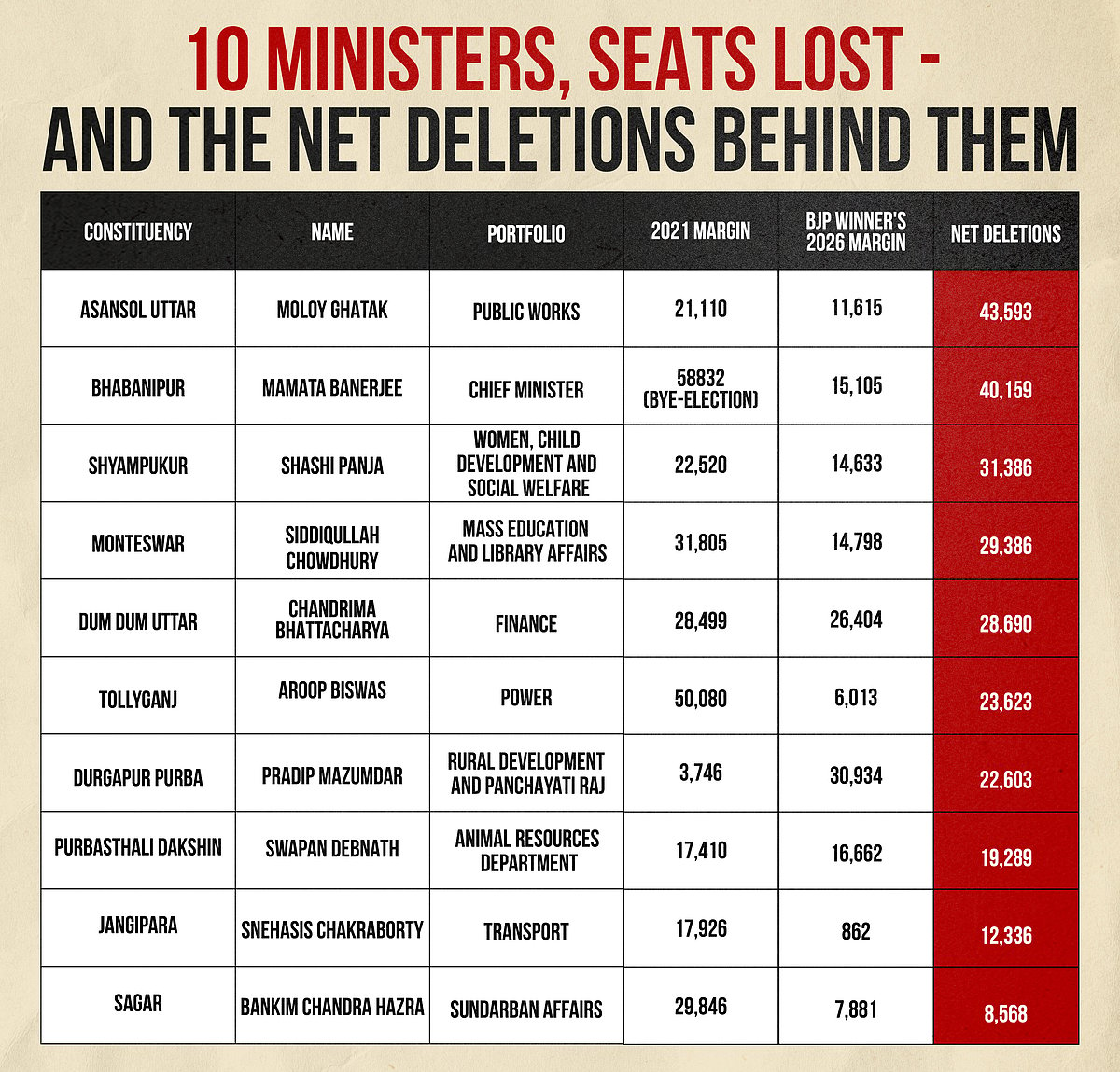
These were not peripheral constituencies. Among the 70 flipped seats, at least 10 sitting ministers lost their seats.
This is where the data starts to raise questions. But it is not where it stops.
Test 2: Net deletions vs electoral swing
For seats that a party managed to retain, electoral swing simply means how much its winning margin shrank between elections.
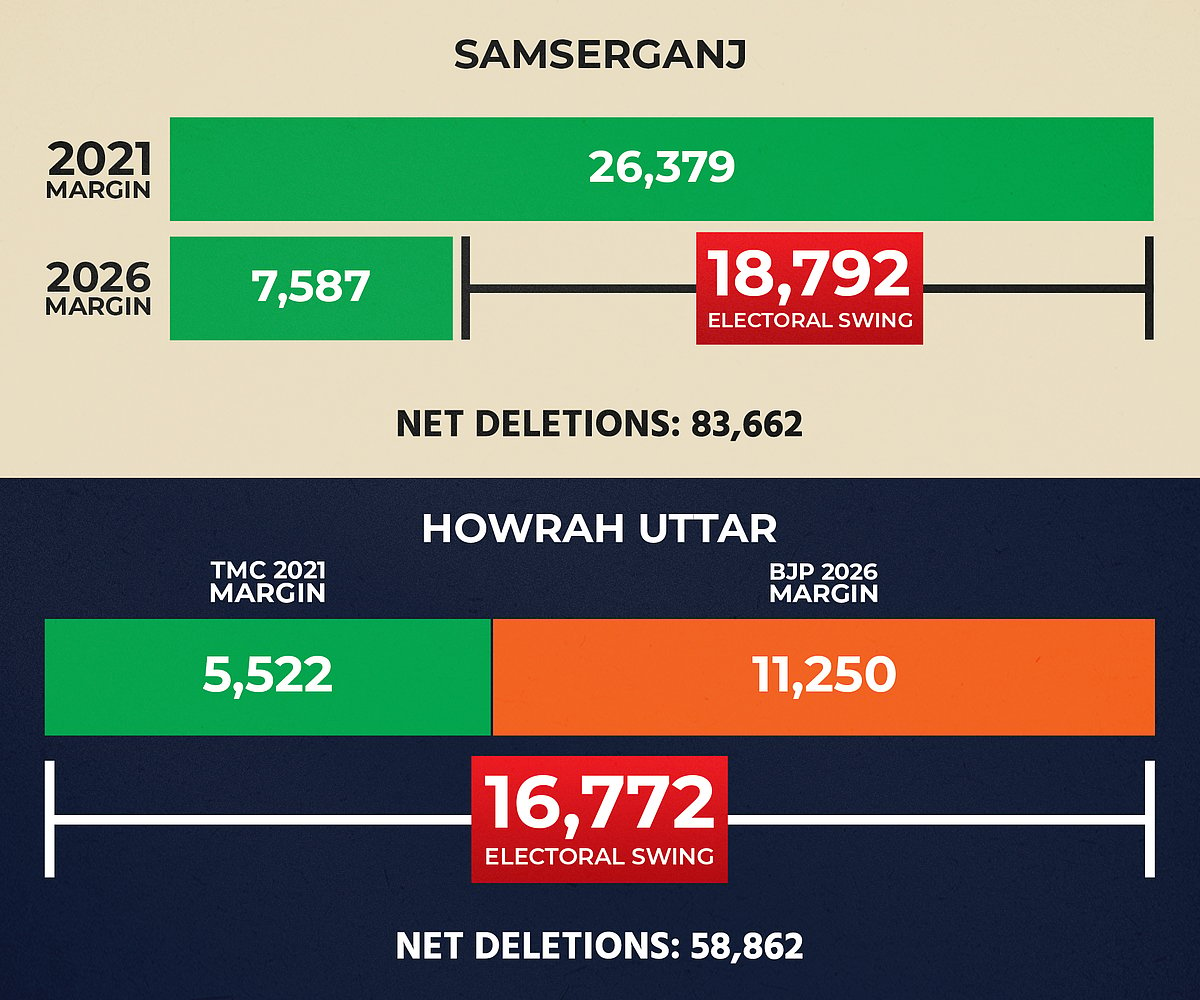
Take Samserganj. TMC won the seat by 26,379 votes in 2021. In 2026, it still held the seat — but only by 7,587 votes. So even though TMC didn’t lose, its support dropped by 18,792 votes. That drop is the electoral swing.
Now compare that to the net deletions: over 83,000 voters were removed from the constituency's rolls. That’s far larger than the actual erosion in TMC’s margin, making the result look far more precarious.
For seats that flipped parties, the swing captures the entire distance the seat travelled politically.
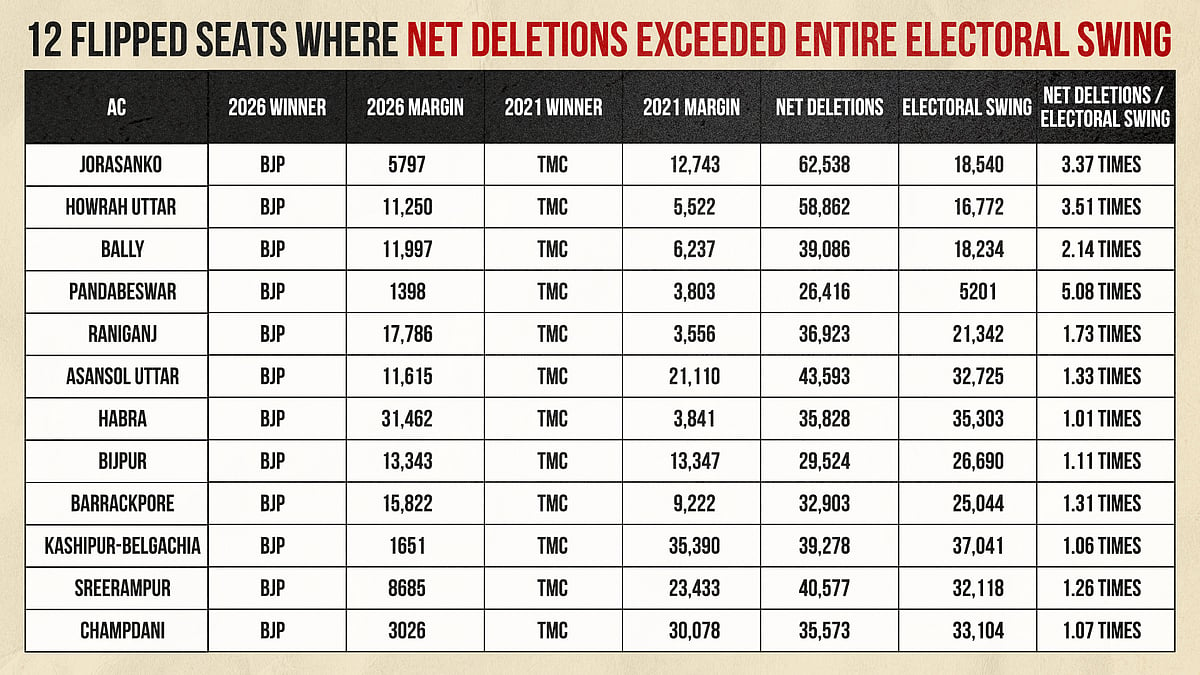
Take Howrah Uttar. In 2021, TMC won it by 5,522 votes. In 2026, the BJP didn’t just close that gap — it went ahead and won by 11,250 votes. So the total political shift wasn’t 11,250. It was 16,772 votes: the old TMC lead plus the new BJP lead.
And here too, net deletions were much higher than the swing: nearly 59,000 voters removed from the rolls.
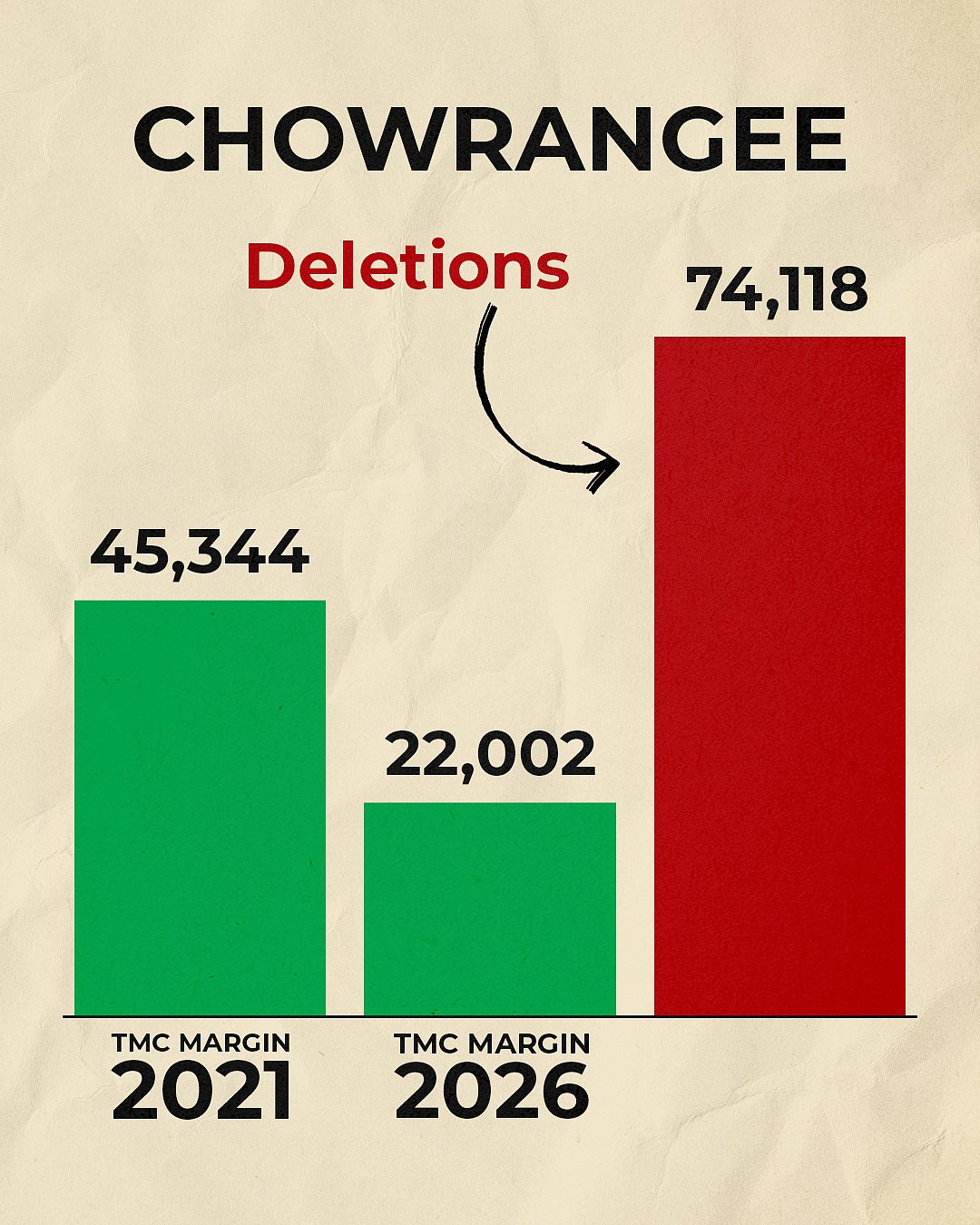
In Chowrangee, TMC won by a margin of 45,344 in 2021. The party retained the seat in 2026, but with a margin of just 22,002 – an electoral swing of 23,342 votes. The seat witnessed 74,118 net deletions. Divided against the electoral swing, that is a ratio of 3.17 – the deletions were more than three times the ground TMC lost.
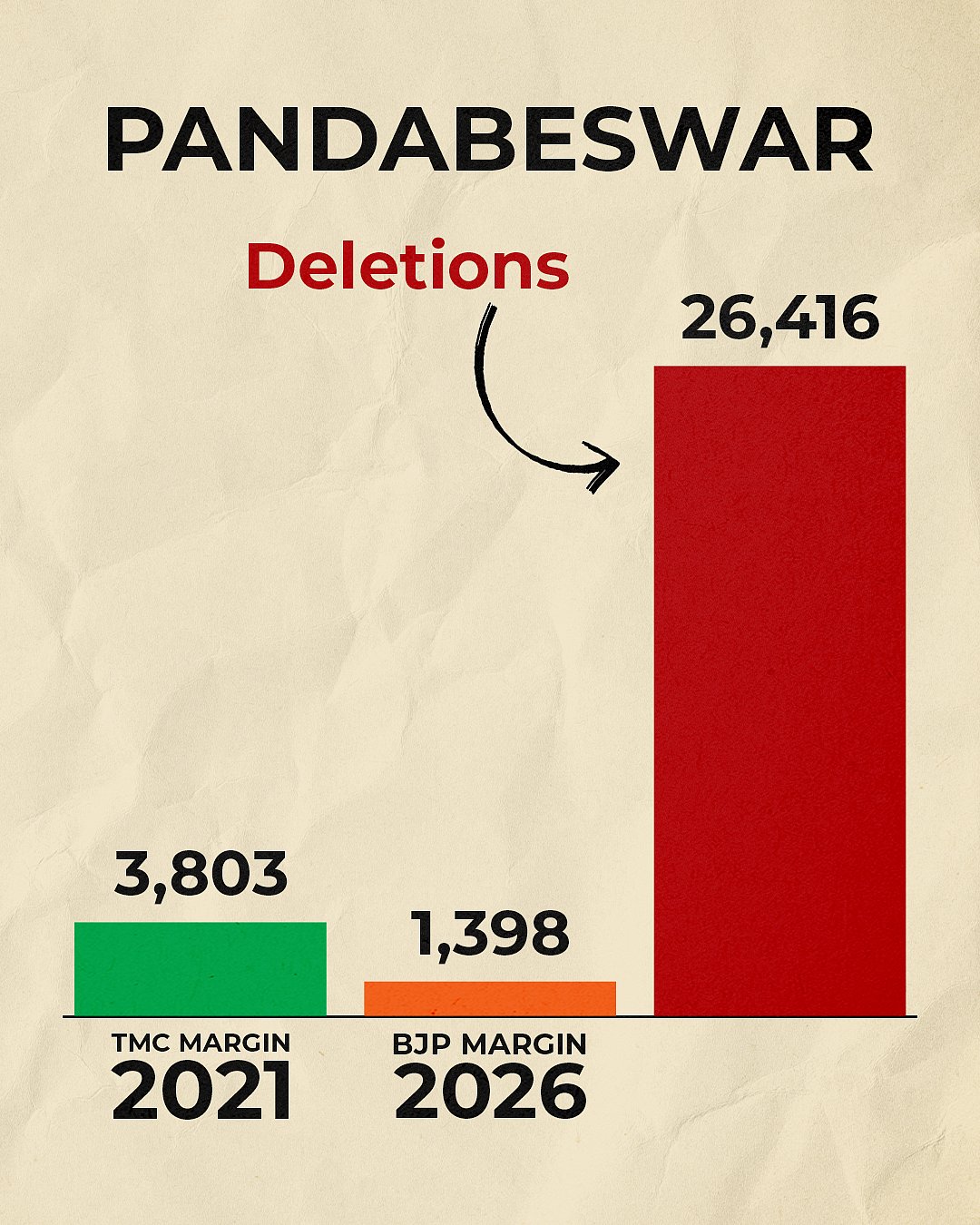
In Pandabeswar, TMC won by 3,803 in 2021. BJP won it in 2026 by 1,398 votes – a total electoral swing of 5,201 votes. The seat witnessed 26,416 deletions, five times the entire swing.
Using this methodology, 12 flipped seats show net deletions exceeding the swing in margins. It’s a smaller number, but even this doesn’t explain why the BJP was able to flip a total of 130 seats from the TMC.
Test 3: Under adjudication deletions vs margin
The 27.16 lakh voters placed under adjudication represent a smaller but more precise lens than the 66.62 lakh net deletions. Unlike the broader net deletion figure, which captures everyone removed for any administrative reason, under-adjudication voters were those whose eligibility was specifically challenged and reviewed during the revision exercise – making them a more targeted measure of the SIR’s electoral impact.
A constituency-level analysis of 293 seats shows that in 49 seats, the number of under-adjudicated voters deleted exceeded the winning margin. BJP won 26 of these, TMC retained 21, and Congress won 2.
Now, of the 49 seats where the UA deletions were higher than the 2026 winning margin, the BJP won the following seats:
Three of these BJP wins came by defeating Mamata Banerjee's cabinet ministers — Moloy Ghatak in Asansol Uttar (public works), Snehasis Chakraborty in Jangipara (transport), and Siddiqullah Chowdhury in Monteswar (mass education).
Even Jangipur, a Muslim-majority constituency in Murshidabad, close to the Bangladesh border, is one of these. It had been a TMC stronghold since 2014, with the party winning it by a margin of 92,480 in 2021. Following the adjudicated deletions of 36,581, BJP won this seat by a margin of 10,542 votes – despite the “infiltrator” narrative and the fear of being disenfranchised. There was a swing of 1,03,022 votes.
But comparing UA deletions to the 2026 winning margin still doesn’t account for the swing from 2021. That’s the fourth and final test.
Test 4: UA deletions vs electoral swing
An even stricter test, comparing UA deletions to the electoral swing from 2021, shows that in 14 seats, the deletions were higher than the overall change in margin. Of these 14, the BJP won only one – Pandabeswar – and the TMC won the rest in 2026. In 2021, the TMC had won all 14.
Under this test, the SIR’s measurable electoral footprint shrinks to one seat. What the deletion story also can’t account for is what happened on BJP’s side of the ledger. The party did not lose a single seat it had won in 2021. Seats where it had won on very thin margins have grown substantially. On the other hand, even the seats TMC managed to retain, the party’s cushion has eroded.
For example, the BJP won the Dinhata seat by just 57 votes in 2021. By 2026, that margin had grown to 17,447. UA deletions in this seat were 17,274.
Similarly, in Balarampur, the BJP won by 423 votes in 2021; by 2026, their margin was 35,051. UA deletions in this seat were 1,037.
In Kulti, the BJP won by 679 votes in 2021; by 2026, their margin was 26,498. UA deletions in this seat were 11,664.
What this analysis shows is that in dozens of constituencies, the number of deleted voters was large enough to overlap with electoral margins. Whether that overlap reflects correction, disenfranchisement, or some combination of both may remain unresolved.
That is a question of public interest that warrants a full and transparent answer, something which the Election Commission refuses to provide.
Deletion data for this report was taken from Sabar Institute, and data for the winning margins was taken from the Election Commission’s website.
We take no ads, bow to no government or corporation, and answer only to you, the reader. This Press Freedom Month, pay to keep news free.
Newslaundry is a reader-supported, ad-free, independent news outlet based out of New Delhi. Support their journalism, here.