When renowned artist Pichai Pongsasaovapark was in Pattani, he was stunned to see large piles of scrap wood from decommissioned fishing boats that had been demolished by cranes. These scraps of wood were distributed to local villagers to be used as firewood for boiling anchovies.
"What I witnessed left me with many questions. Each of these boats holds immense value since they were crafted from dozens of sturdy takien logs. They should have been stored or repurposed. For example, they could have been transformed into a coffee shop, homestay or an educational museum," said Pichai.
"Instead of demolishing them, preserving some of these decommissioned fishing boats for an exhibition could educate young generations about Thailand's history with the EU's yellow card [for Illegal, Unreported, and Unregulated fishing] and how the crisis was managed. The exhibition should include the boats' names and specifications and the exact compensation amounts paid by the government."
Inspired by his question surrounding the demolition of the decommissioned fishing boats, Pichai created the exhibition "Beyond Loss", which is on display at VS Gallery. The exhibition addresses the struggles faced by commercial fishing communities in Pattani and reflects on the broader collapse of the local fishing ecosystem.
"Beyond Loss" is a continuation of Pichai's exhibition in 2024 "Net Loss" which reflected on the effects of the government's efforts in 2015 to regulate the fishing industry to lift the yellow card warning issued by the EU.
To lift the formal warning, the government launched the Royal Ordinance on Fisheries, B.E. 2558 (2015) and the Royal Ordinance on Thai Vessels, B.E. 2561 (2018). Although the yellow card was lifted in January 2019, commercial fisheries, especially small and local operators, were greatly affected by these new regulations. As a result, many people lost their businesses and sources of income. There was a major disruption within the industry.
"A yellow card is a serious warning because the subsequent red card means the EU would ban all Thai seafood exports," explained Pichai. "To get the yellow card lifted as quickly as possible, the government enacted several strict laws.
"However, fishermen could not adapt to sudden changes. Those with unregistered boats and those lacking Vessel Monitoring Systems [which cost tens of thousands of baht at the time], were unable to fish for months or even a year. Further, the government mandated official logbooks and paperwork, which the fishermen were not accustomed to handling," explained Pichai.
"If fishermen violated the law, the penalties were severe, including imprisonment and substantial fines exceeding hundreds of thousands of baht. This forced them to sell their boats to the government under 'The Vessel Buy-Back Programme for Sustainable Marine Resources Management'. My research in Pattani focuses on this period when the government purchased the first batch of 48 boats."
During the research, Pichai encountered many fishermen who had been struggling due to the loss of their livelihoods -- even those who received compensation from the Buy-Back Programme which aimed to eliminate illegal fishing and reduce overfishing. Hearing their experiences left him deeply devastated.
"I interviewed a woman whose husband had been a fisherman since his youth, but is now partially paralysed. She broke into tears while telling me that it was incredibly agonising for her to sell their boat.
"She had to battle with countless government agencies before receiving a compensation of just over 1 million baht, but that left them with no future livelihood," he said.
According to ThaiPublica.org, Pattani used to have over 2,000 commercial fishing vessels, but after the government's strict enforcement, the number of fishing vessels decreased to less than 1,000.
"The decline in the number of boats does not only affect fishermen; it also impacts everyone involved in the fishing ecosystem. This includes vegetable vendors who sell food to the boat crew; ice merchants who sell ice used for keeping the fish fresh and suppliers of fishing equipment," said Pichai.
"A boat owner shared a tragic story with me. When his boat was forced out of the system, the entire crew became unemployed. The captain had worked with the boat owner for years and depended on this job for his livelihood. Without an alternative career and under pressure to support his family, the captain eventually decided to take his own life."
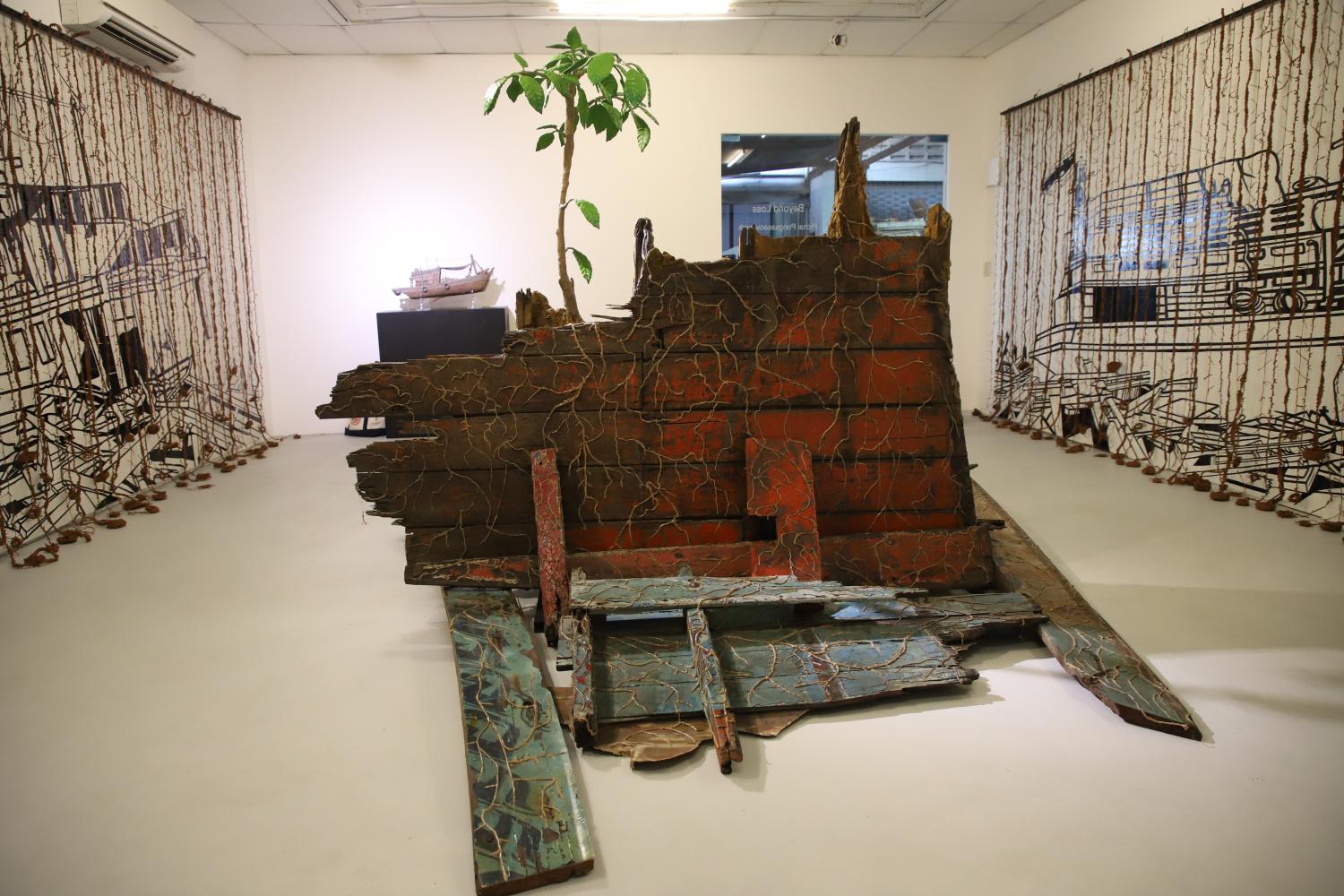
On display at VS Gallery, the exhibition, "Beyond Loss" showcases three installations: Beyond Loss, Return Of Nang Ta-Khian and Laphprasert.
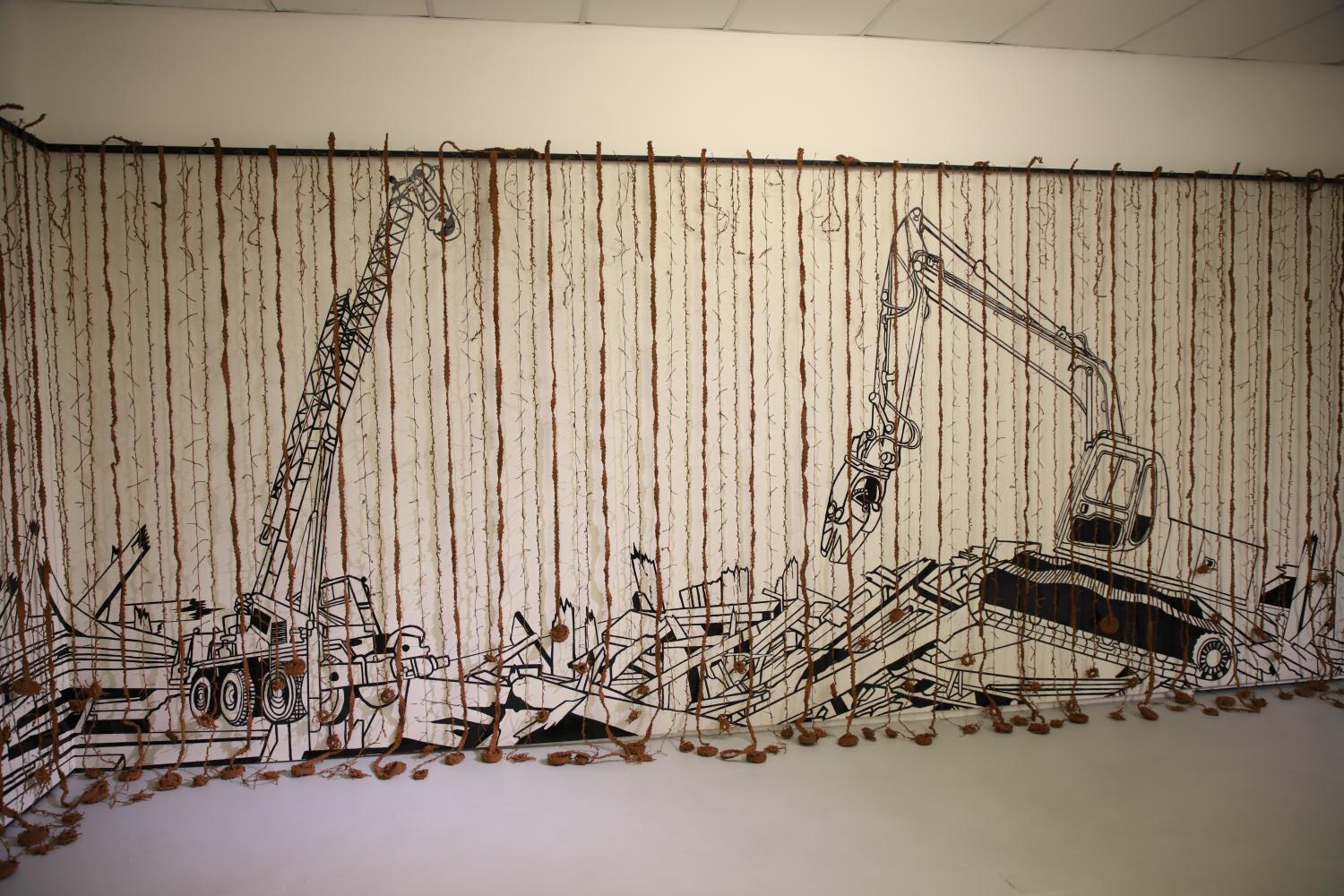
Beyond Loss features a large-scale oil painting on plastwood which depicts the wreckage of 48 decommissioned commercial fishing boats. Trawl nets are a type of fishing gear that barely sells due to strict legal regulations. Knowing they would never sell, Pichai's sister who runs a fishing supply store gave the nets to him for his artwork.
For Beyond Loss, Pichai cut these trawl nets into strips, coated them with ash gathered from the burnt remains of the demolished boats and hung them like curtains in front of the paintings of the demolished vessels.
"I want viewers to ask the same question that I did. Why were these vessels demolished? Couldn't they have been put to better use? Each commercial fishing boat is massive. It measures approximately 18m to 19m by 2.5m wide and 3m in height. To think that 48 of these boats were completely destroyed is staggering," he said.
Pichai explained that he incorporated trawl nets into his artwork because they symbolise the strict legal regulations designed to protect marine life. However, while these laws aim to preserve nature, the rigid enforcement severely crippled local fishing communities.
Return Of Nang Ta-Khian comprises a sculpture of a tree sprouting from a pile of wood scraps from the demolished fishing boats.
"Fishermen believe that a guardian spirit called Mae Ya Nang protects their vessels. Through the work, I want the spirit of Mae Ya Nang to be reborn within the takien tree as this carries a message of hope," said Pichai.
"When Thai people see a tree growing out from a narrow crevice in a rock or wall against the odds of survival, they believe that a divine spirit resides in it. This resin sculpture was replicated after a real takien tree.
"Fishermen pass down their knowledge generation to generation. Before the invention of GPS, they relied on the stars to navigate the seas. Sadly, the government failed to provide any measures to help those who were forced to sell their vessels to return to the fishing industry."
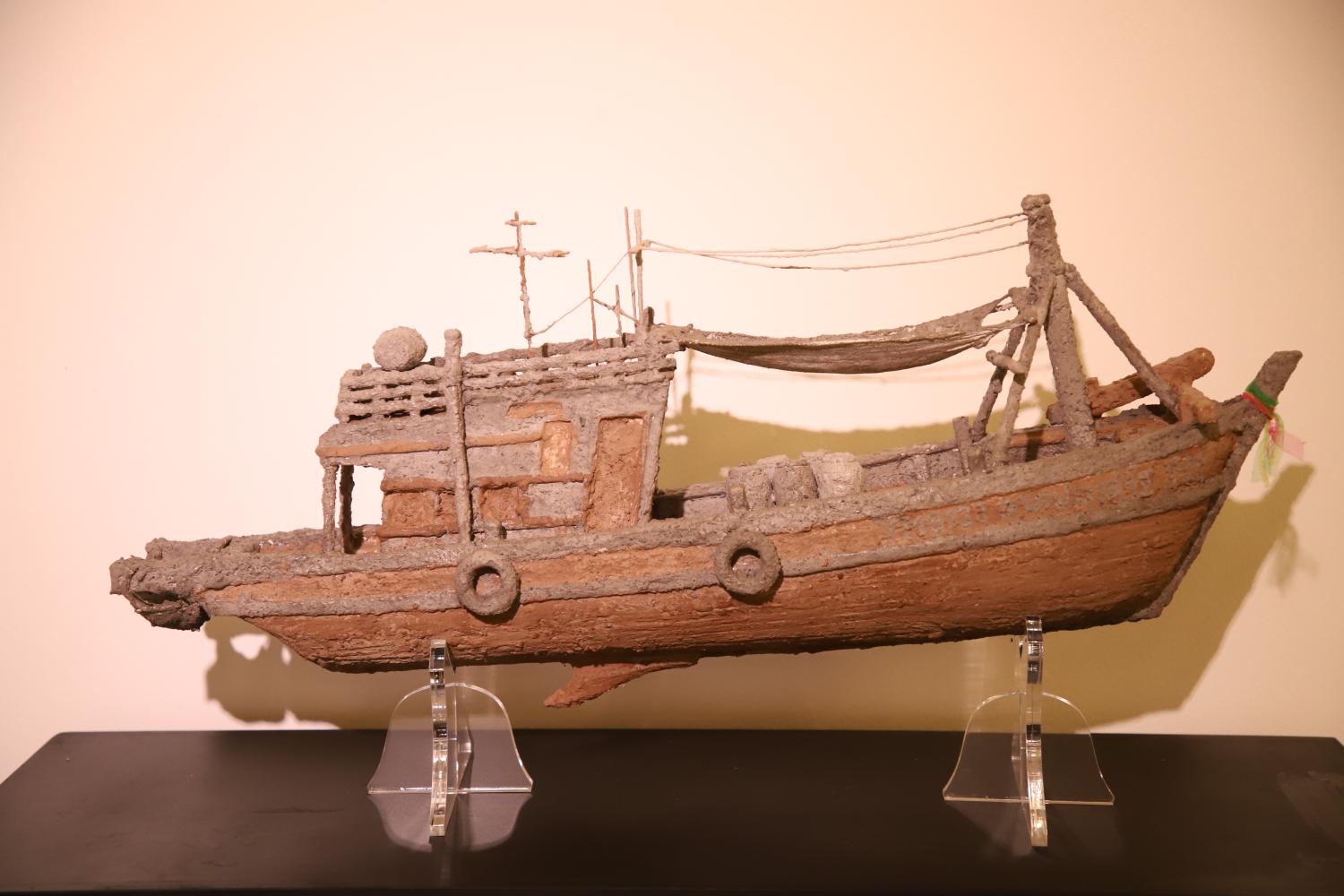
The model boat, Laphprasert, originally exhibited in "Net Loss" returns in "Beyond Loss" to show the final remains of scraps used as firewood to boil anchovies. Pichai discovered that unlike ordinary ash which is light and powdery, ash from hardwood like takien is granular.
Even though Pichai is an artist whose work focuses on social issues and the environment, he hopes that people do not just protect nature and forget about human beings.
"Everything is driven by self-interest and profit. Many people want to protect the environment, but saving it should not destroy the ways of life of local communities. We must think about people who live in the ecosystem and how they are affected," he said.
"Beyond Loss" runs at VS Gallery, Naradhiwas Rajanagarindra 22, until Sunday. Admission is free. For more information, visit facebook.com/VSGalleryBangkok.