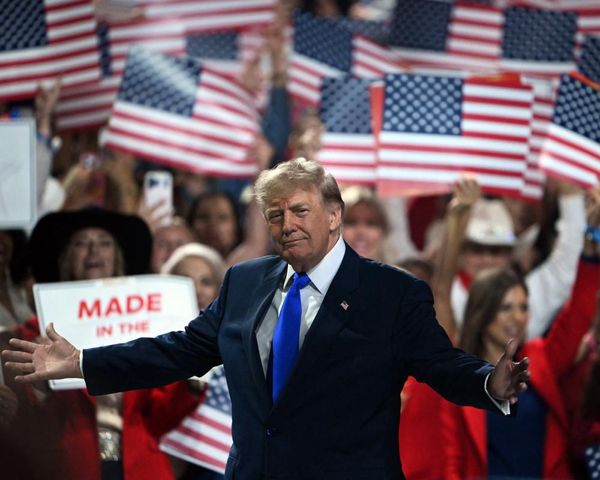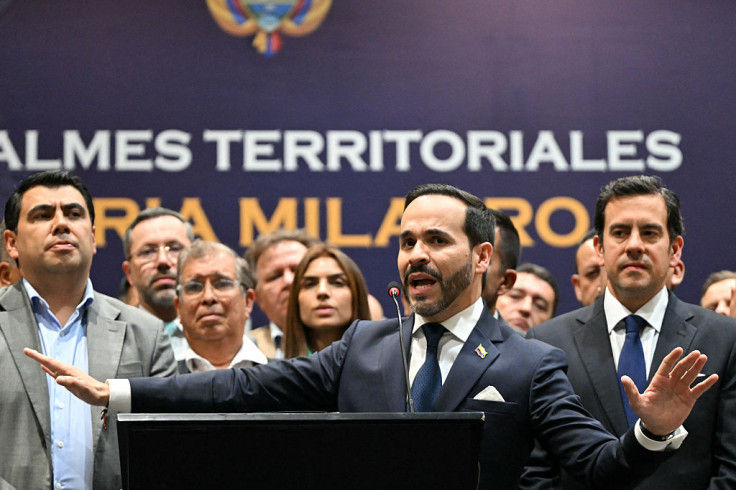
Colombia President Abelardo de la Espriella is the latest Latin American leader to mirror the hardline rhetoric of United States President Donald Trump, but experts say his plan to deport thousands of immigrants may not be feasible.
Weeks after taking power, de la Espriella announced that his government would begin to carry out operations aimed first at deporting criminals. But later the operation would impact anyone without regular immigration status. "Colombians first, Colombians second, and Colombians third," he said.
Unlike Trump, who has dramatically increased deportations from the United States, de la Espriella's party does not hold political control of his country's legislature. Nor, experts say, does the country have the capacity to carry out sweeping immigration raids like those seen in U.S. cities such as Chicago and Los Angeles.
"In Colombia, I think the rhetoric is going to be easier than the implementation," said Robert Harding, a political science professor at Valdosta State University.
De la Espriella's posture reflects his interest in tightly aligning Colombia with the United States. Through his "Shield of the Americas" regional security alliance, Trump has pushed for Latin American countries to impede migration and linked its rise with that of organized crime throughout the region, including illicit gangs like the infamous Venezuela-born Tren de Aragua.
For de la Espriella, "it's all a big show — he wants to join this club," said Gimena Sanchez, the Andes director for the human rights advocacy nonprofit Washington Office on Latin America.
If realized, the largest impact of de la Espriella's deportation plan would be on the estimated 2.9 million Venezuelans who have migrated to Colombia since 2018 following the country's economic and social collapse.
Estimates vary, but it is believed about 850,000 Venezuelans now live in Colombia without regular status, meaning they do not have a visa or residency permit. In 2021, Colombia announced a 10-year temporary protected status for Venezuelans under President Iván Duque, but saw its commitment to regularizing migrants wane under leftwing former President Gustavo Petro.
De la Espriella now joins other recently-elected right-wing leaders throughout Latin America in taking a firm stance against immigration, particularly from Venezuela, and linking it to concerns about security.
Argentinian President Javier Milei and Chilean President José Antonio Kast, for example, have both sought to appease the United States and their political bases by promising to rein in immigration.
But experts noted data indicates the level of deportations from those countries have yet to reach massive levels and might not ever in Colombia, either. Nevertheless, in each case, the rhetoric sends a signal to Washington that immigration is a top concern.
In Colombia, immigration wasn't an explicit focal point of de la Espriella's unexpected rise to power in the way it served Trump during his 2024 campaign in the United States.
But the Colombian president, who was backed forcefully by Trump in the campaign, sees a clear benefit from a tight alliance with the United States; on the day de la Espriella took office, the U.S. announced it would dedicate a US$1 billion security aid package for Colombia.
Diego Chavez-González, a Latin American analyst for the Migration Policy Council, questioned whether an all-out immigration operation would benefit either the United States or Colombia. He warned that sending thousands of immigrants back across the 2,219-kilometer land border between Colombia and Venezuela could make them susceptible to recruitment and exploitation by groups that control the region, such as the National Liberation Army, or ELN.
"Having irregular status makes them invisible and makes them very vulnerable," Chavez-González said of migrants. "Being harsh on crime is one thing, but I think there is a confusion by many politicians — irregularity is not the cause of crime, irregularity is a consequence of bad policy."
The border between Venezuela and Colombia is notoriously porous, with thousands of people crossing every day.
"If a Venezuelan wants to migrate to Colombia, that person can migrate to Colombia very easily," Chavez-González said.
Criminal organizations have a presence not only in rural areas along the border, WOLA's Sanchez noted, further complicating any government efforts to dispel irregular migrants linked to crime.
"The ones that he's looking for, they're in conflict areas, urban and rural, the country doesn't have control of," Sanchez said.
A destabilized border between Colombia and Venezuela has drawbacks for the United States, which is looking to stabilize Latin America firmly under its sphere of influence under the "Donroe Doctrine". But it's also a threat to de la Espriella, whose unexpected ascendency was built on a campaign dedicated to improving security in Colombia.
Not only does he face a divided legislature, de la Espriella's administration was also forced to contend with a far more immediate and pressing disaster after an Aug. 10 earthquake left large portions of western Colombia destroyed or damaged.
Though he campaigned on reducing the size of the state, de la Espriella was forced to increase his predecessor's budget proposal by about 10% to 634.95 trillion Colombian pesos (approximately $206 billion USD), partly in order to pay for relief in the wake of the earthquake — likely limiting the Colombian government's will to funnel resources into ramped-up immigration enforcement operations.
But while enormous raids might not become the norm, the president's rhetoric can have an impact. Immigrant advocacy groups have expressed worry about the spread of misinformation that provokes fear in the immigrant community and have urged migrants not to "self-deport," as they have from countries like the United States.
De la Espriella's rhetoric is highly likely to curry favor with Trump, but whether it lands with the Colombian populace remains to be seen, experts said.
"He's being a typical politician in the sense that he has talked up a big game to a population that is rightfully frustrated, scared and hoping for a miracle," Harding said.