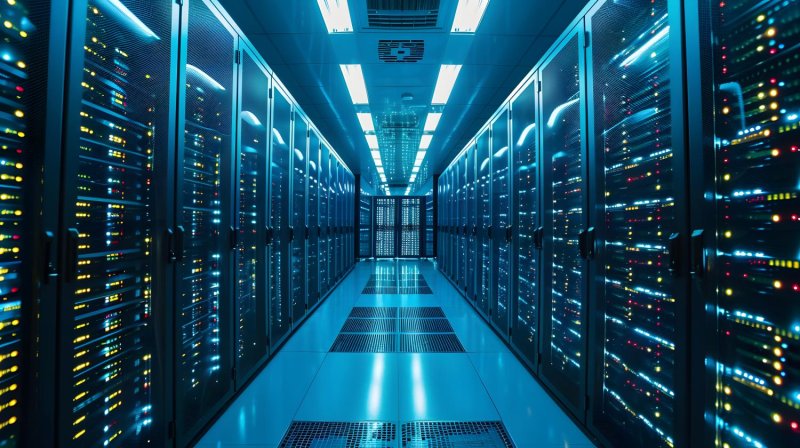
Thailand's investments in data centres are projected to reach US$4.31 billion by 2030, representing average annual growth of 18% from 2024 and achieving total capacity of 2.93 gigawatts, helped by strong government support and solid demand, says CGS International Securities.
Thailand is undergoing a fundamental transformation in its digital infrastructure, driven by artificial intelligence (AI), cloud adoption, data sovereignty regulations and spillover demand from capacity-constrained neighbouring countries, especially Singapore, said Kasem Prunratanamala, head of research at CGS.
Investments in digital infrastructure in Thailand totalled $1.48 billion in 2024 and are projected by Mordor Intelligence to expand by an average 18% per year until 2030. Power capacity is expected to surge 30% annually from 0.77GW to 2.93GW.
"Investment momentum has accelerated sharply into 2026," said Mr Kasem, adding Board of Investment (BoI) investment applications in the digital sector reached 874 billion baht for 48 projects in the first quarter of this year, skyrocketing 823% year-on-year.
Among the approved applications are investment of 842 billion baht by TikTok System, along with applications from Global Switch, Skyline Data Center and Evolution Data Center, according to CGS.
Thailand FastPass, the BoI's economic mechanism designed to cut approval times by 20-50% for major strategic investments, is also driving significant growth in data centre investments, he noted.
Electricity demand forecasts explicitly incorporate the rise of data centres, which are projected to require 100% clean energy, with total demand estimated at 6.2-8.6GW by 2050, according to the National Energy Policy Council.
JLL's 2026 Global Data Centre Outlook projects global capacity to nearly double from 103GW in 2025 to 200GW by 2030, an annual growth rate of 14% that requires up to $1.2 trillion in real estate investment and $1-2 trillion in IT equipment spending.
CGS acknowledged that Tier 3 data centres are by far the most popular in Thailand, accounting for 85% of the market because they offer high reliability with less than two hours of downtime per year, which is more than sufficient for most businesses such as banks, factories, retailers and government agencies.
Tier 3 offers a much lower cost than Tier 4, which can cost roughly twice as much to build due to its fully redundant power and cooling systems.
Risks to data centre investments are power grid bottlenecks, substation saturation in the Eastern Economic Corridor (EEC) delaying project delivery, a slowdown in global hyperscaler capital expenditure or AI investment cycles, and delays in direct power purchase agreements, said Mr Kasem.
CGS said SET-listed Gulf Development is well-positioned to capture a disproportionate share of Thailand's long-duration data centre growth, particularly in the power-constrained EEC.
GSA, which is Gulf's data centre and digital infrastructure platform, is a structural extension of its integrated energy and infrastructure franchise, leveraging the group's strengths in power procurement, liquefied natural gas and utility access to develop hyperscale, AI-ready capacity, he said.