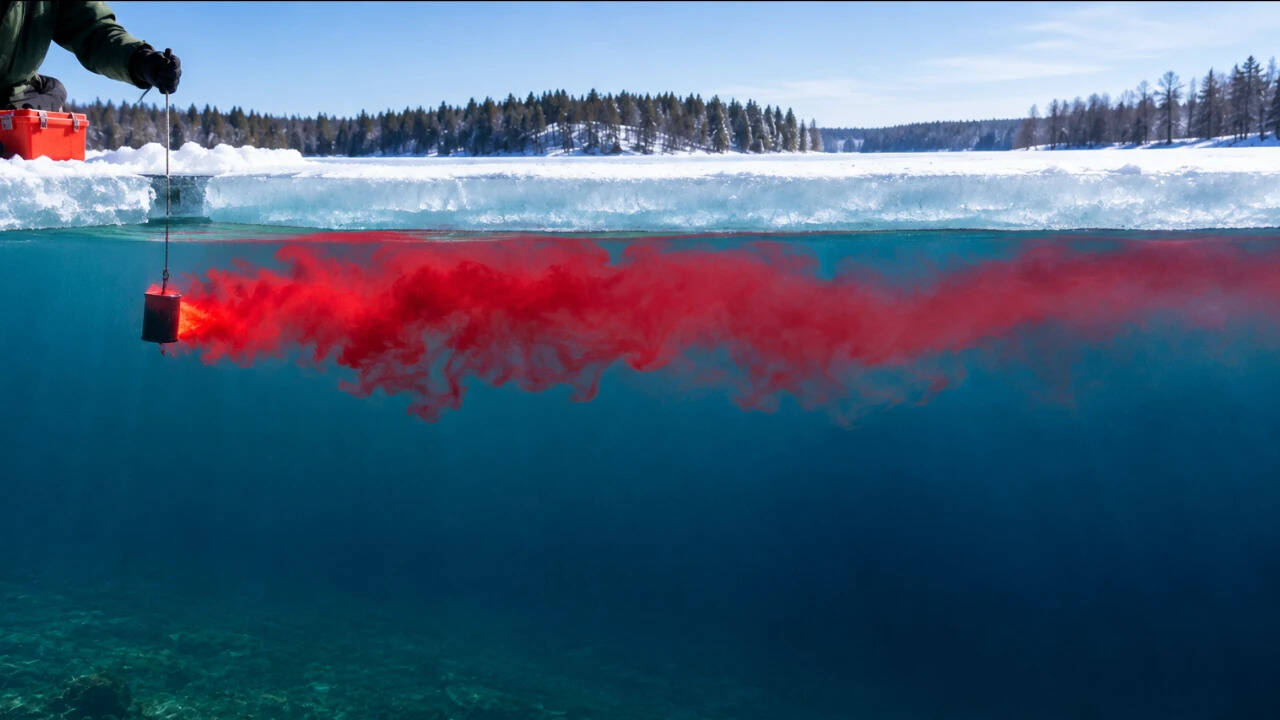
A widely repeated account holds that in 1984, scientists injected red dye under the ice of Lake Erken in Sweden and found that after 26 hours, about 95 percent of it remained in the uppermost seven meters. The "two teaspoons" figure often attached to this account does not match the dye quantities described in the underlying field research, so it should be treated as an unverified detail of the popular retelling rather than a number from the published study. That study is a genuine series of winter tracer tests carried out by hydrologist Lars Bengtsson, who released dye into three ice-covered Swedish lakes in 1984 and published the results two years later in Nordic Hydrology as Dispersion in Ice-Covered Lakes.
Get breaking news anytime, anywhere. Download the TOI app now!
Five dye releases across three ice-covered lakes
In that paper, Bengtsson describes introducing dye into three ice-covered lakes to study its spreading pattern, in five separate experiments that ran for periods ranging from half a day to sixteen days. According to Bengtsson's paper, one of the three lakes had high river flow, while the other two were affected by winds acting against the ice layer. Lake Erken is a mesotrophic lake found in Uppland and covers an area of about 24 km2 and is situated about 70 km northeast of Stockholm. Lake Erken is one of the important locations where winter limnology of Sweden has been studied for a long time. The 1986 paper by Bengtsson on dispersion in three ice-covered lakes does not mention the names of the lakes in its published abstract.
Wind tilts the ice and the ice drags the water
As Bengtsson's later research would demonstrate, the presence of seiche currents in a frozen lake is directly linked to movement of the ice layer above it. In winter, wind does not act directly on the water surface; instead, it tilts the ice sheet and sets it moving with the lake's seiche period, and the moving ice then drags the water beneath it through friction, much as a floating lid would drag the liquid beneath it if pushed across a bathtub's surface. Seiche currents caused by ice sheet movement also cause water beneath the ice to move. As Bengtsson's research showed, seiche currents proved to be weak, moving at just 3 to 4 millimeters per second.
Under 1 square centimetre per second versus around 100 square centimetres per second
In a follow-up review, Bengtsson brought together measurements from multiple Swedish lakes to compare the different processes capable of stirring water beneath ice: seiche oscillation, river through-flow and convection driven by heat escaping from the lake-bed sediments or by sunlight filtering through the ice later in the season. Published as Mixing in ice-covered lakes in Hydrobiologia in 1996, the paper found that the through-flow lake had a lower value of transverse dispersion coefficient than 1 cm2/s, whereas for the seiche lakes, the values were about two magnitudes larger, on the order of 100 cm2/s, which is similar to the values of an ice-free lake in summer. Convection driven by sediment heating was described as a slow, continuous process that operates all winter but never matches the efficiency of seiche-driven mixing.
Why the water column stays layered beneath ice
The phenomenon behind why a dye patch beneath ice remains localized in a shallow zone instead of sinking or mixing throughout the entire body of water lies in the strange density relationship between water and freezing temperature. Water reaches its maximum density at 4°C, an anomaly well documented in the limnology literature that helps keep the water column from mixing vertically beneath the ice.
Whatever the exact numbers behind the often-repeated 1984 account, this kind of winter tracer work sits within a well-established field of physical limnology represented internationally by organizations such as the International Society of Limnology , the scientific society that, according to its own website, has been devoted to the study of inland waters since 1922. Taken together, Bengtsson's 1986 work on seiche currents and his 1996 mixing study suggest the same basic point: ice cover does not stop currents so much as redirect them into thin, persistent horizontal layers.