Media Intelligence (MI) Group has called for Thailand to urgently develop a national media transition plan, warning the issue no longer only concerns digital TV broadcasting survival, but also the structure of the country's media and information systems.
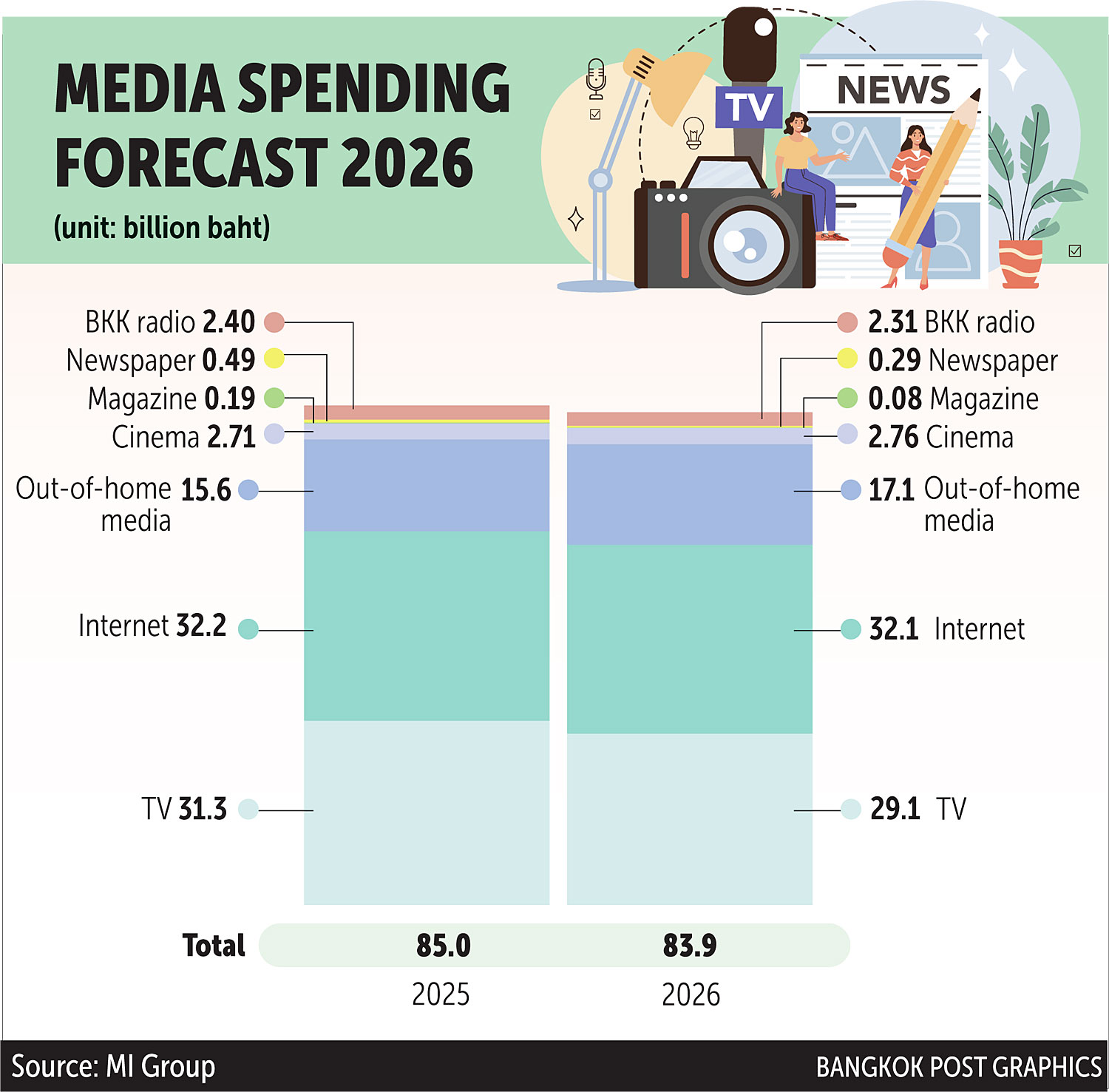
Thailand's mainstream media is weakening, as ad revenue shifts to foreign digital platforms, while information and Thai values are being shaped by factors outside Thailand, said the group.
Ad spending in Thailand during the first five months of 2026 contracted by 4.48% year-on-year to reach 32.8 billion baht, reflecting muted market conditions caused by a slow economic recovery and the war in the Middle East.
MI Group predicts full-year ad spending to decline by 1.3% to tally 83.9 billion baht, supported by government stimulus measures, a tourism recovery, and a possible rebound in consumer spending in the second half of the year.
DEEPER CONCERN
The main challenge for local broadcasters is the ability of global platforms to reach local consumers, said Pawat Ruangdejworachai, the group's president and chief executive.
TV advertising is expected to fall to 29.2 billion baht this year, while digital media advertising rises to 32.2 billion, up from 2.78 billion in 2012, according to the Digital Advertising Association of Thailand.
The shift shows ad money is moving to foreign platforms that increasingly control media consumption, commerce, data, payment systems, algorithms and consumer attention, said MI Group, adding that "value" is flowing out of the country.
Thais spend more time on global platforms, and part of the profit from these platforms' advertising revenue is sent back to their parent firms.
Thai behaviour, interests and online transactions are collected in systems Thailand does not own. That data can be used to develop artificial intelligence models and algorithms that further shape what Thais see and consume.
The real issue is not competition between TV and online platforms, but how Thailand maintains a media balance when media owned by Thais is shrinking, while the power to determine Thais' access to information and news is continuously shifting to foreign platforms, noted MI Group.
The company warned that if mainstream media becomes too weak to perform its public role, Thailand could lose part of its national information infrastructure.
This would affect citizens' access to credible news, public safety communication, cultural influence, data sovereignty and national resilience.
MI Group said this question should become a national policy priority, especially as Thailand approaches the expiry of digital TV broadcasting licences in 2029.
Today the digital TV broadcasting industry has become financially strained. Thailand expanded from six free TV channels to 24 digital TV channels, but over the past decade only 14 major players have remained in operation, with falling revenue and shrinking audiences.
MI Group said that if Thailand chooses to promote a forced shift of people to online platforms without a proper transition plan, it could create a new form of information inequality, as people do not have equal access to digital information, whether in terms of cost or digital literacy.
NATIONAL AGENDA
The company said Thailand must urgently establish a national media transition plan and elevate it to a national agenda. The plan should prepare the country for a new media and information environment over the next 10–15 years.
MI Group proposed a framework with four core priorities.
The first is a national media strategy, as Thailand should treat media and information as strategic national infrastructure, not merely a business sector. A long-term roadmap is needed to guide the development of Thai media in the digital era.
Second is an information sovereignty framework, as the country must preserve its ability to access, govern and protect information that affects the public interest, without becoming overly dependent on foreign platforms.
Third is creating a fair and competitive media structure, and fourth is promoting media security and universal access to trusted information.
"Without a national transition plan, Thailand risks losing not only mainstream media businesses, but also the power to protect and define its own information system," said MI Group.
In a related matter, the National Broadcasting and Telecommunications Commission is scheduled to meet on June 19 to consider finalising the long-delayed roadmap for digital TV broadcasting for the period 2026-2030.