
- EU data shows PHEVs emitted six times their official CO2 ratings on average, with the gap widening each year.
- On average, their tailpipe CO2 emissions were just 14% below those of conventional gas and diesel cars.
- Automakers want to scrap a 2027 rule change that would bring official PHEV emissions ratings closer to reality.
Plug-in hybrids look great on paper. If charged regularly, they will achieve and even exceed their manufacturer-claimed efficiency and emissions numbers. It’s all about keeping the combustion engine off and driving on electricity. The problem is that many people still treat them like regular hybrids, don’t charge them, and end up producing much higher emissions than advertised.
Their emissions problem is a familiar story. Last September, European data showed they produced roughly five times their official CO2 emissions. Now the gap is even bigger, just as manufacturers push back against efforts to make the numbers more honest.
According to a new Transport & Environment (T&E) analysis of newly released European Union data, PHEVs registered in 2024 averaged 145 grams of CO2 per kilometer, against an official 24 g/km. The findings come from onboard fuel monitors in 220,000 vehicles, reflecting how those cars were actually driven rather than how they performed in a standardized lab test.
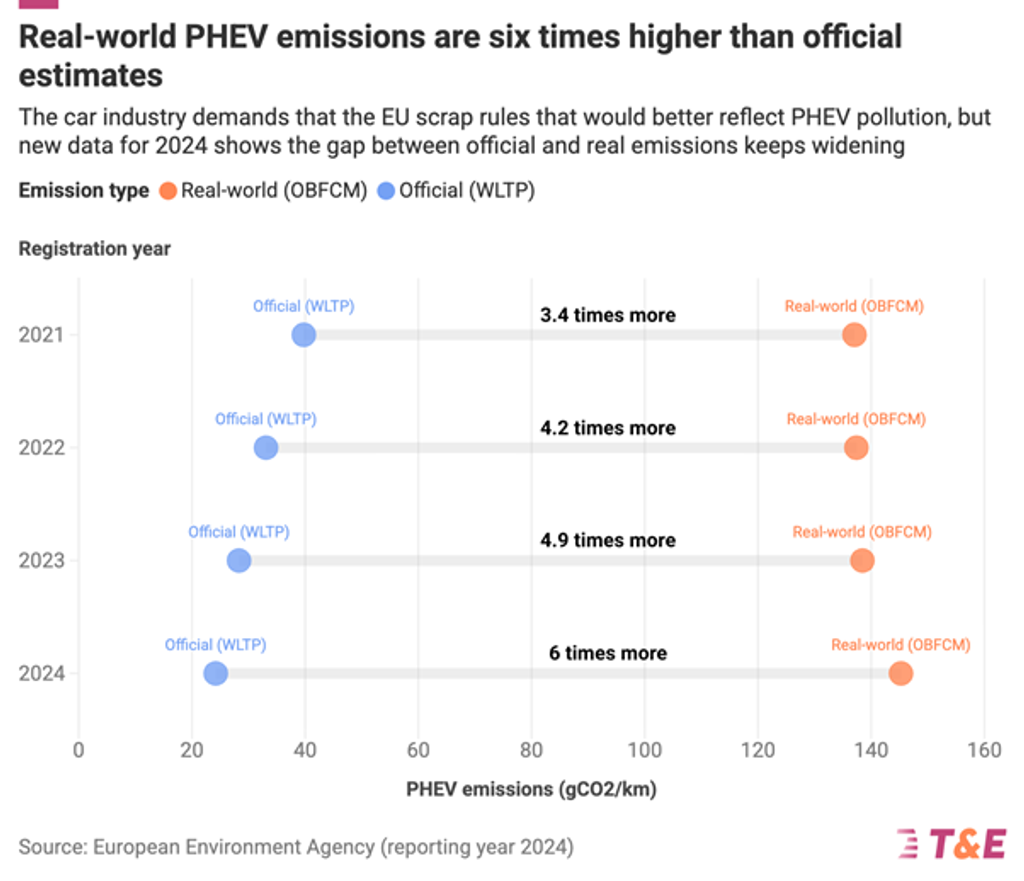
For 2023 registrations, those figures were 138 and 28 g/km. Actual emissions rose about 5% while official ratings fell roughly 15%. T&E says the discrepancy has widened annually since monitoring began in 2021.
The data also shows that PHEVs’ real-world emissions were only 14% below those of regular combustion cars’ 169 g/km, down from a 17% advantage the previous year. It’s important to note that these are average tailpipe figures, not lifecycle comparisons.
Official tests use an estimate called the “utility factor” to account for how much a PHEV spends running on electricity. The more electric driving they assume, the lower the car’s CO2 rating. But if owners rely on the combustion engine more than expected, actual emissions will be considerably higher.
The assumption is that if a car spends more time using its battery, it lowers its rated CO2 output. The EU began tightening that assumption starting in 2025, but it’s doing it in stages, with a new correction expected in 2027. Manufacturers know this change is coming and are pushing back because it would make their PHEVs look less green on paper and therefore less appealing to buyers.
It also helps determine if automakers meet their fleet CO2 targets. An earlier report estimated that passing off PHEVs as having lower emissions helped automakers avoid billions of euros in fines. It also highlighted the fact that drivers reported fuel efficiency numbers far higher than the advertised figures.
Powertrain supplier Horse, which opposes the change in how PHEV emissions are calculated, posted a paper in early March called “How tighter PHEV utility factor requirements will harm the auto industry.” Its concern is basically that more realistic CO2 ratings would make PHEVs a tougher sell.
T&E also analyzed a paper published by ACEA (the European Automobile Manufacturers' Association), in which the association wants the next utility factor correction canceled.
There’s a lot at stake here because PHEVs continue to grow in popularity across the EU. ACEA says they accounted for nearly 10% of all new passenger vehicle registrations across the bloc in the first half of 2026.
T&E argues that weakening the rules would delay EV investment and hurt Europe’s ability to compete with China. It wants lawmakers to reject the industry’s demands; a Council debate is expected October 12, followed by a parliamentary vote in November.
More accurate emissions estimates won’t make PHEVs burn less fuel. But they would make it harder for carmakers to take credit for cutting emissions that only disappear on paper and are far higher for most drivers. After years of warnings about PHEV emissions, that seems a bit overdue.