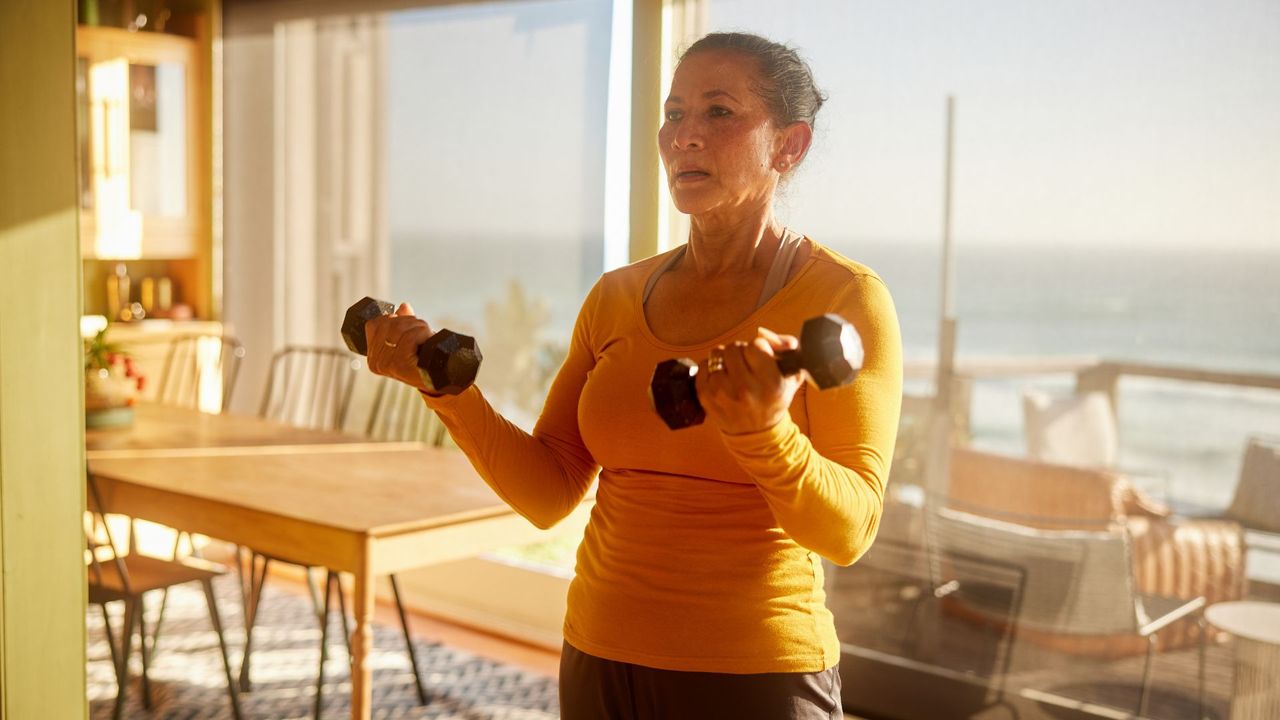
The solution to living healthier and for longer? Strength training. Lifting weights has been proven time and again to be the route to improved strength, mobility, and flexibility, all important to stay independent with age.
Few people know this more than Jo Whiley. She spoke to expert PT and strength coach Kate Oakley, who works exclusively with women in midlife and menopause, on a recent episode of Dig It, alongside fellow host Zoe Ball.
"I use strength training as an umbrella term. If your goal is to get stronger, strength training is it. All you're trying to do is give your bones work to do. Bone density is declining from our 30s. You don't need barbells, pull-up bars, and the stuff you see all over social media. You can honestly start with a couple of pairs of dumbbells at home and some resistance bands," says Kate.
It's "never too late" to start strength training, she says, and notes that she works with women in their 80s who are picking up weights for the first time. "It's never too late to start, but I would say to start safely and carefully. Don't go from zero to 45 minutes, three or four times a week. Start with 10 minutes, and feel that strength build."
Body weight exercises will be the right starting point, or, "if you feel ready", using a set of dumbbells.
A post shared by Dig It with Zoe Ball and Jo Whiley (@digitpod)
A photo posted by
Exercises to start strength training over 60
1. Squats
Kate says that squats are "absolutely top of the list" when starting strength training over 60. "It mimics the movement we need every day. When I start up and sit down from a chair, that's a squat. When we're thinking about older age, we want to be able to get out of bed, out of a car," she says.
There will be a squat variation that works for all women, she notes, even if you think you can't do the exercise.
How to do a squat:
- Stand shoulder-width apart, hands by your sides. If you feel confident, hold your weights.
- Bend your knees and come down as if you were sitting on a chair behind you, making sure to track your knees over your toes.
- Push through your feet to return to standing.
Expert tip: Raise your heels on a set of dumbbells or a few coffee table books, says Kate. "You'll actually be able to get into that squat position because sometimes it's about your ankle mobility or the length of your femur. It's not that you're doing anything wrong or that your body's weird. You just need to find the right squat for you.”
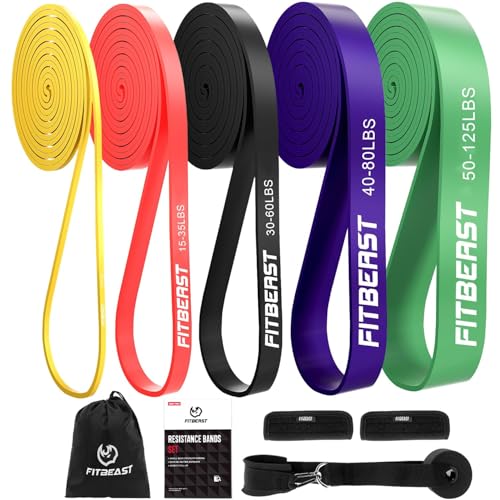
Resistance bands mirror dumbbells as you anchor and pull them. The tighter they are, the more resistance they give. They are easy to store and cheaper to buy than other weights.
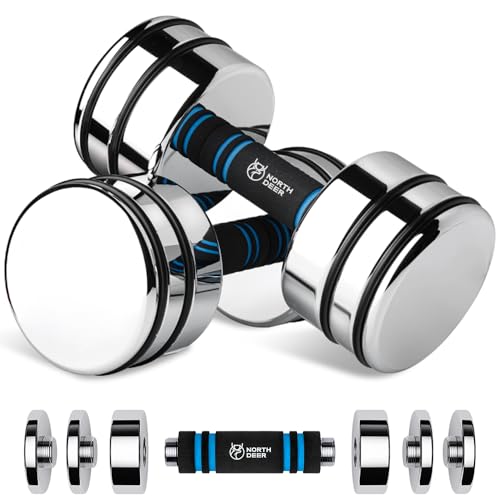
Adjustable dumbbells are a great way to invest once and use for numerous exercises. Slide the weights on and off to go up and down in resistance.
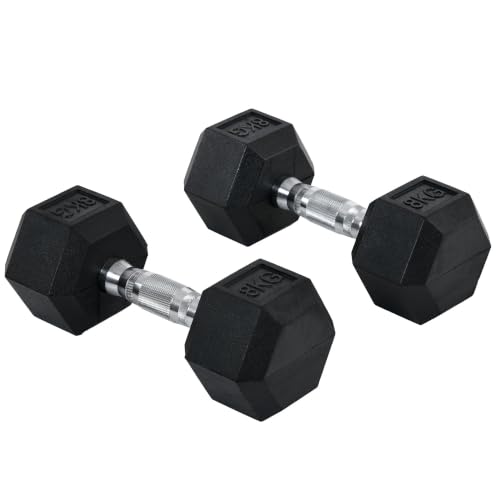
A hexagonal set of dumbbells is a reliable pair. They feel stable in hand and don't roll away when you put them down on the floor.
2. Chest press or press-up
You don't need to do a full upper-body dumbbell workout to build strength in your arms, back, chest, or shoulders. Kate recommends doing simple exercise snacks like a tricep or chest press against the kitchen counter while waiting for the kettle to boil. You could also do them against the wall.
"Just keep the elbows in close and push up from the counter. Say you can do 10 one week, maybe the next week you can do 12," says Kate.
How to do it:
- Place your hands against a wall or kitchen counter - any stable surface - and take a step backwards. Stand shoulder-width apart.
- Slowly and controlled, bend your elbows to bring your chest to the surface.
- Push through your hands to come back to standing.
- Repeat the movement.
Expert tip: The higher you take your hands, the easier a tricep press will become, says Kate. If you find you can press away from a kitchen counter, try the press movement against a wall.
Keeping your arms closer together will target more of the triceps (back of the arms). Widening the arms will target more of the muscles in the chest and shoulders.
3. Wall sits
You can even do strength training while brushing your teeth. A wall sit is one of the better quadriceps exercises and glute exercises. If you can do it even for half the time you spend brushing, you'll see serious progress in a few months.
Here's how to do it:
- Rest your back against a wall, drop into a seated position with your hands together in front of your body (or by your sides).
- Make your hips stay facing forward, and your knees stay in line with your toes.
- Try to keep the position for at least 30 seconds.
Benefits of strength training over 60
- Improves bone density and muscle mass: Bone density begins to decline in our 30s, and we start losing muscle mass during perimenopause. It's important to build these up to stay "living the life we want", says the PT.
- Avoids muscle wastage: Jo shares that she's noticed her body change a lot over the last six months, as she hasn't had much time to go to the gym. Kate says that strength training can help avoid this.
- Improves posture: Growing strength in your chest and shoulders will naturally improve your posture and prevent (or minimise) any "humps" or slouching. The best exercise to do is a chest press, shoulder press, or a push-up against the kitchen counter, says Kate.
- May help alleviate aches, pains, and joint issues: "It can feel counterintuitive to start strength training, but actually it can really help," she says. Jo also shared how she has continued exercising with arthritis . "If you've got issues with your knees, if you build strength in your quad muscles (thighs) and glutes (buttocks), then that can really support your knees."
If you are concerned about your ability to strength train safely, speak to a certified physiotherapist and/or qualified personal trainer, who will be able to create a routine that works for you.