
We've been promised a futuristic world for decades now, only to be given...whatever the hell we have now. Flying cars ain't a thing, transporters have terrifying theoretical physics, lightsabers aren't real (though that's technically an ancient technology), and the prospects of space travel are likely melting your face off thanks to cosmic radiation, and not the cool kind that turns you into a superhero.
The closest we've come to a future design is the Tesla Cybertruck, and that's giving more dystopian dumpster than bleeding-edge Tron lightcycle. Honestly, that tracks for what we're dealing with right now.
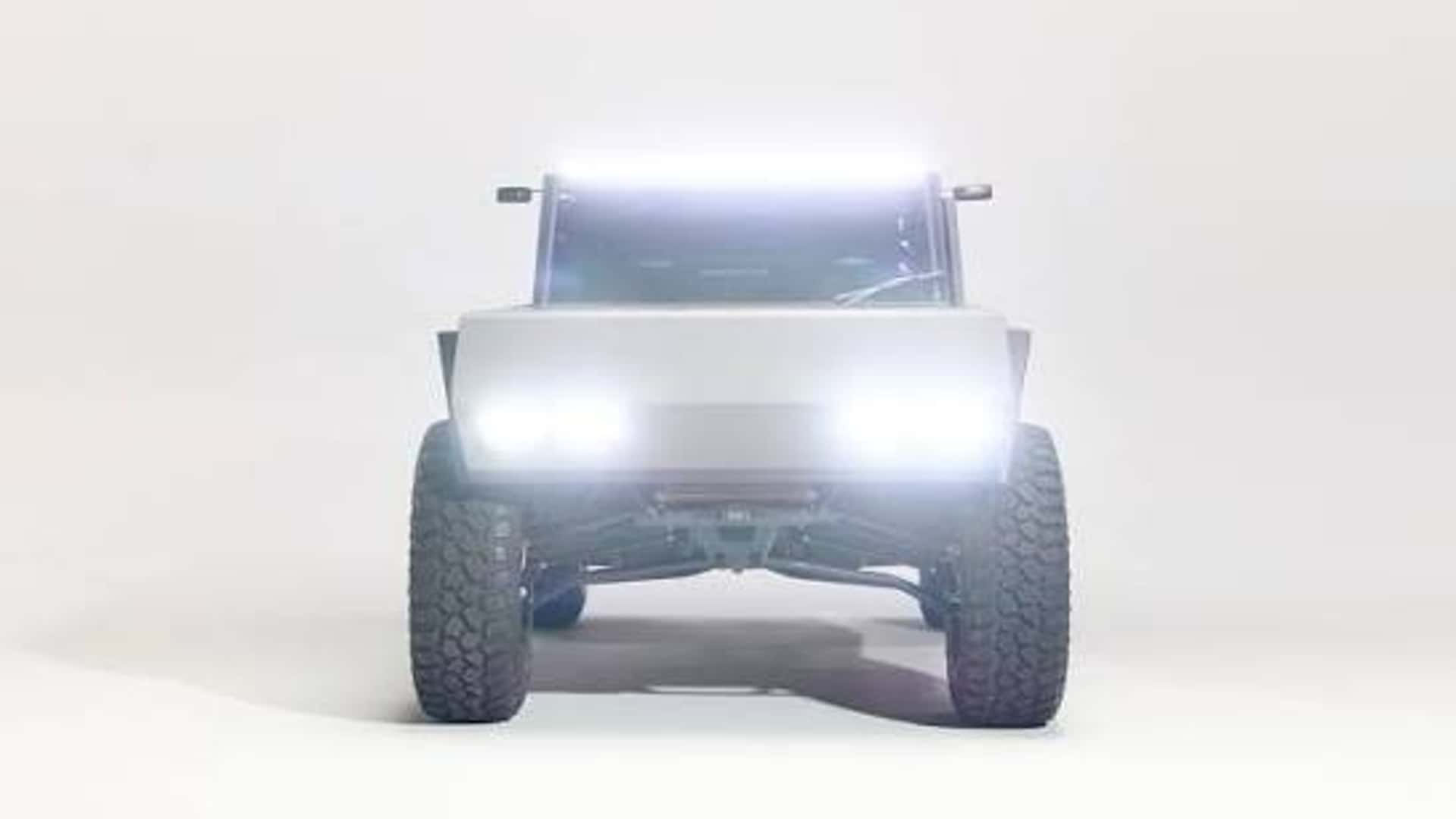
Joey Ruiter's latest industrial design is in that same vein as the Cybertruck, but doesn't include the dumpster in its dystopian conceit. And instead of some overly complicated 800W electrical architecture, the former furniture designer went with a turbocharged side-by-side platform, one plucked basically out of my backyard, in the form of a Can-Am Maverick X3.
Decker, is that your new ride?
View this post on Instagram
Called the RVR, but pronounced "rover," the machine uses a Can-Am Maverick X3 RS Turbo RR, which is the two-seat, higher-horsepower version of my Maverick X3 Turbo RR Max, and is the latest in a string of designs from Ruiter whose usually an industrial furniture designer, but whose machine designs have gone viral numerous times in the past, and who recently had his own Petersen Automotive Museum display.
The RVR, however, is one that looks not super out of place for the world we live in today, though still very much adhering to Ruiter's apparent love of brutalist designs. Speaking to Road & Track, Ruiter told the magazine, "Arguably, my bodywork is completely unnecessary, but it’s done in a way that’s slightly refined and more mechanical." What that seems to mean is that it's very straightforward, and few lines are curved or organic in design. So you end up with a machine that looks ready to conquer Mars' Olympus Mons.
Interestingly, Ruiter told Road & Track that he didn't have to drill or cut anything on the Can-Am, instead going for a drop-on body that lined up perfectly with the existing UTV structure. But that's because he used the bare chassis as his vision board, cutting out cardboard and steel and seeing what worked and what didn't. Obviously, gullwing half doors worked, as did angular sheet metal, bright LEDs, and different wheels and tires.
The end result, however, is probably my favorite from the designer, as, to me, it looks the most cohesive. Whether that's a compliment or not, I'm not sure, but I'm into it, and not just because the AI apocalypse is coming and I may need it to run over some proto T-800s.