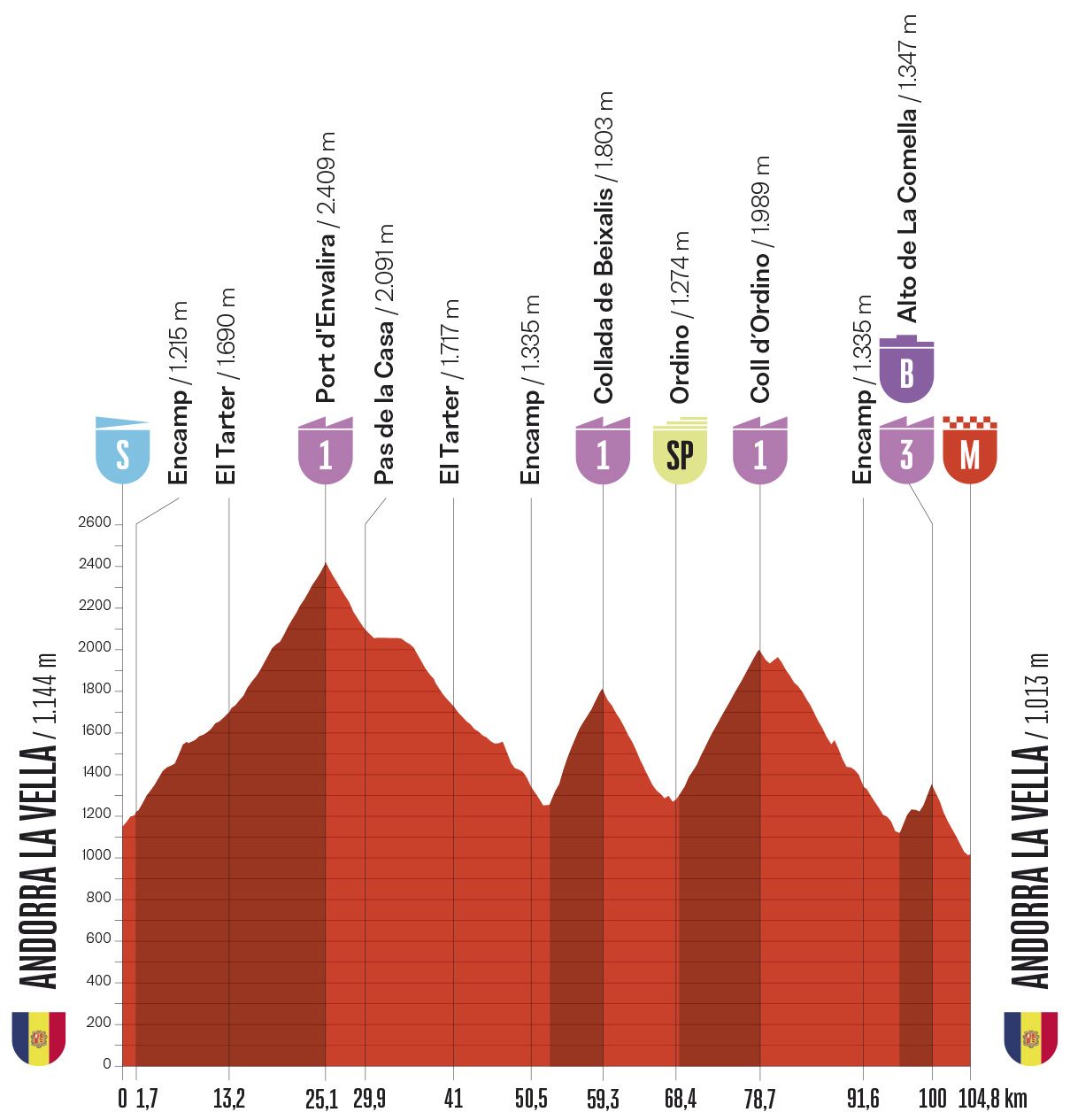
- Stage 4: Andorra la Vella - Andorra la Vella
- Date: August 25, 2026
- Distance: 104.8km
- Elevation gain: 3,024m
- Start time: 14:49 CEST
- Finish time: 17:22 CEST
Will history repeat itself in the first major high mountain stage of the Vuelta a España on Tuesday? Time and again in the Vuelta, as soon as the roads steepen in earnest in its usual first-week encounter with the big climbs, the major top GC favourite makes his move. And in this year's first showdown in Andorra, with Tadej Pogačar very much the standout contender, it is highly unlikely Tuesday's stage will be the exception to the rule.
It is impossible to know, given the cancellation of the first summit finish of the race on stage 3, how that might have played out. But there's no lack of riders and media pointing to stage 4 as the moment the Slovenian could launch one of his massive long-distance attacks, and take the Vuelta GC by the scruff of its neck for good.
The problem for any GC contender who is not in top form on stage 4 is that there is literally nowhere to hide. Just 104.8 kilometres long, from the moment the flag drops in Andorra La Vella on Tuesday afternoon to the point where the peloton returns to the capital of the mountainous mini-stage, the climbing and descending never lets up.
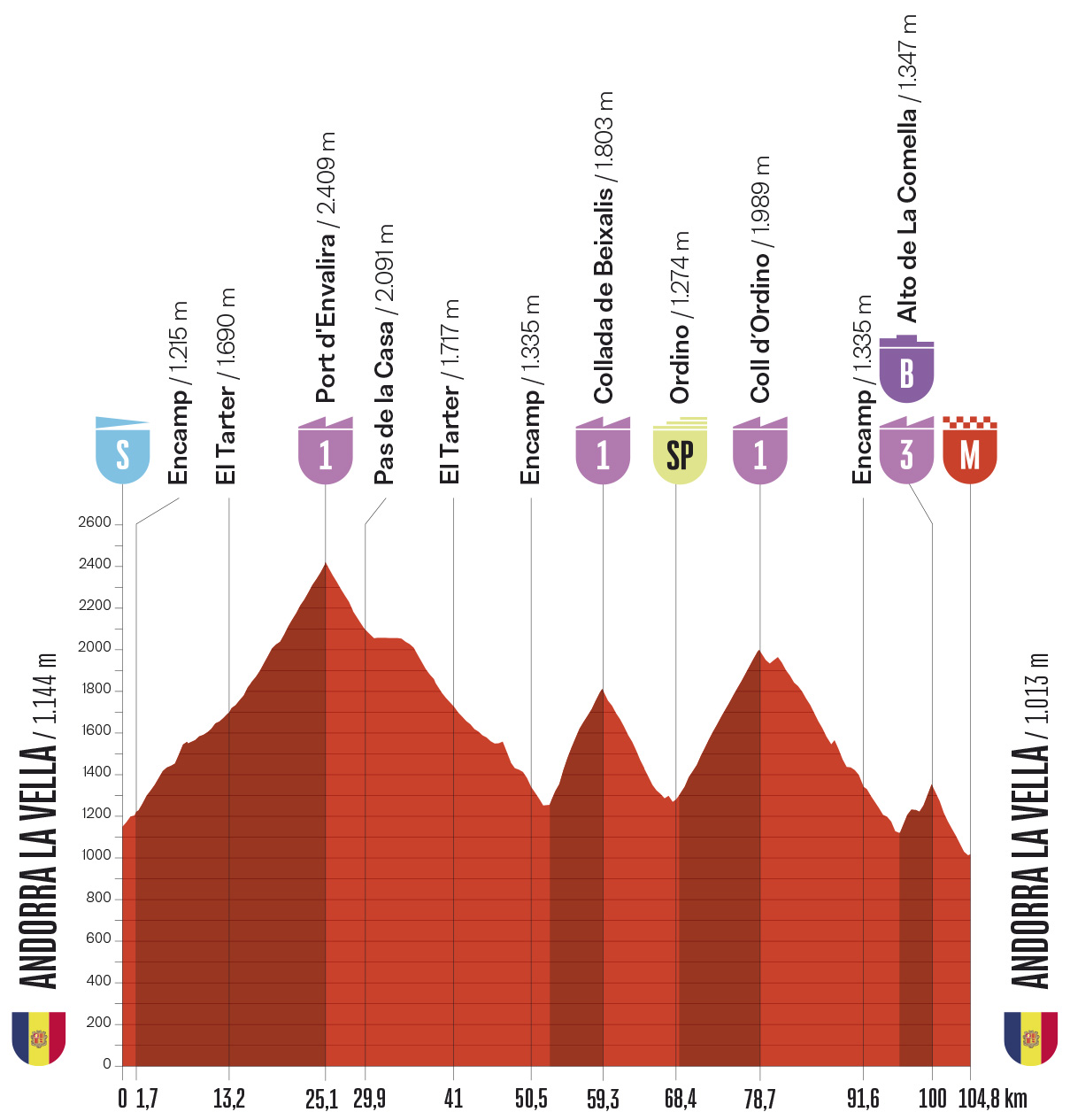
Starting from the gun with the Port d'Envalira, a mere 25.1 kilometres long, an equally drawn-out descent leads into the trio of final climbs of Collada de Beixalis (km 59.3), Coll d'Ordino (km 78.7) and Alto de La Comella (Km 100). After three Cat.1 ascents, this last, the Comella, is by far the easiest, a Cat.3 just five kilometres long and five kilometres before the finish. But given what has come before, that final upward pitch will likely only underline all the challenges the peloton has already faced.
"Envalira we all know, we've been over there in the Tour several times, and the speeds we go now, it'll most likely be a selection phase for the breakaway," New Zealand National Champion and Andorra resident George Bennett (NSN) tells Cyclingnews, "but from Beixalis onwards, it's a real mountain bike race.
"It's so steep up there on Beixalis," - 8.5% in total but with a full second kilometre of averaging 16% - "then there's a technical downhill, 500 metres flat and it's straight into Ordino. If Pog' wants to go early, he can do that without wasting too much energy."
"After that, on the downhill to Comella, he's not going to lose too much time there. So it's going to be an absolute knockout stage, an awesome stage."
The other reason why Pogačar could really open up the throttle isn't just because of the climbs in themselves, or because of the incredibly explosive nature of a stage which packs 2,953 metres of climbing into just over 100 kilometres. The road surfaces in Andorra, Bennett explains, favour major, all-out efforts.
"I love the roads in Andorra; I really trust them a lot more than other roads: well-maintained, clean. Just like stage 3 in fact, which wasn't your typical wild Pyrenean road; instead they're a lot more like the Alps."
The shortness of the stage will make for a lot of worried faces at the start line in Andorra-la-Vella, given there will be a risk of riders missing the time cut, and likely a lot of the peloton will be working on the rollers beforehand as well. But Bennett points to the way that on the Envalira "it's fairly easy on the wheels and it's not too bad. If you have ambitions of the breakaway, yes, it's tough,, but ultimately you approach it as best you can. There's not much you can do on a day like this, and in that way it's a very honest stage."
Stage 4 is also a microcosm, Bennett argues, of the whole structure of the Vuelta, with a lot of very difficult days early on. Andorra, in that sense, is just another big piece of the jigsaw.
"It's a very front-ended race, so many mountain stages early on. But the Vuelta's always an exciting race in that sense, with lots of chances for early breaks to stay away, " Bennett says.
However, as Bennett points out, this is a very typical format for the Vuelta, with the New Zealander recalling how tough 2020 was in particular. That year, very late in the season because of the pandemic, the race started with an ascent of the Arrate, the Basque Country's most emblematic climba nd continued with a lengthy incursion into the Pyrenees and Sierras of Soria. Then it was onto the Angliru and Galicia before "easing out a bit in the second week and some epic final stages."
Yet that Vuelta structure of a very tough start and an easier second week is also true of 2023 and 2025, which moved into the Pyrenees early on. Then in 2024, overall winner Primoz Roglič was already on the attack on stage 5 in the mountains of Extremadura.
Bennett himself got a late call-up for the Vuelta after some NSN teammates were injured, but describes himself as "super-happy to be here; it's a great opportunity for me. You certainly don't get stages like this in the Deutschland Tour and to race here at home is so special."
But rather than breaks which would favour Bennett's chances, stage 4 could well be a GC day. Fans with longer memories may recall how the last rider to capture the Tour-Vuelta double, Chris Froome, used a very similar stage 4 route through Andorra in the 2017 race to make a hefty downpayment on his final victory in the Spanish Grand Tour.
Vincenzo Nibali won the stage that day, but everything suggests right now that Pogacar could follow the Briton's wheeltracks once again on Tuesday. And given Andorra was where Pogačar won his first-ever Grand Tour stage in the Vuelta back in 2019, too, what better way does he have to commemorate it?
Stage details
For the fifth time in its history, the Vuelta a España will feature a stage held entirely in Andorra. The last time was in 2019 when Tadej Pogačar claimed his first stage win in his Grand Tour debut.
Stage 4 is a classic Andorran stage, immediately starting with a long climb up Port d’Envalira, the highest paved mountain pass in the Pyrenees. A 27-kilometre descent towards Encamp follows, including a stretch through the 2.87km-long Envalira Tunnel, before tackling three climbs, Collada de Beixalís, the Coll de Ordino and La Comella, with the latter cresting 4.8 kilometres from a fast descent to the finish line. The short, intense stage should start to shape the GC top 10.
Climbs
- Port d’Envalira (cat. 1, 23.3km at 5.1%), km. 25.1
- Collada de Beixalís (cat. 1, 6.5km at 8.5%), km. 59.3
- Coll d’Ordino (cat. 1, 9.9km at 7%), km 78.7
- La Comella (cat. 3, 3.9km at 5.9%), km. 100
Sprints
- Ordino, km. 68.4
For unbeatable coverage across road, gravel and tech, subscribe to Cyclingnews. You'll get comprehensive race coverage of La Vuelta a España, subscriber-exclusive analysis from our expert columnists, in-depth features and industry-leading tech insight. Plus, the Cyclingnews app lets you follow the action wherever you go! Join today.