
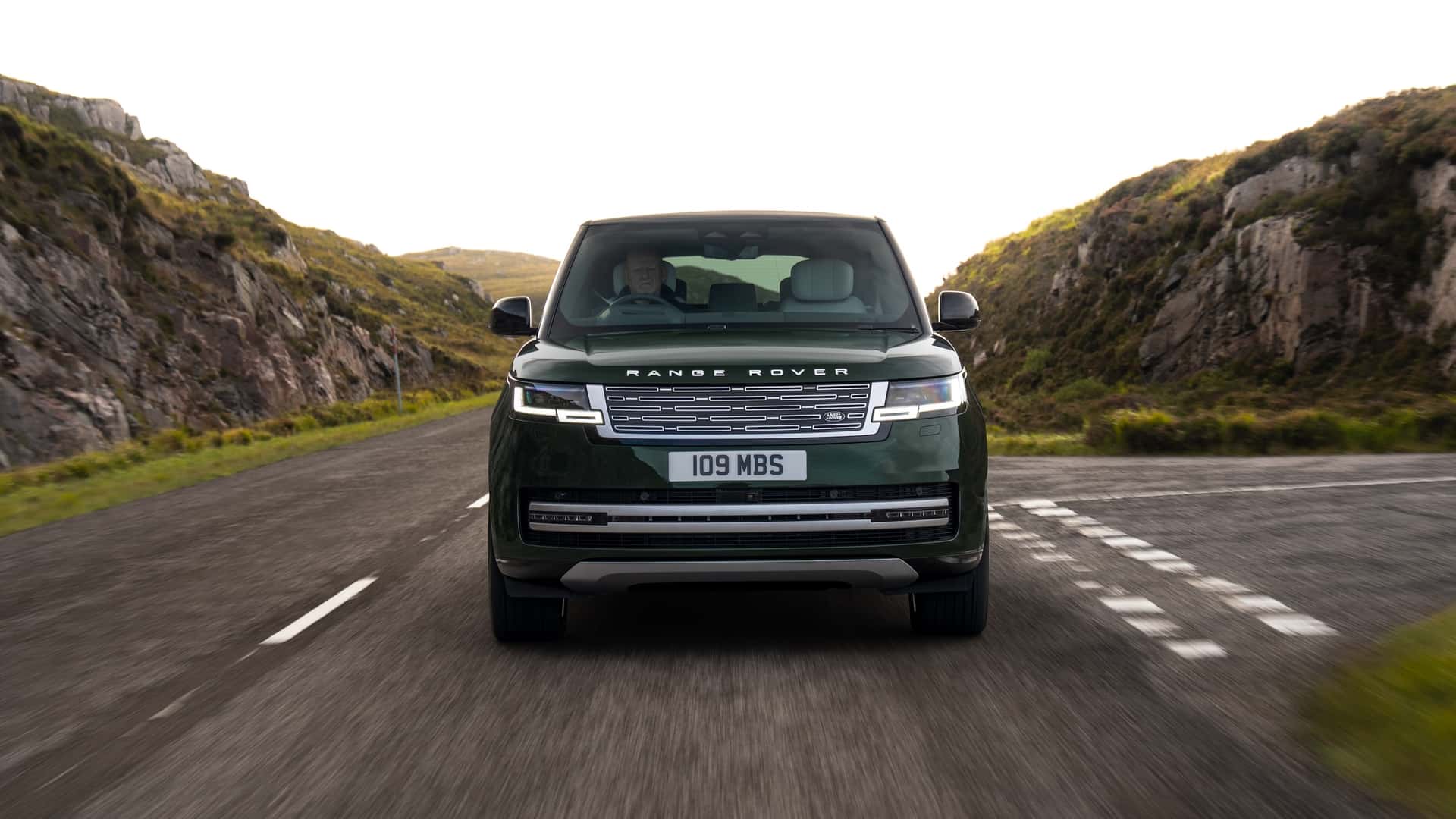
A fully battery-powered Range Rover was first promised to consumers at least five years ago, when Jaguar Land Rover (JLR) revealed its “Reimagined Strategy,” in which it vowed to electrify every product in its lineup. But while promises of an imminent release date for this electric vehicle have been frequent during the past half-decade, it only just made it into our hands. And while it’s a quality product, these delays have had me scratching my head. So, when I met up with the Land Rover development team in Scotland this week, I asked point blank what went wrong.
Turns out, plenty. The main issue, according to program chief Simon Fairbrother, derived from creating a propulsion system that would meet the desired attributes. “When we set out, we were going to have an induction motor at the front,” he says. The benefit of such a system is that the forward unit can be disconnected in ordinary on-road driving when all-wheel-drive capabilities are not needed, improving efficiency and range. It can then be re-coupled when additional traction is necessary.
But during testing, especially high-temperature testing, such a setup couldn’t deliver the desired, consistent Range Rover off-road capability. “It was getting too hot, and we were having to back off the power,” Fairbrother says. This was unacceptable to the development team, sending them back to the proverbial drawing board.
Fortunately, the brand had developed a more robust permanent magnet motor setup for the rear drive unit. So its solution was to simply replicate that system for the front axle. Of course this meant that the brand had to go back and strenuously model and test and validate this setup as well. “To make sure that we weren't exposing ourselves to another, I wouldn't say error state, but potential compromise,” Faribrother says.
Compromise is not exactly in the Range Rover vocabulary. The model is not just a flagship for Land Rover, but a venerable benchmark for the ultra-adept luxury SUV category, which it helped to invent back in 1970. This meant that, in addition to sporting supreme and reproducible off-road capabilities, the new electric version had to maintain a relaxing “magic carpet” driving style on-road, and a refined spacious cabin with a command driving position.