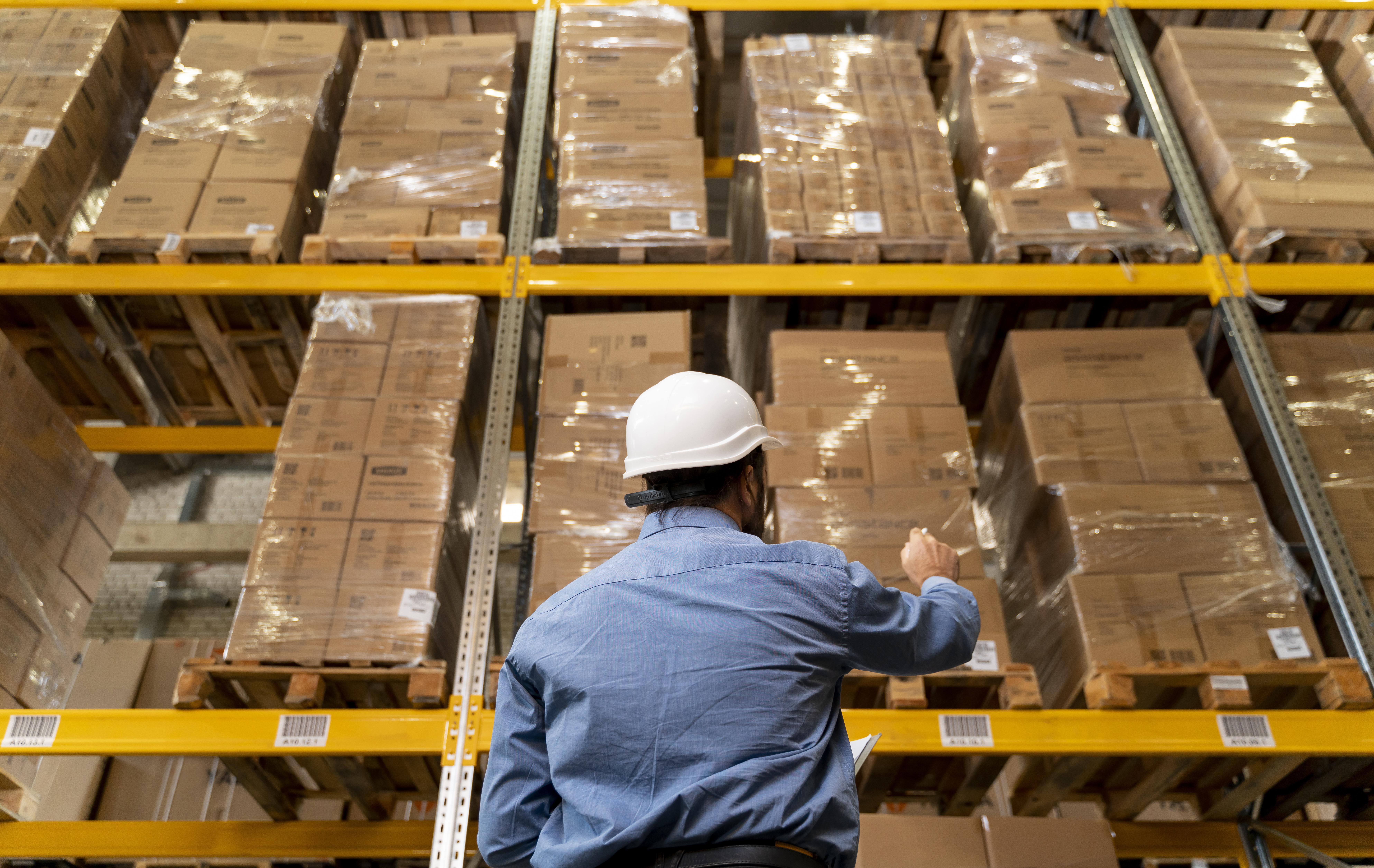
Photo by Magnific
For much of the last decade, one of the cheapest ways to get a small parcel to an American customer was to ship it directly from overseas under the $800 de minimis threshold. That route changed. Warehousing and fulfillment choices that used to sit mainly with an operations manager are now being made with customs and landed-cost considerations in the room.
Two things moved at roughly the same time. The channel producing all those parcels kept growing, and the regulatory shortcut that made them cheap to move disappeared.
The channel kept growing
The Census Bureau put US retail e-commerce sales at $1,233.7 billion for 2025, or 16.4% of all retail sales. Online grew 5.4% across the year while total retail grew 3.5%, and by the first quarter of 2026 the share had reached 16.9%.
Nobody in the industry finds that surprising. What matters for a warehouse is the shape of the demand rather than the size of it: many small orders, going to many addresses, each carrying a delivery promise the seller made at checkout.
That shape is expensive to serve from a long way away. It was tolerable while the border added almost nothing to the cost of a single parcel.
The route that closed
Executive Order 14324, signed on 30 July 2025, suspended duty-free de minimis treatment for shipments valued at $800 or less, effective 29 August 2025. According to US Customs and Border Protection, goods from all countries at or below that value are no longer eligible and are subject to all applicable duties, taxes and fees. Non-postal shipments have to be filed under an appropriate entry type in the Automated Commercial Environment by a party qualified to make entry. China and Hong Kong had already lost eligibility on 2 May 2025.
In June 2026 the suspension for non-postal modes was carried into rulemaking as an indefinite measure, aligning the regulations with what had until then been an executive action. Whatever view anyone takes of the policy, the operational consequence is plain enough. An entry requirement now attaches to parcels that previously carried almost none, and the administrative cost of that entry does not shrink in proportion to the value of what is inside the box.
Where the stock goes instead
If clearing a thousand small parcels costs more than clearing one container holding the same goods, the arithmetic can start pointing in a different direction. Bring the inventory in as a bulk shipment, clear it once, hold it inside the destination market, and ship domestically from there.
That is the argument for holding stock across several markets rather than running everything from a single origin, and it has changed how companies approach worldwide warehousing and fulfillment services. The main customs process happens upstream and at greater shipment volume, rather than being repeated at the individual consumer-parcel level. The final leg becomes a domestic delivery rather than an international one, which is faster and easier to price.
None of that is a discovery. Retailers have positioned inventory this way for decades. What changed is that the alternative got more expensive, so the comparison now goes the other way for a category of goods where it previously didn't.
What the spreadsheet tends to leave out
Holding inventory in-market solves a border problem by creating a working capital one. Stock in a warehouse is money that is not doing anything else, and it stays that way until somebody orders the thing.
The costs that get underestimated are fairly consistent:
- Forecasting error across markets. Stock in the wrong country is worse than stock you don't have, because you paid to move it and you will pay again.
- Returns. A domestic delivery promise usually comes with a domestic returns expectation, and the handling work on a returned item often exceeds the work of shipping it out.
- Compliance overhead. Food, organic and regulated categories carry certification, segregation and documentation requirements that follow the goods into storage.
- Slow-moving lines. Consolidation makes sense for products that turn over. For a long tail of SKUs that sell twice a year, it mostly buys expensive shelf space.
Which is why the decision is rarely all-or-nothing. Plenty of operations end up split, with fast lines held close to the customer and the rest shipped as and when.
The part worth watching
The interesting question is not whether inventory moves closer to buyers. Some of it clearly will, because the cost of the alternative went up and the delivery expectations did not go down.
The question is how much of the shift is durable. Customs policy can move again, and some of it is still working through litigation. Warehouse leases and network design cannot move nearly as fast, which means companies are making multi-year commitments against a rule that is younger than most of their contracts. That mismatch is the thing to keep an eye on.