Get Premium
Dark mode theme is available exclusively for premium users. Learn more about the benefits of subscribing.
No fees, cancel anytime.

 Dark Mode Ad-Free Browsing Unlimited Content
 Ad-Free Browsing Unlimited Content Dark Mode
Join 1.2 million Panda readers who get the best art, memes, and fun stories every week!

Innocence is one of the rare joys children get to enjoy. Ideally, they shouldn’t experience the harsher side of life until they are old enough to understand the world around them. But of course, things aren’t always that way.
This ninth-grade girl, for instance, got her first taste of sexism from the mother of a boy she went up against in a math competition at school. She was left so taken aback that it became a bitter memory she carried through the next few years.
However, it was her graceful response through a well-thought-out revenge plot that turned things around for her, albeit a year later.
Image credits: Green odette / Pexels (not the actual photo)
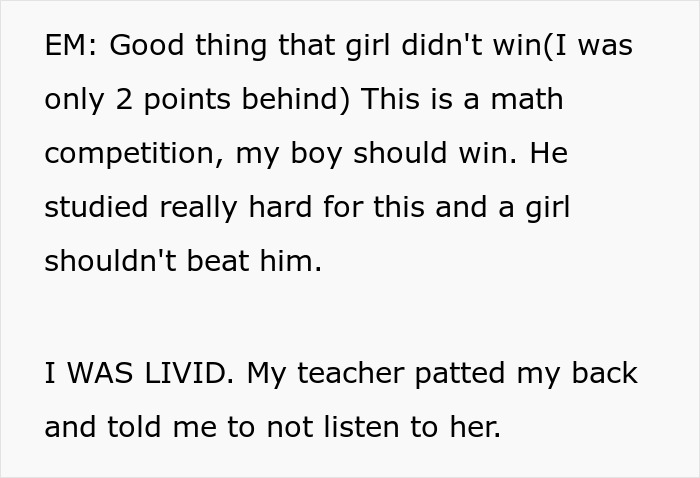

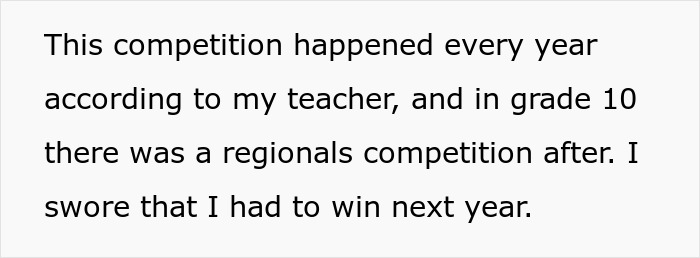
Image credits: Mikhail Nilov / Pexels (not the actual photo)



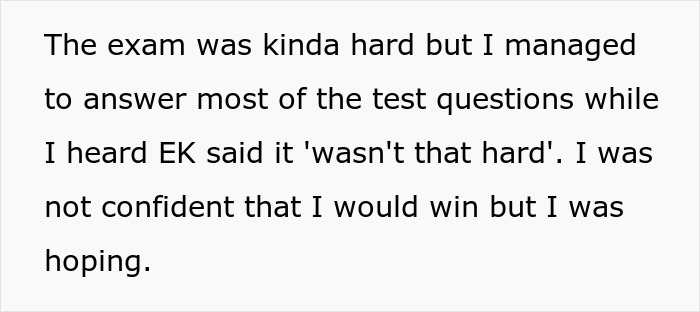
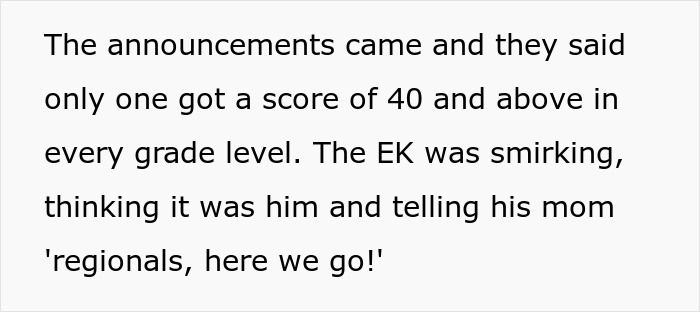

Image credits: AI25.Studio AI GENERATIVE / Pexels (not the actual photo)


Image credits: yumi1756
The mom’s comment carries more long-term repercussions than she probably thought. According to Dr. Sal Raichbach, the child may develop a more negative view of their confidence and perceived skill level.
“Even if the young child has the skills/ability to succeed, he/she now questions whether using those abilities will lead to negative reactions from others (e.g., dislike, judgment, etc.) or whether he/she would be ‘an outcast,’” Dr. Raichbach tells Bored Panda.
Even in these progressive times, such stereotypes persist. Dr. Raichbach says that comments from family members, classmates’ reactions, peers’ teasing, media coverage, and praise given to certain individuals perpetuate these biases.
“Research indicates that parents’ and teachers’ expectations regarding students’ mathematical abilities are often gender-based and influence how students perceive themselves in mathematics,” Dr. Raichbach explained, noting how it ultimately creates anxiety in students, which could alter their performance in school.
To do this, Dr. Raichbach urges teachers to compliment students on the strategies they use to solve problems, the effort they put into challenging tasks, and the curiosity they show while learning.
At home, Dr. Raichbach says parents should celebrate each child individually rather than compare them.
“Parents must understand that a child’s success is a reflection of the child’s individual strength(s) NOT a reflection of another child’s worth,” he said. “The child should never feel forced into becoming smaller so that the family does not feel uncomfortable.”
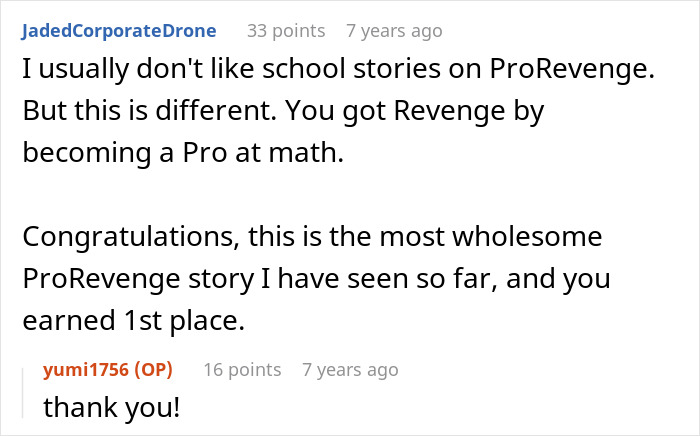
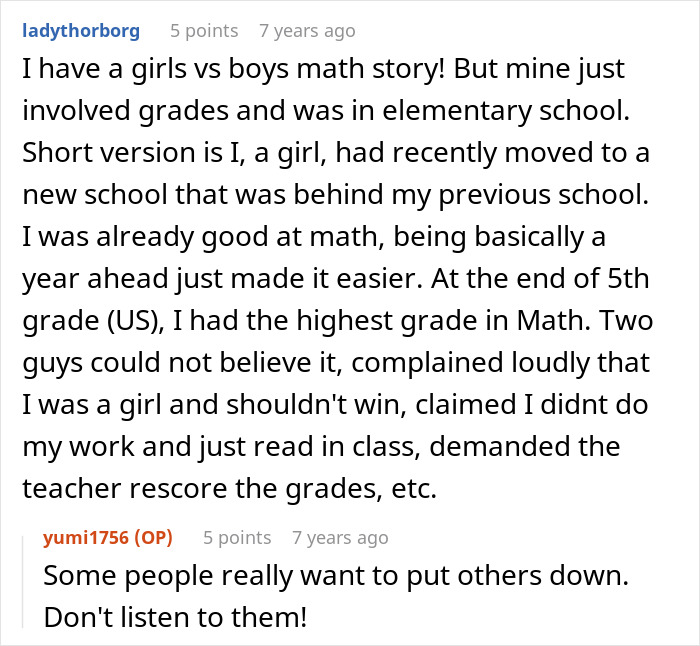
It’s an unfortunate situation for the author, who should have never experienced such prejudice at that age. Hopefully, it does not severely affect her as she grows older, and props to her for handling the situation and “getting revenge” by doing her best to achieve success.















By entering your email and clicking Subscribe, you're agreeing to let us send you customized marketing messages about us and our advertising partners. You are also agreeing to our Privacy Policy.
Thank you! You've successfully subscribed to newsletters!






































 No fees, cancel anytime










30
1