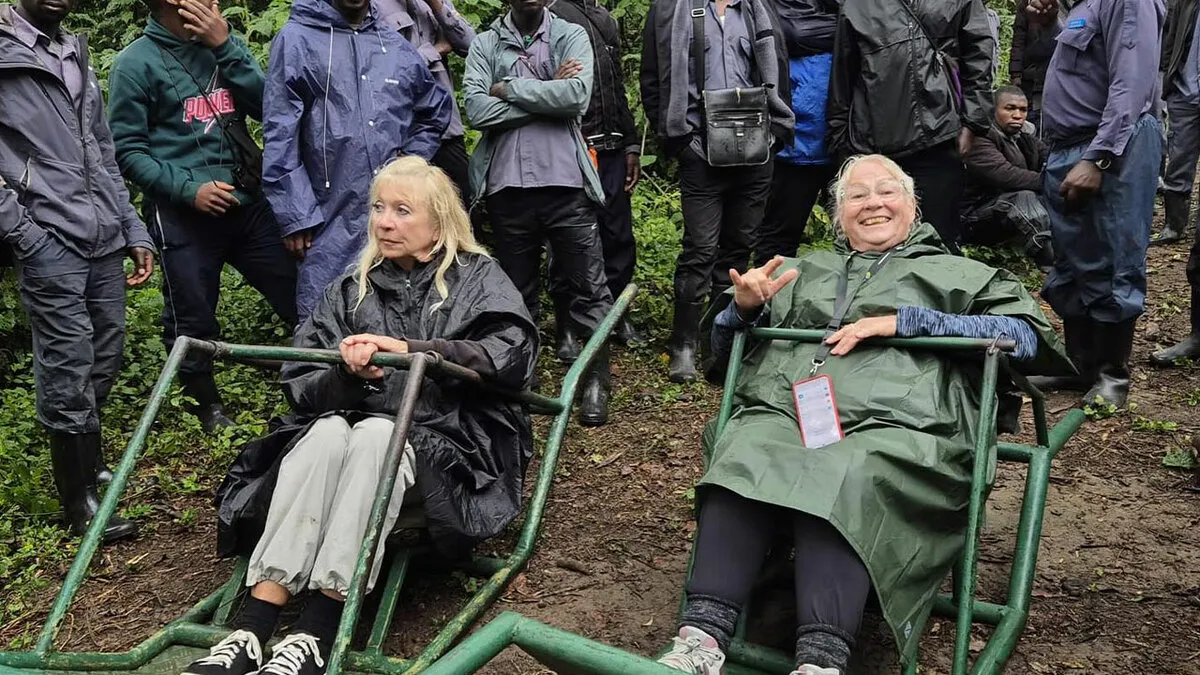
My lust for adventure is as fiery as the next person's, and the tattoo around my wrist confirms that "fear will not steal my energy." What will steal my energy, however, is the knowledge that I have some physical limitations I have chosen to make peace with. As much as I long to stare into the eyes of a mountain gorilla (and I have been told you should not make direct eye contact but I prefer to imagine I have Jane Goodall-level animal telepathy), I also know I will be the first person to start complaining after a kilometre of humid jungle trekking. Possibly before that. The peak of Everest piercing through clouds at basecamp sounds deeply transcendent. Weeks of altitude acclimatisation and squatting over a hole in the floor of a teahouse at 5,000 metres, less so. I subscribe to what might be called the adventure lite package. I stay within driving distance of an airport served by Ryanair, sleep on a friend's couch at worst, and learn enough of the local language to order coffee and apologise for my pronunciation. But some people look at their physical limitations and throw them out the window of their private charter, because they have money and they have ambition and they have found a local solution to both. They can be carried into the gorilla forest in a sedan chair by twelve rotating porters. They can be guided to the summit of the highest mountain on earth by a Sherpa who will carry their pack, fix their ropes, and in many documented cases physically drag them to the top. And the question of whether any of this is a dignified arrangement for anyone involved is one that the travel industry has been avoiding. Is it economic opportunity or colonial cosplay? Is it employment or exploitation dressed up as adventure tourism? And who exactly gets to decide, the person in the chair or the person carrying it? ai-generated image The sedan chair service operating in the gorilla trekking forests of Uganda and Rwanda has acquired a nickname that tells you everything about the optics and nothing about the ethics: the African Helicopter. For somewhere between $300 and $500, a tourist who finds the terrain too steep, too long, or too humid can be carried through the jungle on a chair by up to twelve rotating porters. The service operates roughly once or twice a week, according to Gerald Lad Nestori, a content creator who works on gorilla tours in both countries and spoke to Bored Panda exclusively about it. The videos, when they surface on social media, generate a predictable cycle of outrage. A visibly wealthy tourist, usually white, being carried through an African forest by local men. The image pulls on every uncomfortable nerve in the post-colonial imagination, and the comment sections do not disappoint. “Guys respect yourself,” one user from Uganda wrote. “History repeats itself,” said another. The problem with comment sections, as with most things, is that they are not interested in complexity. Jamie Jones, President of WhirlAway Travel, offers the context that tends to get lost in the thirty-second viral clip: "This practice has been around much longer than the recent press has made it seem. It began in the early 2000s truly as a way to assist those with limited mobility, age, injury, or chronic health conditions to participate in an activity that supports conservation on both a wildlife and community level." The economic argument is hard to ignore. Each sedan journey employs between four and twelve local porters. The tips alone represent significant income for families in communities where formal employment is scarce. Josh Bandura, founder of Frugal Flyer, makes the point about social media that applies to this conversation more than almost any other: "The main issue with social media is that it compresses full experiences into a few-second-long video, which can change the sense of it completely. A porter with a smile can be understood as an inspirational story, but the same frame with the porter serious can communicate the opposite." Teacher Mpamire The chair, filmed from one angle, looks like the British Raj. Filmed from another, it looks like twelve men earning their children's school fees. Both things can be true simultaneously, which is exactly what makes this conversation so resistant to the clean verdict the internet prefers. Nestori notes that the service does create some disruption to the gorilla families themselves, the commotion of twelve people carrying a chair through the forest being a different proposition to a small quiet trekking group. The gorillas did not consent to being a tourist attraction either, but the very expensive permits to see them are granting them a fighting chance in this heartless world. So is the sedan service just adding a few more drops into the conservation bucket? The Ugandan and Rwandan governments have not stepped in to regulate the sedan service, largely because the employment argument is too significant to dismiss. When the alternative is no income, the ethics of the chair become a lot harder to call from the comfort of a laptop. Bandura's advice for tourists navigating this is to ask whether the porters are receiving fair pay, whether tipping is possible and appropriate, and whether they have the ability to decline work they find too physically demanding. "This can be discussed previously with the tour operator to understand the real situation of workers," he says. The difference between exploitation and employment often comes down to whether the person doing the physical labour has any power in the arrangement, and that is a question worth asking before you book rather than after you have posted the video. Cordillera de los Andes If the African Helicopter makes you uncomfortable, the current state of Everest will make you question the entire premise of adventure tourism as a whole. Nepal issued a record number of climbing permits in 2026, breaking the previous record of 479 set in 2023. The mountain that Edmund Hillary and Tenzing Norgay reached in 1953 after months of gruelling preparation is now accessible, at sufficient financial investment, via helicopter to base camp, where a private tent with a queen-size bed, Persian rugs, electricity, and Wi-Fi will be waiting. Lukas Furtenbach, founder of Furtenbach Adventures, described his operation to the Times of London, saying that "every climber has a two-room stand-up tent with a bed, desk, electricity and Wi-Fi, and large lounge tents with a bar, movie screening, library, hot showers. Last year we even had a sauna and infrared cabin powered with a clean fuel cell." This is fine because the electricity is green, right? The cost of a personal Sherpa guide runs between $5,000 and $8,000 per season. An expedition sirdar, the lead guide and manager, costs between $10,000 and $12,000. High-altitude porters earn between $3,000 and $5,000 per season, with summit bonuses of $1,500 or more per climber who reaches the peak. ngatenjisherpa Nepal sets minimum daily base wages, which are low enough that the bonuses are what make the work financially meaningful. The Sherpa is not just a guide. He is, in many cases, the reason the climber reaches the summit at all, doing the technical work of fixing ropes, carrying equipment, and managing altitude sickness in someone who has been on the mountain for a fraction of the time the Sherpa has. And then there is the poo. The BBC reported that climbers will now be required to carry their own waste back down from Everest, following complaints that human excrement was visible on rocks and that climbers were falling ill. "Our mountains have begun to stink," said Mingma Sherpa, chairman of Pasang Lhamu rural municipality. At extreme altitude, excrement does not decompose; it accumulates. The mountain that people pay $50,000 or more to climb has been treated, by those same people, as an open toilet, and the community that lives in its shadow has been dealing with the consequences. The new regulation requiring climbers to bag and carry their own waste is so obviously reasonable that the fact it needed to be legislated says something about the entitlement that expensive adventure tourism tends to generate. Mick Truyts Kami Rita Sherpa, who holds the record for the most Everest summits of anyone alive, told Nepali Times that "the younger generation is aware of the dangers and some have given up working on the mountains. But if we Sherpas were not here, there would be no mountaineering." This is a fact. The infrastructure of Himalayan climbing, the fixed ropes, the established routes, the logistical management of expeditions, is built and maintained by Sherpas. The climber who reaches the summit and posts about it on Instagram has, in almost every case, been supported by people whose contribution to the achievement goes largely unacknowledged in the caption. Muhammad Hary Previous record holders like Apa Sherpa have migrated abroad. A new generation of Sherpas are scientists, climatologists, businessmen, and airline pilots, their opportunities built on the income their parents generated carrying wealthy foreigners up a dangerous mountain. The Sherpa community is not a monolith of victimhood, and treating it as such is its own form of condescension. The death rate among Sherpas on Everest is roughly ten times higher than among the climbers they guide. The 2014 ice avalanche in the Khumbu Icefall killed sixteen Sherpa guides in a single morning. The climbers they had been preparing to guide were at base camp, safe. These are not statistics that appear in the glossy brochures of expedition companies offering sauna-equipped base camp experiences, but they are the statistics that define what the job actually involves. ecoadventuresafaris The honest position on all of this is uncomfortable, and it should be. The sedan chair in Uganda employs people who need the work. It also looks from the outside like something that should not exist in 2026. The Sherpa on Everest is doing skilled, dangerous, essential work. They get paid, but is there ever really a price for putting your life on the line for a stranger looking for a thrill? The tourist at base camp ordering an espresso in their geodesic dome has paid for an experience that would not exist without the labour of people whose relationship to risk is not a lifestyle choice but a professional reality. None of this means adventure tourism should not exist. It means it should exist with clearer eyes about what it actually is. The money flowing into Sherpa communities and porter communities is real and can make a difference. The power differential between the person paying and the person carrying is also massive. Both of those things deserve to be held at the same time, which is harder than picking a side but considerably more honest. Didier Descouens The next time a sedan chair video goes viral and the comment section erupts, the useful question is not whether the image is offensive. It is whether the porter was paid fairly, whether he had a choice in taking the work, and whether the tourist who hired him knows the answer to either of those questions. If they do not, the problem is not the chair. It is the incuriosity of the person sitting in it. I will be staying within driving distance of a Ryanair airport. But if I ever do make it to Uganda, I will be tipping extremely well and asking every question before I book anything. My white guilt and I have reached an arrangement. earthpulse111