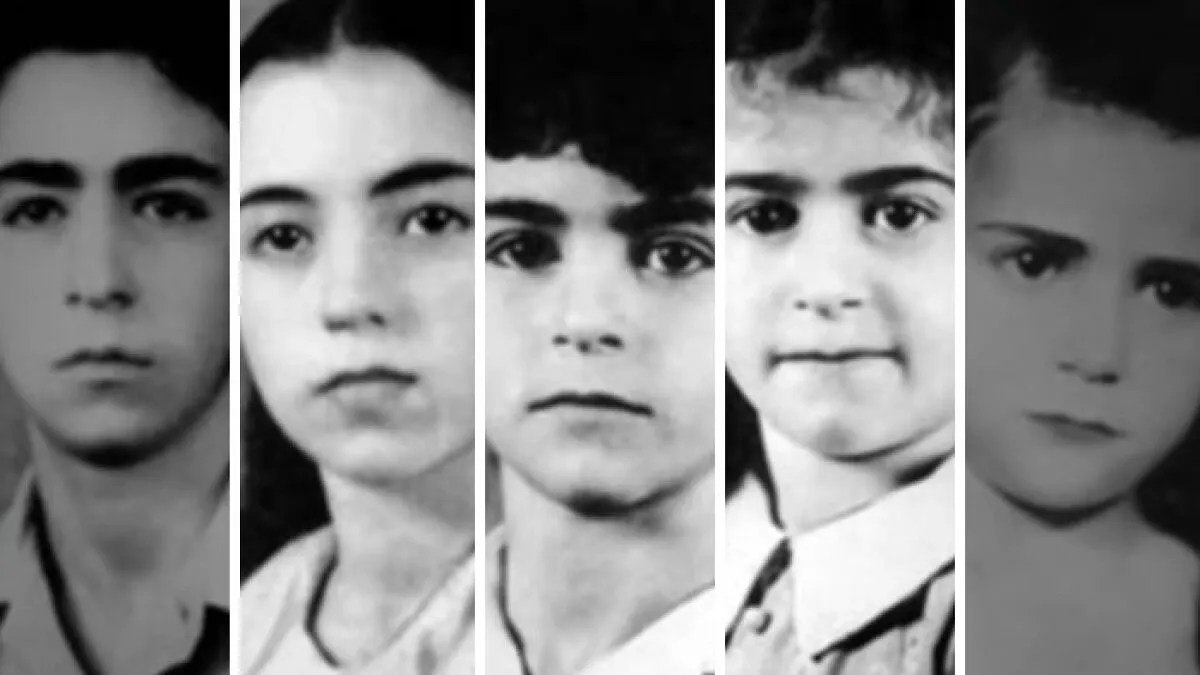
On Christmas Eve 1945, George and Jennie Sodder went to sleep inside their family home outside Fayetteville, West Virginia, with nine of their ten children under the same roof. By sunrise, the house was gone. A fire had torn through the two-story timber home shortly after 1:30 am, forcing George, Jennie and four of their children outside while flames consumed the staircase leading to the bedrooms above. Five siblings, Maurice, 14, Martha, 12, Louis, 10, Jennie, 8, and Betty, 5, were presumed trapped inside. Officials quickly concluded that all five had passed away. George Sodder never believed them. Then, more than two decades later, the family received a photograph of a young man who bore a striking resemblance to Louis. casefilepodcast/Instagram The man at the center of that search had begun his own life thousands of miles away. George was born Giorgio Soddu on November 23, 1895, in Tula, Sardinia, Italy. In 1908, at only 13, he crossed the Atlantic with an older brother and entered the United States through Ellis Island. His brother eventually returned to Italy. Giorgio stayed. He adopted the name George Sodder and began building the kind of life that had drawn generations of immigrants to America. During his early years, he worked on Pennsylvania railroads before moving south to West Virginia, where he found employment as a driver in Smithers. Eventually, George established his own trucking company. He began hauling fill dirt and later moved into coal transport, an increasingly profitable business in the region. Smithsonian Mag It was in Smithers that he met Jennie Cipriani, another Italian immigrant whose family had settled in West Virginia. Jennie had been born in Troia, Puglia, Italy, on March 2, 1903, and immigrated as a child. Her father operated a store in Smithers. George and Jennie married in 1922. A year later, they settled roughly two miles north of Fayetteville in a two-story wooden house surrounded by an Italian-American community. Their first child, John, was born in 1923. Over the next two decades, their family grew to ten children: John, Marion, Joe, George Jr., Maurice, Martha, Louis, Jennie Irene, Betty Dolly and finally Sylvia, born in 1942. By the early 1940s, the Sodders were prosperous by local standards. George's trucking business had done well enough to give the family a comfortable middle-class life. But George was also outspoken. Mondadori via Getty Images George openly criticized Benito Mussolini and the authoritarian government he had left behind in Italy. Those views reportedly created tension with some members of West Virginia's Italian immigrant community, where Mussolini still had sympathizers. Months before the fire, several incidents began to disturb the family. In October 1945, a life-insurance salesman visited George and attempted to sell him a policy. When George refused, the salesman allegedly became angry. “Your god**mn house is going up in smoke,” he reportedly told George, adding that his children were “going to be destroyed.” History Channel Brazil The threat allegedly came with an explanation: George's “dirty remarks” about Mussolini. Another visitor later came to the property while supposedly looking for work. While inspecting the house, he pointed toward a pair of fuse boxes and warned that they would “cause a fire someday.” George found the observation strange. The house had recently been rewired, and an inspection had reportedly determined that the electrical system was safe. Then, in the weeks before Christmas, George's older sons noticed a strange car parked along the highway. Its occupants appeared to be watching the younger Sodder children as they returned from school. Nothing connected those incidents conclusively. Then came Christmas Eve. Smithsonian Mag On December 24, 1945, the Sodders gathered at home for Christmas. Nineteen-year-old Marion had bought toys for three of her younger sisters, Martha, Jennie and Betty, who excitedly asked their mother if they could remain awake beyond their usual bedtime. Jennie agreed. At around 10 pm, she went upstairs with three-year-old Sylvia while George and the older boys who were home, John and George Jr., were already asleep. Joe was away serving in the Army. Before retiring, Jennie told Maurice and Louis to complete their evening chores and make sure the younger children went to bed. Around 12:30 am on Christmas morning, the telephone rang. George Marks/Retrofile/Getty Images (not the actual photo) A woman Jennie did not recognize asked for someone whose name meant nothing to her. Behind the caller, Jennie could hear laughter and the clinking of glasses. She told the woman she had the wrong number and hung up. When Jennie looked around the house, however, she noticed something odd. Lights remained on downstairs and the curtains were still open, suggesting the children had gone to bed without completing the chores she had assigned them. She turned everything off, closed the curtains and returned upstairs. Roughly half an hour later, another sound woke her. Jennie heard what she later described as a loud bang or thump on the roof, followed by something apparently rolling across it. The house became quiet again. Around 1:30 am, she woke for the third time. This time, the house was filling with smoke. Glenn Turner/Unsplash (not the actual photo) The fire appeared to have begun around George's ground-floor office, near the telephone line and fuse box. George and Jennie escaped with Marion, John, George Jr. and Sylvia. Five children remained upstairs. George tried to get back inside, but the staircase leading toward them was already engulfed. He ran outside for the ladder that normally rested against the house. It was gone. Crime Junkie The family tried to telephone the fire department, only to discover that the phone no longer worked. A barrel of water outside had frozen solid. Desperate, George turned to his trucks. He planned to position one beside the house and climb from its roof into an upstairs window. Neither truck would start. The house burned to the ground in roughly 45 minutes. Fayetteville's volunteer fire department did not arrive until later that morning amid reports of manpower problems and difficulty finding a driver. Fire Chief F.J. Morris inspected the ruins and concluded that the five children had lost their lives inside. Yet according to the account that haunted George, no recognizable human bones were recovered. History Channel Brazil A coroner's inquest quickly followed. Investigators blamed faulty wiring, even though the Sodders remembered electrical lights remaining illuminated during the early stages of the fire. More troubling to George, the jury reportedly included the insurance salesman who had allegedly warned months earlier that the house would burn because of George's anti-Mussolini views. Certificates were issued on December 30 for the passing of Maurice, Martha, Louis, Jennie and Betty. Kateryna Hliznitsova/Unsplash (not the actual photo) A funeral followed on January 2, 1946. George and Jennie were so overwhelmed that they could not attend. But the official explanation was already beginning to unravel in their minds. The missing ladder was eventually discovered roughly 75 feet from the house, down an embankment. A telephone repairman reportedly examined the family's line and said it had not burned through. Someone had cut it. Kindel Media/Pexels (not the actual photo) Police eventually arrested a man seen stealing a block and tackle from the Sodder property around the time of the fire. The man reportedly admitted cutting a line because he thought it was electrical, but denied any connection to the blaze. George and Jennie remained unconvinced that five children could have disappeared so completely inside a short-lived house fire. Jennie began conducting grim experiments of her own. She burned animal bones to see whether fire could reduce them completely to ash and consulted a crematorium employee. Both strengthened her conviction that recognizable remains should have survived a wood-frame house fire lasting less than an hour. Witness accounts made the mystery worse. History Channel Brazil A bus driver claimed to have seen people throwing what looked like “balls of fire” toward the house. Sylvia later discovered a small green rubber-like object nearby that George came to believe could have been part of an incendiary device. Other witnesses said they saw the missing children inside a passing vehicle while the house burned. One woman claimed that the following morning she saw children resembling the Sodder siblings at a roadside stop accompanied by several adults and a vehicle bearing Florida plates. George then hired private investigator C.C. Tinsley. Tinsley discovered that the insurance salesman who allegedly threatened George had indeed served on the coroner's jury. He also encountered rumors that Fire Chief Morris had recovered a human heart from the ruins and quietly buried it in a metal box. When confronted, Morris produced the box. A funeral director examined what was inside and identified it as fresh beef liver. Rumors later circulated that Morris had planted it in an attempt to convince the Sodders that their children had passed away. Crime Junkie George refused to abandon the property. Four days after the fire, despite instructions to preserve the scene for further examination, he covered the ruins with several feet of soil and turned the area into a memorial garden. In August 1949, he persuaded Washington pathologist Oscar Hunter to oversee a new excavation. Searchers recovered several objects, including coins, part of a dictionary and small pieces of human bone. For a moment, it appeared that George might finally have an answer. Crime Junkie The fragments were sent to Marshall T. Newman at the Smithsonian Institution. Newman identified them as lumbar vertebrae belonging to one person approximately 16 to 22 years old, already older than most of the missing children. More importantly, the bones showed no evidence of exposure to fire. He considered it “very strange” that those were the only human fragments discovered. The most likely explanation, Newman concluded, was that the bones had arrived with the soil George used to cover the property, possibly because the fill came from ground near a cemetery. The Smithsonian returned them to George in September 1949. Their whereabouts later became unknown. Josué Sánchez/Unsplash (not the actual photo) West Virginia lawmakers held two hearings on the disappearance in 1950. Afterward, Governor Okey L. Patteson and state police superintendent W.E. Burchett informed the family that the investigation had reached a roadblock. The case was “hopeless,” they said. The FBI also considered whether an interstate kidnapping could give federal authorities jurisdiction. After roughly two years of leads producing no breakthrough, that investigation ended as well. George refused to accept the verdict. Smithsonian Mag In 1952, the family erected a large billboard displaying photographs of Maurice, Martha, Louis, Jennie and Betty. A reward initially set at $5,000 was eventually doubled. The sign became a familiar landmark outside Fayetteville. Tips poured in. One woman, Ida Crutchfield, claimed she had seen the children at a Charleston hotel about a week after the fire with several Italian-looking adults. Investigators doubted her story, partly because she came forward only after seeing photographs years later. There were reports involving a convent in St. Louis, suspicious conversations in Texas and possible relatives in Florida. None could be confirmed. Smithsonian Mag In 1967, a tip suggested that Louis and Maurice might be living in Texas, prompting George to travel there with his son-in-law, Grover Paxton, but the lead went nowhere. Then, around 1967 or 1968, the Sodders received what would become one of the most haunting clues in the entire case: an envelope postmarked Central City, Kentucky, containing a photograph of a man in his 30s who, to the family, looked remarkably like what Louis might have become. Written on the back was the cryptic message: “Louis Sodder / I love brother Frankie / Ilil boys / A90132 or 35.” Cottonbro Studio/Pexels (not the actual photo) George immediately hired another private detective and sent him to Kentucky to investigate the photograph, but the man never reported back and the family was unable to locate him afterward. Convinced the image might be genuine, George added it to the family’s roadside billboard while deliberately omitting the Central City postmark, fearing that revealing the location could put Louis in danger if he was still alive. By the late 1960s, George admitted the family had hit a “rock wall.” Still, he kept searching. History Channel Brazil George Sodder passed away in 1969. For nearly a quarter-century, he had challenged officials, hired investigators, traveled after leads, excavated his own property, questioned witnesses and displayed his children's faces beside the highway. He never received the answer he wanted. Jennie continued the vigil after he was gone. She expanded the family home, fenced the property and cared for the memorial garden while wearing black in mourning. She passed on February 15, 1989. Crime Junkie Only then did the family finally remove the weathered billboard. The search nevertheless passed to another generation. Some relatives came to believe that organized crime figures may have targeted George because of his politics or attempted to extort him, with one theory suggesting the children were taken by people who knew the house would be burned and convinced them that leaving would save their lives. No evidence ever established that scenario. casefilepodcast/Instagram Sylvia Sodder Paxton, only three years old when she escaped the fire, became one of the family's most persistent voices. She said she had promised her parents that she would never allow her siblings' story to disappear. Sylvia passed away in 2021 without learning what happened to them. By then, the case had repeatedly resurfaced through books, radio programs and true-crime investigations. NPR revisited it for the fire's 60th anniversary in 2005. Journalist Stacy Horn said she leaned toward the children having died in the blaze while acknowledging the “genuine weirdness” surrounding the case. Find a Grave Local author George Bragg reached a similar conclusion in his 2012 book West Virginia's Unsolved Murders, arguing that logic favored the idea that they had lost their lives in the fire while admitting certainty remained impossible. Later reporting also offered mundane explanations for some clues. One relative suggested George's trucks might have become flooded because the family repeatedly tried starting them in panic rather than because someone had sabotaged them. The History Channel brought the case to another national audience in 2022 through History's Greatest Mysteries, while podcasts, online forums and amateur investigators have continued examining the evidence. As of September 2026, there is still no definitive answer.