
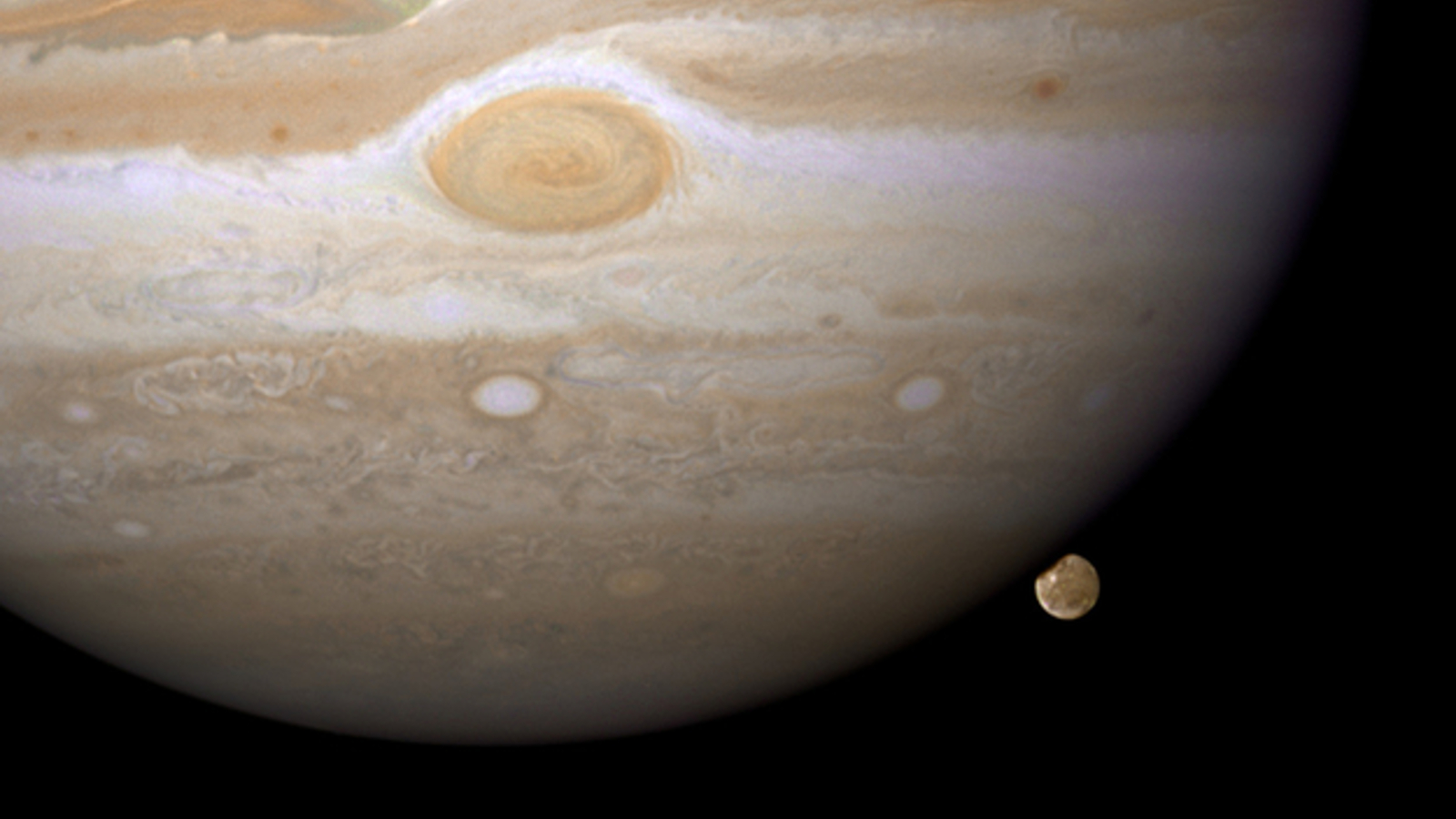
Around 4 billion years ago, an enormous asteroid that was at least 10 times larger than the space rock that wiped out the dinosaurs smashed into Jupiter's massive icy moon, Ganymede. The cataclysmic collision was so devastating it created the largest impact crater in the solar system and knocked the supersized satellite off its axis, new simulations show.
Ganymede is Jupiter's third-closest major moon, orbiting the gas giant roughly once every seven days. It has a diameter of 3,270 miles (5,260 kilometers), according to NASA, making it the most massive of the solar system's many moons and larger than the planet Mercury. Just like Earth's moon, Ganymede is tidally locked, meaning the same side constantly faces Jupiter's swirling, storm-covered surface. Researchers believe the moon has a roughly 60-mile-deep (100 km) ocean hidden far below its icy surface.