
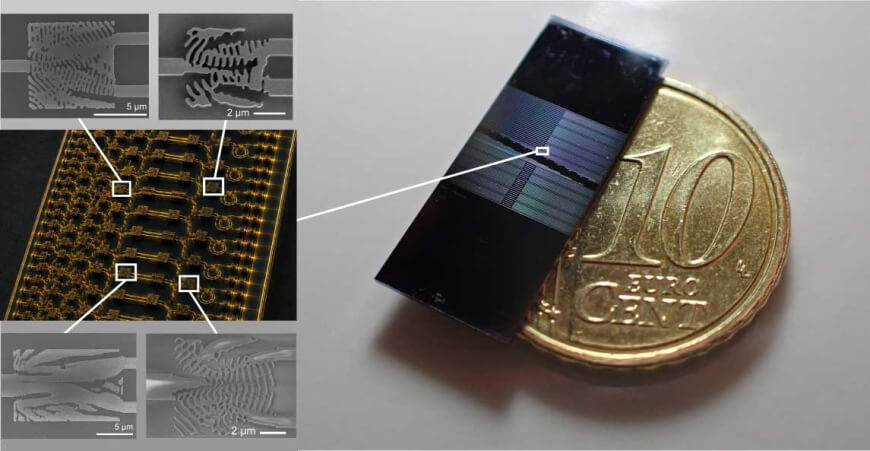
Scientists have successfully shrunk three components used in photonic microchips by up to 500 times, leaving considerably more space for other on-chip functionality. The achievement was made possible with an artificial intelligence (AI) algorithm that generated these tiny designs, which the researchers described as "beyond human intuition."
Whereas conventional microchips use electrons to transmit and process information, photonic microchips utilize particles of light (photons). They can therefore process and transmit data much faster than electronic chips can, because photons can carry information at the speed of light. They also offer higher bandwidth, as different wavelengths can carry distinct data streams, and they lose less energy as heat.