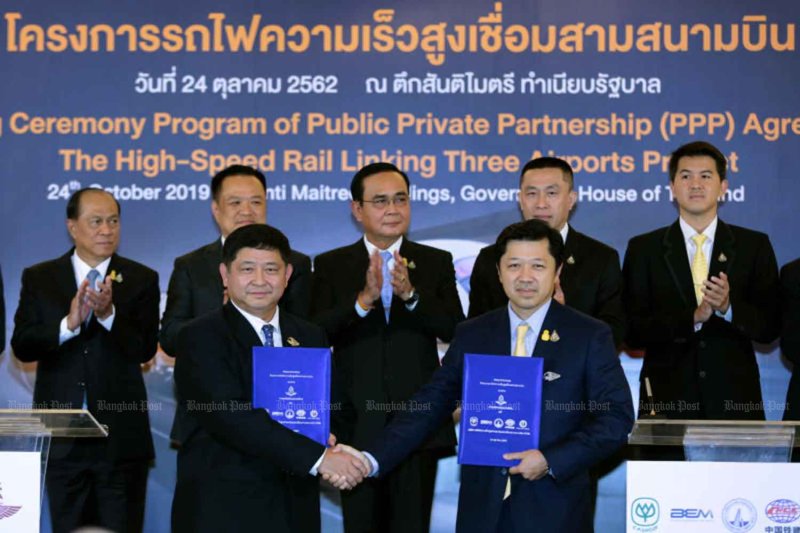
The government has denied reports that it has already decided to terminate the public-private partnership contract for the high-speed rail project linking Don Mueang, Suvarnabhumi and U-Tapao airports.
Deputy Transport Minister Siripong Angkasakulkiat said on Tuesday that terminating the contract was only one of several options the Transport Ministry would submit to the Eastern Economic Corridor (EEC) Policy Committee, with no final decision yet made.

He said changing construction costs and financial figures meant authorities had to reassess the best way to complete the transport link between Bangkok and the EEC.
Any decision, he said, would need to take into account the state budget, investment value, overall cost-effectiveness and the structure of the public-private partnership.
Alternatives, including proceeding with the existing high-speed rail project or developing the so-called "missing link" railway network, would all be submitted to the committee before a final decision is made, he added.
The planned development of the Red Line suburban railway includes the Bang Sue–Phaya Thai, Makkasan–Hua Mak and Bang Sue–Hua Lamphong (Missing Link) sections. The 25.9-kilometre project, with an estimated investment of 44.6 billion baht, is intended to complete Bangkok's urban rail network.
Asked about the consequences if the joint investment contract were terminated, Mr Siripong said legal issues surrounding any breach of contract or grounds for termination would have to be carefully examined to determine which party, if any, had failed to meet its obligations.
He said he believed the dispute would be difficult to resolve because neither the government nor the private concessionaire would be willing to concede easily, making legal proceedings likely.
Pressed on whether compensation claims would follow, Mr Siripong said such claims were likely but would depend on the outcome of the legal review.
He acknowledged that the government had initially been unable to hand over all construction sites as scheduled, although both parties had signed memorandums of understanding to address the delays.
At the same time, he said the private partner also faced financial obligations, including debt repayment issues that had been addressed through subsequent agreements.
Given the circumstances, responsibility for any breach of contract could lie with both parties, he said, adding that any compensation would depend on the specific obligations each party had failed to fulfil.
Deputy Prime Minister Pakorn Nilprapunt, who oversees legal affairs, said he had not yet received the proposal because it was still under consideration by the State Railway of Thailand (SRT) and had not reached the Transport Ministry's legal review process.
He said it was too early to say if terminating the contract would be legally possible before examining the agreement and its detailed provisions.