
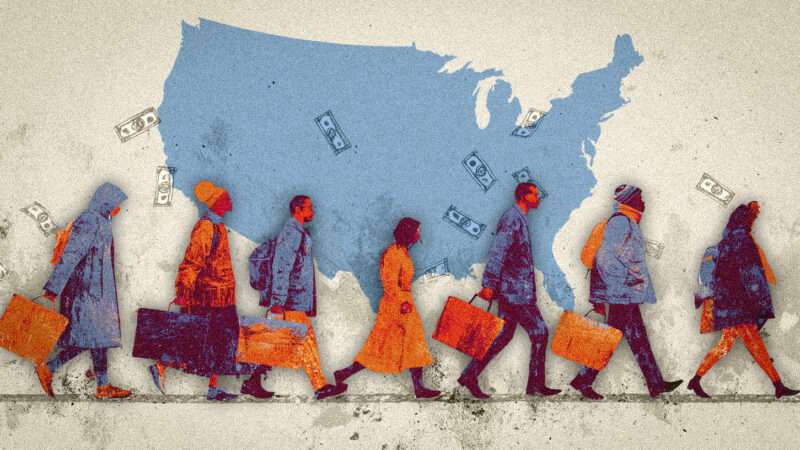
If you've spent any time on social media lately, you've probably seen some chatter about state income taxes. "Red," Republican-governed states are lowering them or eliminating them, and "blue," Democrat-governed states are actually raising them. They say that there are no controlled experiments in economics, but we have had quite a few over the years, from North and South Korea, to East and West Germany, to even Chile and Argentina. With some states raising taxes (a lot), and some states cutting taxes (a lot), you probably already know the long-term results of this experiment long before it even begins. States with lower taxes will attract talent and capital, and states with higher taxes will lose them.
This has been going on for a while, and it really started to pick up in 2017, with the passage of the Tax Cuts and Jobs Act, which limited the deductibility of state and local taxes to $10,000, amplifying the tax differences between the states. That set off a migration of people and capital so large that it has resulted in massive population changes across the United States, with California and New York being the source of migration, and Florida and Texas being the primary destinations. The long-term consequence of this is that, in time, it will completely redraw the electoral map.