Get all your news in one place.
100's of premium titles.
One app.
Start reading
The Conversation
The Conversation
Jared Rivera, Postdoctoral Research Fellow, University of British Columbia

FORGOTTEN HISTORY: How the quantum vacuum perturbs atoms shrinks black holes and formed our galaxies - Caught on Camera

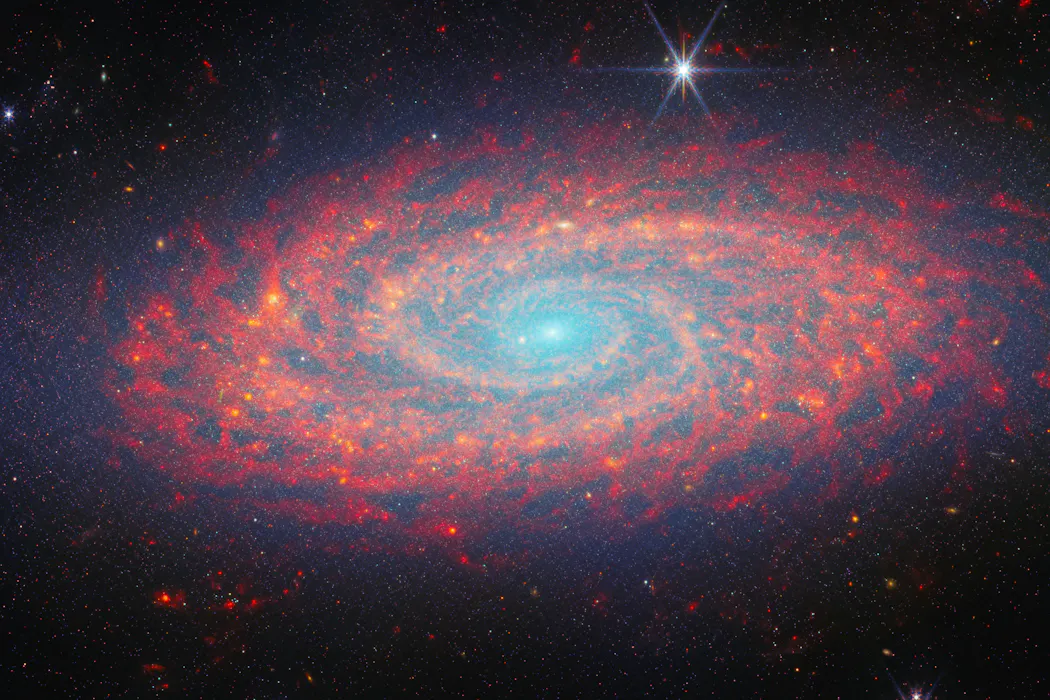
Cosmologists suggest that fluctuations of the quantum vacuum in the first moments of the universe played a role in the formation of galaxy clusters spanning the cosmos. Pictured here is the spiral galaxy NGC 2090, located in the constellation Columba. (ESA/Webb, NASA & CSA, A. Leroy)

The word “vacuum” may conjure the image of empty space. Maybe you think of a region far outside the solar system without planets, debris, gas clouds or light.

According to quantum theory, however, a vacuum is never truly empty. Quantum mechanics extends the Heisenberg uncertainty principle — which states that we cannot measure the position and the velocity of an object exactly at the same time — to a vacuum. The result is that a vacuum can never be still.

Sign up to read this article
Read news from 100's of titles, curated specifically for you.
Already a member? Sign in here
Related Stories
Top stories on inkl right now
One subscription that gives you access to news from hundreds of sites
Already a member? Sign in here
Our Picks
Fourteen days free
Download the app
One app. One membership.
100+ trusted global sources.