IT’S a secretive body of Tory backbenchers which hit the headlines as MPs plotted the downfall of Boris Johnson.
Now a new book is promising an insider’s look at what goes on at the 1922 Committee – including correcting misconceptions over its origins.
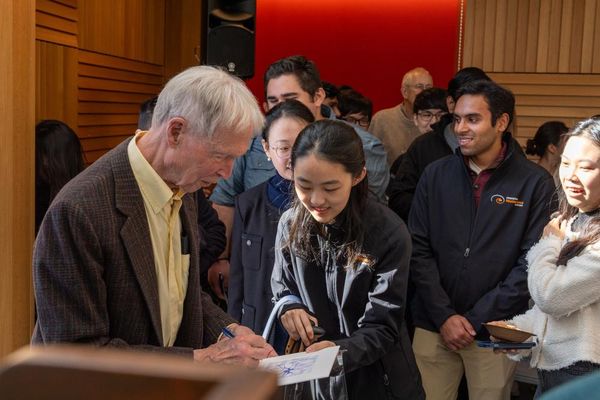
Author Philip Norton, professor of government at the University of Hull – who regularly attends the committee as peer Lord Norton of Louth – said it was surprising how little was known about the “powerful” body which has become known for the “slaying” of prime ministers in recent years.
In the space of three years, between 2019 to 2022, three leaders – Theresa May, Boris Johnson and Liz Truss – resigned following the submission of letters calling for a vote of no confidence from Conservative MPs to 1922 chair Sir Graham Brady.
Norton (below) said Brady probably now had greater name recognition than many ministers.
“He became famous for not saying anything – being asked how many letters have you had [and saying I will] not tell you or an enigmatic smile and not saying anything,” he said.
“It really got a very high profile and that has made the ’22 far more significant than previously.”
He added: “I make the point Graham Brady has seen off more Prime Ministers than the electors have.”
One of the myths which is explored in The 1922 Committee: Power Behind The Scenes, published by Manchester University Press next month, is that it used to be down to “men in grey suits” from the executive committee to to tell Tory politicians when their time in power was up.
Norton said: “One of the myths is that, before MPs formally got the power to elect a leader, Conservative leaders were removed because they got a visit from the men in grey suits – in other words, the grandees, the executives from the 1922 Committee.”
But he added: “Since 1965, when the power to elect was formally introduced and then especially since 1975, when it had the power to vote the leader out of office, it has really become a very important political force.”
Norton said another common misconception was the committee was founded in 1922 – when it is actually celebrating its centenary this year.
The book outlines how it was originally set up in 1923 as a form of “self-help” group for MPs to help find their way around the House of Commons in the absence of any formal induction process.
Norton, who has spent around 25 years attending the committee as a member of the House of Lords, said it now fulfils a range of tasks, including the executive committee acting as an “agony aunt” for upset or disgruntled MPs.
He said moments of high drama were “the exception and not the rule”.
But he added: “You get the exceptional meetings where the fate of the leader may be in doubt.
“Theresa May came to speak to the 1922 Committee after the 2017 General Election when the party had not been returned with a large majority, so to some extent she was fighting for her political life.
“It was a packed meeting, she addressed it and that was high drama.
“Much earlier, Iain Duncan Smith, of course, was subject to a vote of no confidence, so he had to address the ’22, when he was fighting to hold onto the leadership.
“In this case, he lost – he made a very good speech, but at the end of it, I turned to a very senior MP and said what do you think of that – and he simply said ‘too late’.”
Norton added: “So there are those moments of really high drama, the committee room is completely packed, absolutely crowded.
“I think I made the point in the book that meetings like that would give the health and safety inspector apoplexy as it is just standing room only, jam-packed.
“At other times, you get a handful of members [attending].”
Norton described the 1922 Committee as “sporadically powerful” – saying while it did always affect ministers, it had the ability to do so.
“That is why ministers have got to be careful, they have got to be on their toes – as a policy they introduce or a speech they give can suddenly blow up and become controversial, they are summoned to the ’22 and they might be fighting for their [political] lives,” he added.
“The Conservative Party have been in government more often than any other party in British politics, and so the body of Conservative MPs coming together is very important – yet what is surprising is how little is known about it.
“You think this is a really important body – why has no one studied it?”