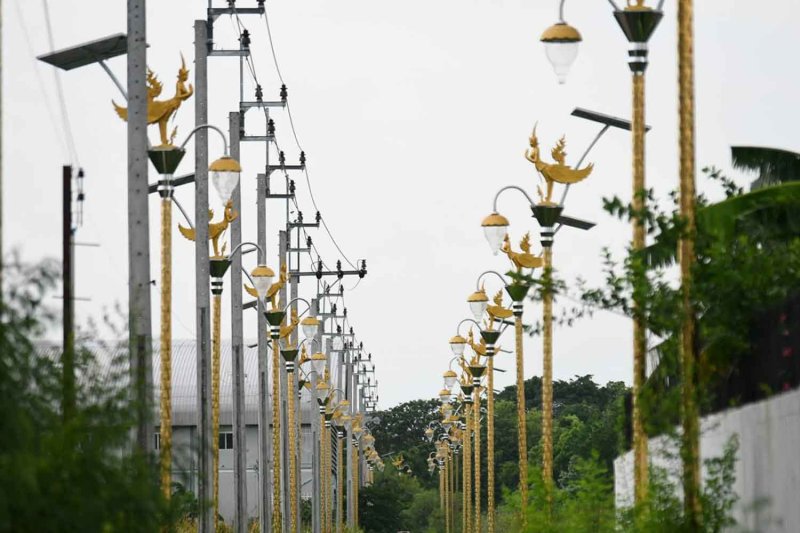
Twelve years after the scandal emerged, the arm of justice has finally reached the controversial procurement of Kinnaree sculpture-style lampposts in Samut Prakan province.
Last month, the Criminal Court for Corruption and Misconduct Cases found Songchai Nokkhamin, former president of the Racha Thewa TAO in Bang Phli district of Samut Prakan, and another defendant, identified as Wassana, guilty of bid-rigging.

The offence involved the procurement of Kinnaree-themed ornamental streetlights in 2013 and an additional budget approved in 2019 to modify the project. Both defendants were sentenced to five years in prison.
The verdict is another reminder to state officials and local administrators that transparency is essential. The arm of justice may have appeared tarnished at times, but it was never idle.
The Racha Thewa tambon administration organisation (TAO) spent more than 642 million baht procuring 6,773 Kinnaree lampposts. The high price of the lamps was one issue; their placement was another. The TAO installed Kinnaree lampposts close together, including along narrow dirt roads and around a large fish pond.
At the time, Songchai was quoted as telling the media the excessive number of lamps in some areas was due to "technical reasons". When asked why the lamps were so expensive, he simply said that good quality did not come cheap.
Ornamental lampposts have become a trend among local administrations over the past decade. They are often used to showcase community pride and local identity. Trang's Muang district used sea cow designs, Saraburi's Tabkwang district used deer designs, and Bang Phli district of Samut Prakan, where Suvarnabhumi airport is located, used aircraft designs. The aircraft lampposts cost 100,000 baht each.
Indeed, many local administrations continue to install such ornamental lampposts -- or other grandiose public infrastructure projects -- as long as they do not violate procurement laws.
Honesty alone is noble, but it is not enough. Public money must be spent rationally and wisely. Without systems to ensure officials develop useful and practical projects, the country will continue to be filled with wasteful and grandiose public infrastructure that could have been built differently -- and some that should never have been developed in the first place.
Looking around our public spaces, it is not difficult to find questionable projects and infrastructure. In public gardens and community parks, there are many exercise machines made of poor-quality materials, posing risks to users. Along rural roads, it is common to see abandoned OTOP centres or lampposts installed too close together or in unsuitable locations, such as inside moats.
Government agencies and lawmakers -- at both local and national levels -- must work to create mechanisms to properly screen public projects and identify problems before irrational schemes are built.
At present, society and anti-graft agencies often rely on complaints or media reports that arrive too late. We cannot wait for the arm of justice to reach every Kinnaree lamppost or wasteful public project. We must find ways to prevent such projects from being developed in the first place.