
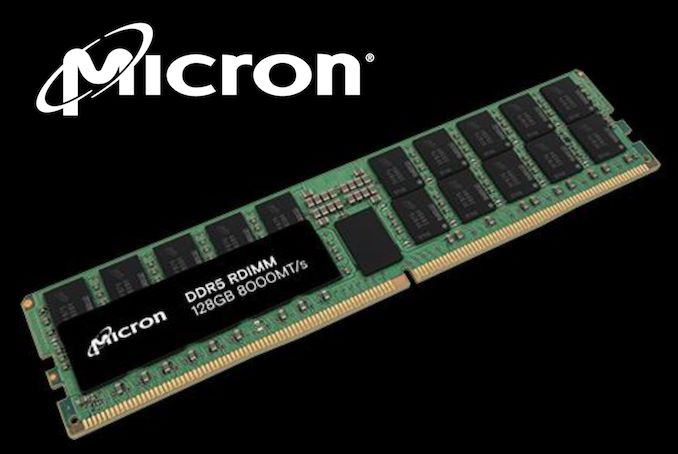
The path to high-capacity RDIMMs for servers has primarily been through 3D stacking (3DS) of DRAM dies using Through-Silicon Vias (TSVs). However, this has presented significant challenges in packaging (driving up the cost), and has also not been efficient in terms of energy consumption. The demand for large memory capacity RDIMMs is being primarily driven by the sudden emergence of large-language models (LLMs) for generative AI and increasing CPU core counts. Both of these require significant amount of DRAM to keep pace with performance requirements. Keeping these in mind, Micron is introducing 128 GB DDR5 RDIMMs capable of operating at up to 8000 MT/s today, with mass-production slated for 2024.
Micron has recently started fabricating 32 Gb monolithic DDR5 dies using its proven and mature 1β technology. The new dies have a 45%+ increase in bit density, and are capable of reaching up to 8000 MT/s while also operating with much more aggressive timing latencies compared to the standard JEDEC specs. The company is claiming that it improves energy efficiency by as much as 24% compared to the competition's 3DS TSV offerings, and the faster operation can also help in faster AI training times. Avoiding 3DS TSV allows Micron to optimize the data input buffers and critical I/O circuits better, while also reducing the pin capacitance on the data lines. These contribute to the reduced power and improved speeds.