
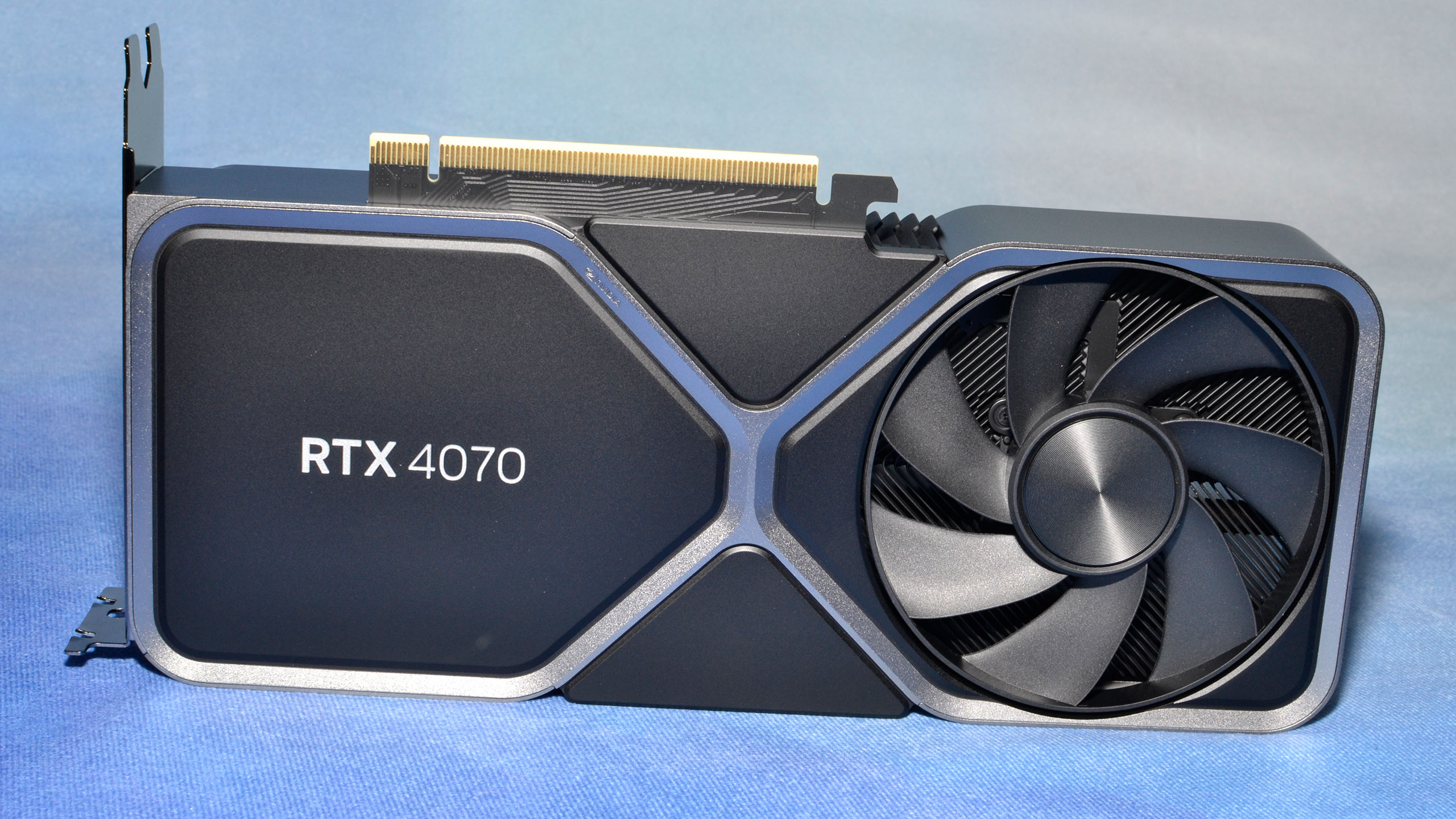
Nvidia positions its new GeForce RTX 4070 as a great upgrade for GTX 1070 and RTX 2070 users, but that doesn't hide the fact that in many cases, it's effectively tied with the last generation's RTX 3080. The $599 MSRP means it's also replacing the RTX 3070 Ti, with 50% more VRAM and dramatically improved efficiency. Is the RTX 4070 one of the best graphics cards? It's certainly an easier recommendation than cards that cost $1,000 or more, but you'll inevitably trade performance for those saved pennies.
At its core, the RTX 4070 borrows heavily from the RTX 4070 Ti. Both use the AD104 GPU, and both feature a 192-bit memory interface with 12GB of GDDR6X 12Gbps VRAM. The main difference, other than the $200 price cut, is that the RTX 4070 has 5,888 CUDA cores compared to 7,680 on the 4070 Ti. Clock speeds are also theoretically a bit lower, though we'll get into that more in our testing. Ultimately, we're looking at a 25% price cut to go with the 23% reduction in processor cores.
We've covered Nvidia's Ada Lovelace architecture already, so start there if you want to know more about what makes the RTX 40-series GPUs tick. The main question here is how the RTX 4070 stacks up against its costlier siblings, not to mention the previous generation RTX 30-series. Here are the official specifications for the reference card.
There's a pretty steep slope going from the RTX 4080 to the 4070 Ti, and from there to the RTX 4070. We're now looking at the same number of GPU shaders — 5888 — as Nvidia used on the previous generation RTX 3070. Of course, there are plenty of other changes that have taken place.
Chief among those is the massive increase in GPU core clocks. 5888 shaders running at 2.5GHz will deliver a lot more performance than the same number of shaders clocked at 1.7GHz — almost 50% more performance, by the math. Nvidia also likes to be conservative, and real-world gaming clocks are closer to 2.7GHz... though the RTX 3070 also clocked closer to 1.9GHz in our testing.
The memory bandwidth ends up being slightly higher than the 3070 as well, but the significantly larger L2 cache will inevitably mean it performs much better than the raw bandwidth might suggest. Moving to a 192-bit interface instead of the 256-bit interface on the GA104 does present some interesting compromises, but we're glad to at least have 12GB of VRAM this round — the 3060 Ti, 3070, and 3070 Ti with 8GB are all feeling a bit limited these days. But short of using memory chips in "clamshell" mode (two chips per channel, on both sides of the circuit board), 12GB represents the maximum for a 192-bit interface right now.
While AMD was throwing shade yesterday about the lack of VRAM on the RTX 4070, it's important to note that AMD has yet to reveal its own "mainstream" 7000-series parts, and it will face similar potential compromises. A 256-bit interface allows for 16GB of VRAM, but it also increases board and component costs. Perhaps we'll get a 16GB RX 7800 XT, but the RX 7700 XT will likely end up at 12GB VRAM as well. As for the previous-gen AMD GPUs having more VRAM, that's certainly true, but capacity is only part of the equation, so we need to see how the RTX 4070 stacks up before declaring a victor.
Another noteworthy item is the 200W TGP (Total Graphics Power), and Nvidia was keen to emphasize that in many cases, the RTX 4070 will use less power than TGP, while competing cards (and previous generation offerings) usually hit or exceeded TGP. We can confirm that's true here, and we'll dig into the particulars more later on.
The good news is that we finally have a latest-gen graphics card starting at $599. There will naturally be third-party overclocked cards that jack up the price, with extras like RGB lighting and beefier cooling, but Nvidia has restricted this pre-launch review to cards that sell at MSRP. We've got a PNY model as well that we'll look at in more detail in a separate review, though we'll include the performance results in our charts. (Spoiler: It's just as fast as the Founders Edition.)













