
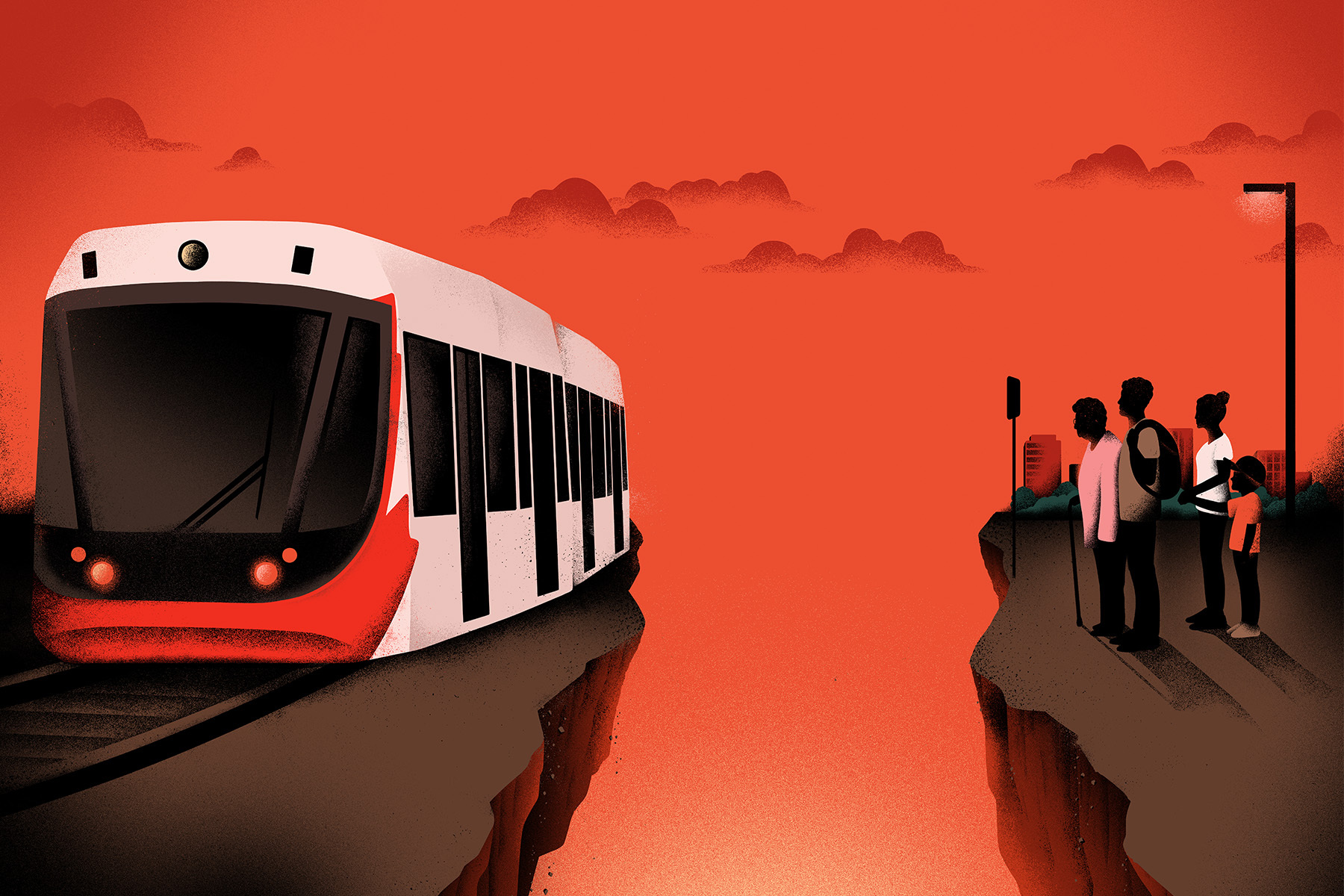
From the sky, Canada’s capital looks like a city on the edge of nowhere: an urban pocket surrounded by forests, farms, and a confluence of meandering rivers. Officially, metropolitan Ottawa takes up 2,790 square kilometres of space—more than four times the geographic size of Metro Toronto and roughly six times the Island of Montreal. The capital stretches from the sparsely populated pasturelands in the northwest to a bird sanctuary and creek in the east and a Victorian hamlet complete with a rickety wooden bridge to the south. Enter the city limits from any which way but north, and you won’t see hints of a city at all. What we call Ottawa is mostly greenbelt, sprawl, and farms—all of it unceded by the Algonquin, who lived here long before an English army engineer showed up, turned some sod near the current site of the Chateau Laurier, and began rerouting the region’s waterways.
The Rideau Canal was the city’s first rapid transitway, a 200-kilometre-long system of lock gates and hand-cranked swing bridges that linked what was then just a small logging town to the St. Lawrence River and the world beyond. Ottawa’s citizens have been taught to view the canal as an engineering marvel, integral to the city’s function and founding. Yet, upon its completion back in 1832, the canal and its concrete banks were considered by many a complete disaster. Its central architect, Colonel John By, was unceremoniously recalled to London, stripped of his commission, vilified in the press, and subjected to two government inquiries. When he was first assigned to oversee the construction, the colonel told his overlords in London that he could have the transitway operational in four years. It took him five. An estimated thousand labourers died under his authority. As upsetting as the death count was, the cost was the real sticking point back in London. The colonel had been given a budget of £62,258 (roughly 14.8 million in Canadian dollars today). By the time the transitway was operational, he’d spent more than fourteen times that. The results were so underwhelming to British eyes that the canal’s initial champions no longer understood why they had even commissioned it to begin with.



