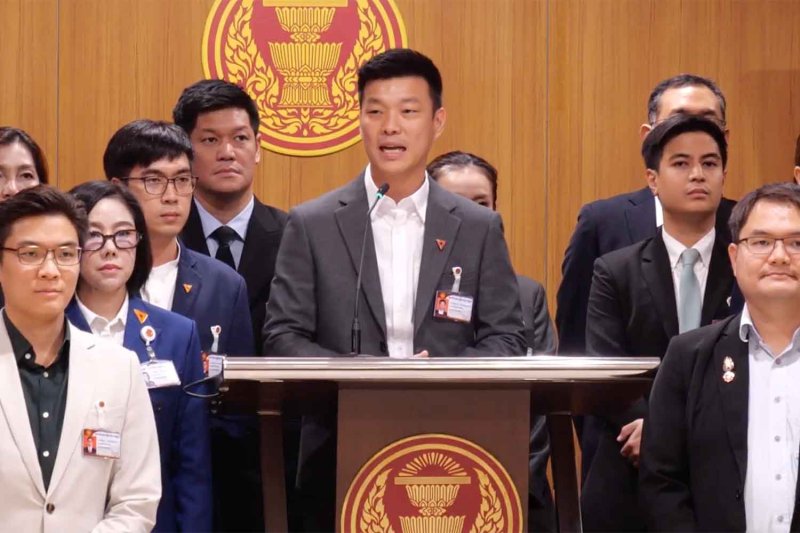
The People's Party (PP) on Wednesday submitted two constitutional amendment bills to parliament proposing mechanisms for drafting a new constitution while reaffirming three key principles: public participation, prevention of political monopolisation and opposition to expanding the Senate's special powers.
At parliament, PP leader Natthaphong Ruengpanyawut said the proposals were designed to overcome obstacles created by Constitutional Court ruling No. 18/2568, which the party views as inconsistent with democratic principles because it limits the public's ability to directly choose constitution drafters.

Mr Natthaphong said the party submitted two versions of the amendment to ensure at least one proposal aligned with the party's three principles would advance during the first reading in parliament.
The principles are guaranteeing public participation, including the election of members of a Constitution Drafting Assembly (CDA); preventing monopolisation by any political faction; and rejecting additional powers or conditions allowing senators to determine the content of a new constitution. Both proposals envisage a 150-member CDA but differ in how members would be selected.
Under the first proposal, voters would directly elect 150 CDA candidates. Of these, 100 would be elected through constituency-based voting at the provincial level, while 50 would come from nationwide party-list-style elections intended to represent thematic interests or professional groups.
The list of 150 elected candidates would then be submitted to parliament for endorsement as a whole. Parliament would either approve the entire slate or reject it outright, triggering a new election.
The second proposal would allow voters to elect 300 CDA candidates -- 200 constituency-based and 100 nationwide candidates -- after which parliament would reduce the number to 150 through a secret-ballot selection process designed to prevent domination by any one group. Lawmakers would vote in rounds to gradually narrow the field until all positions were filled. The two drafts share five common provisions, including granting the CDA authority to appoint drafting committees, allowing outside experts and civil society representatives to participate, and empowering the assembly to draft an entirely new constitution.