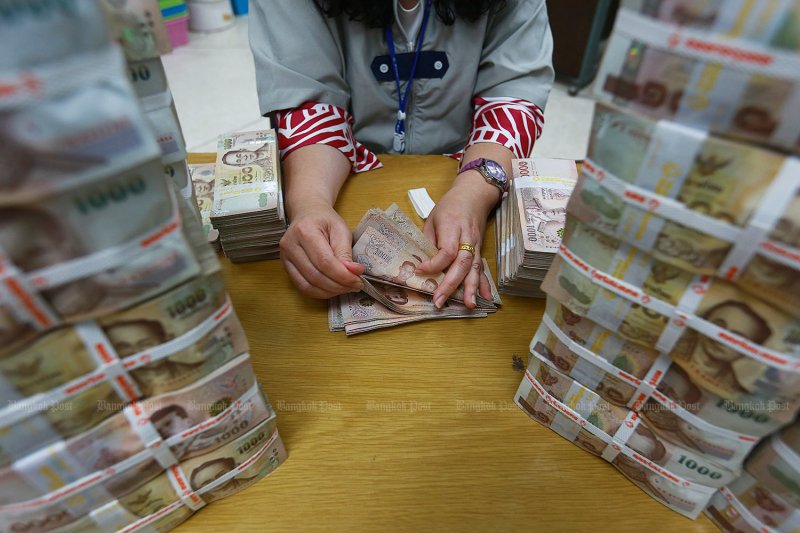
The government's interest payment burden remains relatively low despite the continued increase in public debt, according to the head of the Public Debt Management Office (PDMO).
Jindarat Viriyathavikul, director-general of PDMO, said interest payments on the government's outstanding borrowing account for 10.2% of projected government revenue, below the 12% threshold used by credit rating agencies as an indicator of whether a sovereign bond should be considered a junk bond.

However, rating agencies do not use the same methodology as PDMO to assess the government's interest burden. PDMO's calculation includes interest payments on borrowing by state-owned enterprises, whereas rating agencies exclude such payments.
As a result, the ratio of government interest payments to projected revenue used by rating agencies in assessing Thailand's sovereign credit rating is only 6-7%, well below the relevant benchmark.
According to Mrs Jindarat, as of April Thailand's public debt tallied 66.7% of GDP, below the government's fiscal discipline ceiling of 70%. The office has been managing borrowing costs and debt-related risks prudently, and is confident the public debt-to-GDP ratio will remain below the 70% threshold for four years, she said.
Thailand's public debt increased rapidly following the pandemic, when the government issued two emergency borrowing decrees totalling 1.5 trillion baht to finance relief measures for affected households and businesses.
Public debt totalled 6.88 trillion baht, or 41.2% of GDP, in April 2019 before the pandemic. By April 2026, public debt had risen to 12.8 trillion baht, or 66.7% of GDP.
The increase in public debt resulted in a higher ratio of interest payments to projected government revenue. The ratio rose from 8.31% in 2023 to 9.59% in 2024 and 10.2% in September 2025.
Mrs Jindarat said PDMO has kept the government's average borrowing cost at a relatively low level, with the average cost of debt at 2.67% in 2023, 2.85% in 2024 and 2.77% in 2025. More than 80% of Thailand's public debt carries fixed interest rates, helping to limit exposure to interest rate volatility.
For fiscal 2026, the office set a total debt management target of 2.6 trillion baht. Roughly 1.3 trillion baht is to be raised through long-term financing instruments, including government bonds, savings bonds and green bonds, she said. The remainder is to be sourced through promissory notes, loan agreements and treasury bills.