
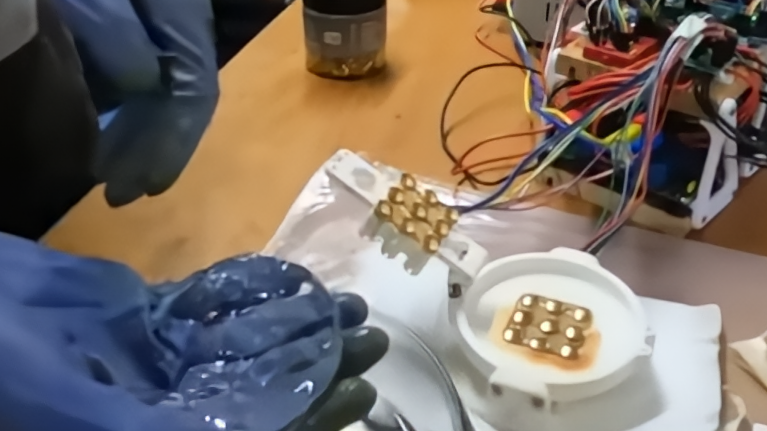
Researchers from the University of Reading in the United Kingdom have successfully demonstrated limited "learning" behaviors from a simple electro-active polymer (EAP) hydrogel when interfaced with an electrode array. Per a research paper originally published in Cell Reports Physical Science and covered at length (including a video) by ScienceAlert, this was demonstrated by having the EAP gel control system play an adapted version of the all-time classic video game Pong. Moreover, the EAP gel control system or "brain" seemed to peak in its Pong-playing abilities after about twenty minutes.
So, how exactly did this happen and what does it mean? While an EAP gel control system certainly doesn't resemble conscious life in any way, it still demonstrates an emergent ability that the material wasn't designed for. As engineer Vincent Strong from the University of Reading explains, "The rate at which hydogel de-swells takes much longer than the time it takes for it to swell in the first place, meaning that the ions' next motion is influenced by its previous motion, which is sort of like memory occuring. The continued rearrangement of ions within the hydrogel is based off of previous rearrangements within the hydrogel, continuing back to when it was first made and had a homogeneous distribution of ions."











