
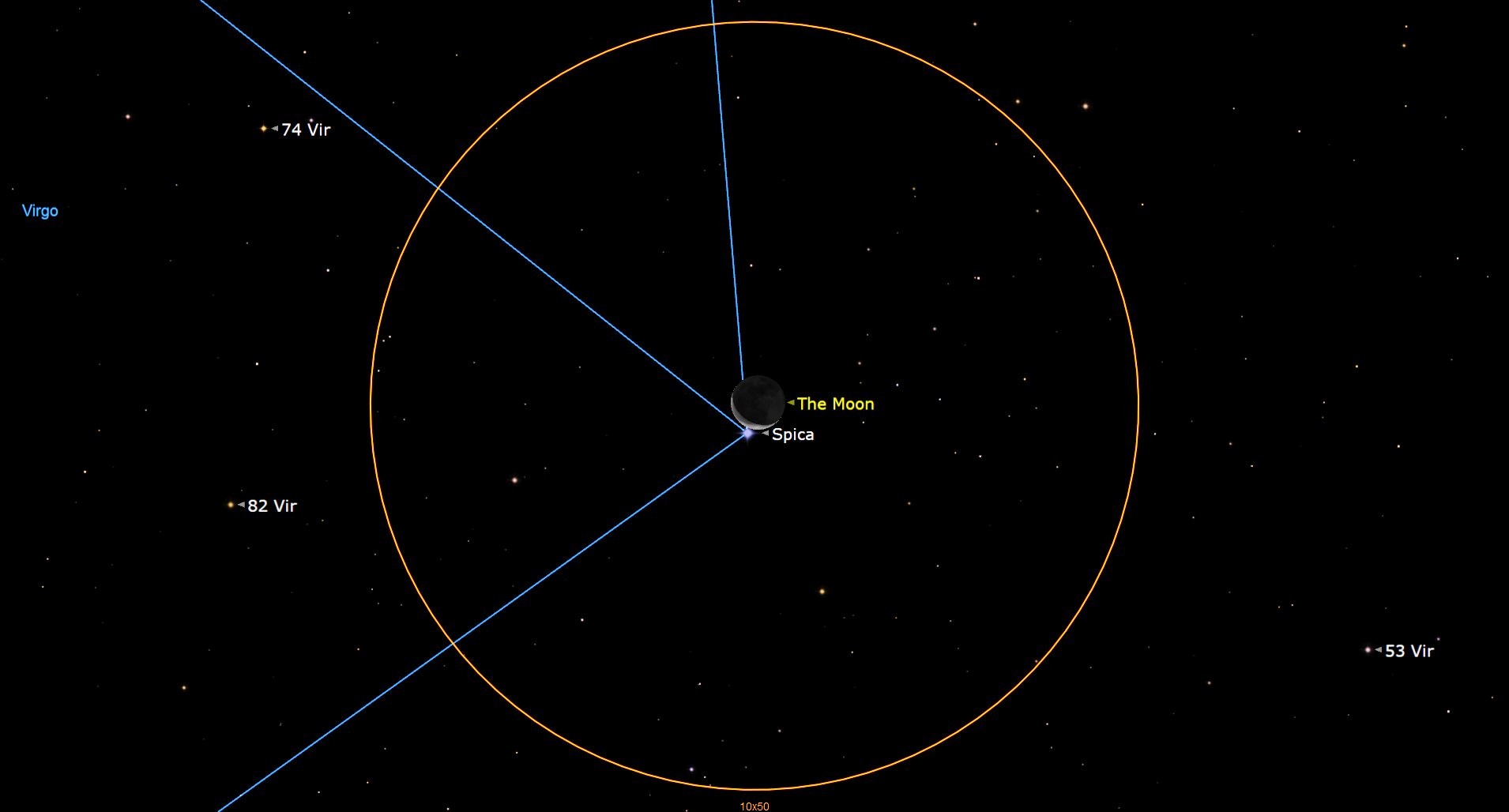
Earlier this month, the planet Saturn was eclipsed by the moon as seen from Central America, northwest portions of South America, as well as central and southern Florida. This event, known as an occultation (derived from the Latin word occultāre, which means "to conceal", can be a startling spectacle, especially if it involves a bright star.
But unlike a planet which can take up to a minute or two to be completely covered by the moon, a star, in contrast, appears to creep up to the moon's limb, hangs on the edge for a minute or two, and then, without warning, abruptly winks out. Later it pops back into view just as suddenly on the moon's other side. The suddenness with which occultations take place was one of the first proofs that the moon has no atmosphere. If our natural satellite were cloaked with an atmosphere, a star approaching its limb would appear to fade away gradually, just as if you were watching a bright star setting beyond the western horizon from here on Earth.