
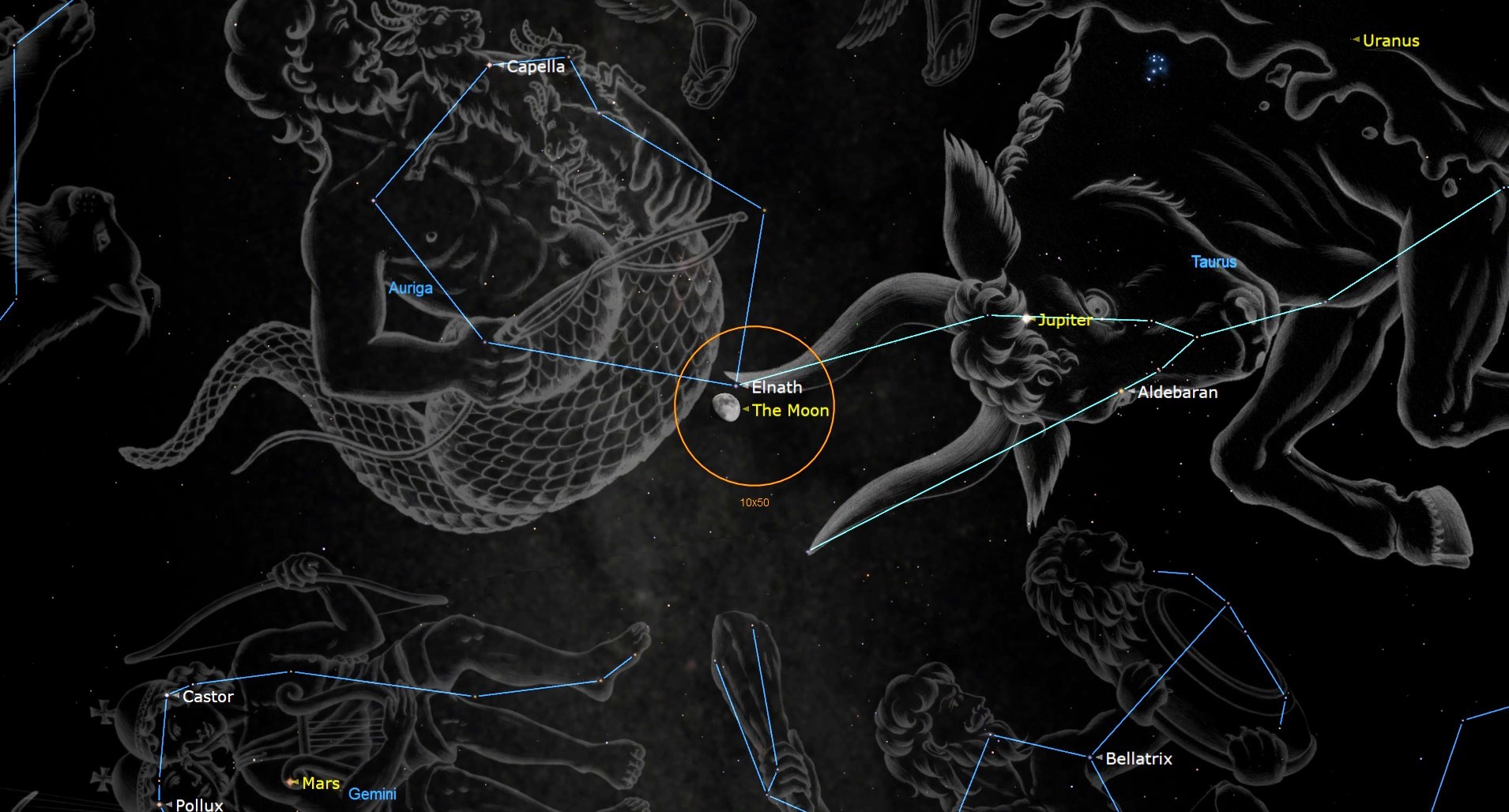
Even to a casual viewer, the waxing gibbous moon of Friday, Feb. 7 will appear unusual. As it crosses the meridian shortly after 8 p.m. local standard time, it will climb so very high in the sky that from central Florida and southern Texas it will be seen overhead. For watchers in Miami or Brownsville, the moon will even pass north of the point directly overhead (the zenith).
To understand why this will happen, first consider that spring will officially arrive on March 20 at 5:01 a.m. Eastern Daylight Time, when the sun will shine directly down on the equator. Our four seasons are the by-product of the 23.5 degree tilt of the Earth's axis and during the course of a year we see the sun cycle between declination 23.5 degrees north and 23.5 degrees south as it circles around the sky along the ecliptic. The sun's changing declination is what determines whether the sun's rays strike us at a low angle or more directly.