
In 2019, Chang-Tai Hsieh and Enrico Moretti published "Housing Constraints and Spatial Misallocation" in the American Economic Journal. It's probably academia's most famous Yes In My Backyard (YIMBY) article. H-M imagined a scenario where New York City and the Bay Area never imposed draconian housing regulation. Then they estimated how much bigger the U.S. economy would have been in this alternate history. Their answer was shocking. Restraining local regulation in just two keys localities would have made total U.S. GDP 4-9% higher.
The key idea: New York City and the Bay Area are the country's most productive areas. Given the same inputs, they yield an exceptionally large quantity of output. In economic jargon, they have sky-high Total Factor Productivity. With much less housing regulation, housing prices in these TFP-rich areas would be much lower. Their populations would, in turn, be much higher. Production would naturally fall in low-TFP regions, but rise far more in high-TFP regions. As a result, the total output of the country would rise.
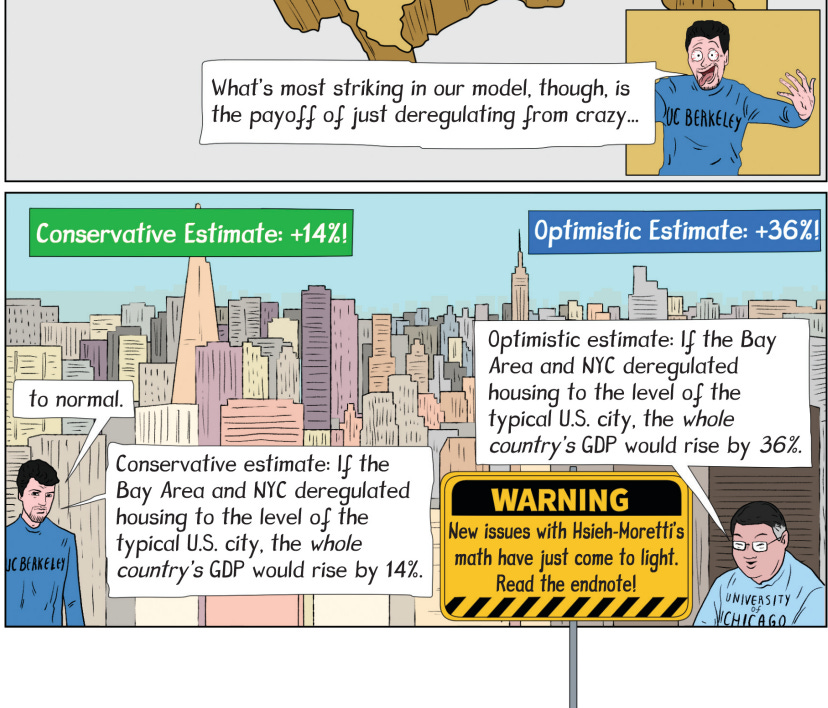
When writing Build, Baby, Build, I reviewed H-M closely. To my surprise, I discovered multiple arithmetic errors, which Hsieh and Moretti quickly acknowledged. Strangely, my corrections actually strengthened their results. Instead of implying that GDP would be 4-9% higher, their paper actually implies that GDP would be 14-36% higher. Super shocking!
Not long before my book went to print, however, economist Brian Greaney published a much more fundamental critique of H-M. This time, however, Hsieh and Moretti did not concede. Nor did Greaney. Given my time constraints, I decided to just insert a warning into the text and add a detailed endnote on the controversy. Like so:
Recently, however, I started wondering what a quick "back-of-the-envelope" or "napkin" calculation would reveal. When I teach the economic effects of immigration, for example, I normally start by multiplying rough estimates of (a) gains per immigrant by (b) total number of immigrants. In principle, one could do the same for domestic migration. Why not give it a try?