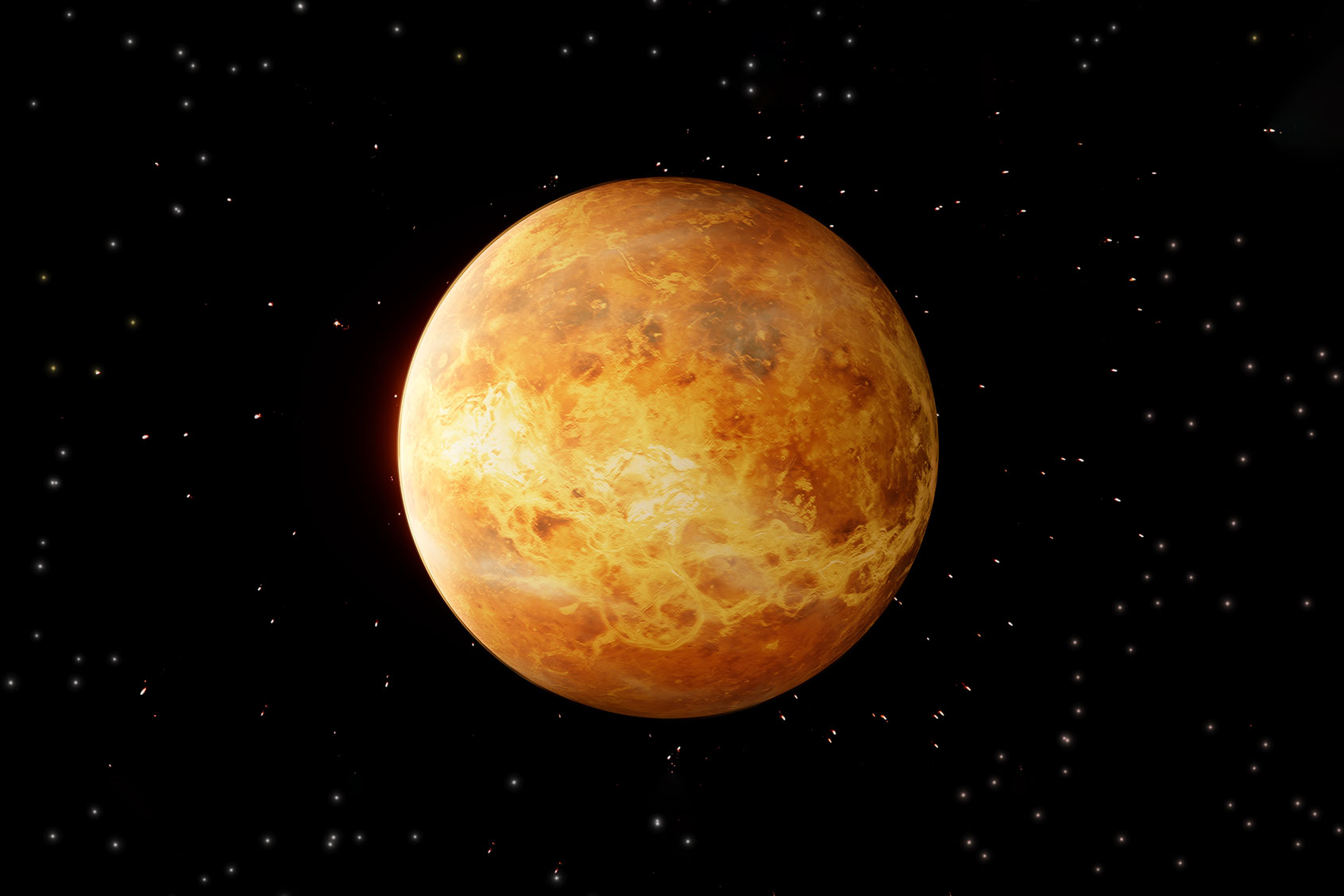
Venus is sometimes called Earth's twin, as it is roughly the same size as Earth, occupies the orbital lane adjacent to ours, and has a problem with greenhouse gases (namely carbon dioxide) in its atmosphere. Yet the similarities between the two worlds end quickly: The greenhouse effect spiraled out of control on Venus, meaning it is a toasty 900 degrees Fahrenheit at the surface — hot enough to melt lead. Beyond carbon dioxide, its atmosphere is, unlike Earth's, filled with churning yellow clouds composed of malodorous sulfuric acid. And its geology is very, very weird compared to our planet's: while Earth's surface is comprised of continental "plates" that slowly drift across the crust over millions of years, Venus has no plate tectonics and a completely different geology.
One of Venus' lingering geologic mysteries involves the innumerable volcanoes which pepper the planet's surface. Astronomers and planetary scientists were unsure if and how many were active, and what their relationship was to the planet's evolution. This is particularly a mystery because in other ways, Venus is so similar to Earth, even on the inside. Hence, the notion that it would have such alien geology seems peculiar indeed.