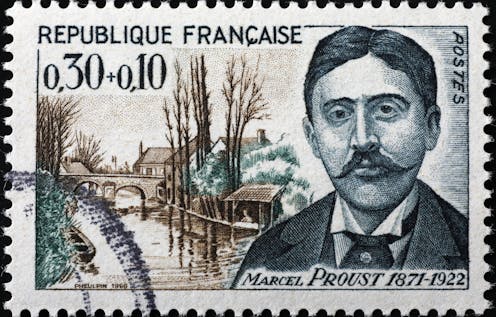
The 100th anniversary of Marcel Proust’s death gives us an opportunity to remember his masterwork, In Search of Lost Time, a sort of French-style Divine Comedy first released in 1913. Much like the way Dante’s 13th-century work forms a neat summary of Medieval wisdom, In Search of Lost Time attempts to cover every facet of human knowledge acquired at the dawn of the 20th century.
It discusses aesthetics with archetypal artists (through characters such as Vinteuil, the composer; Elstir, the painter; and Bergotte, the writer), addresses medicine by touching on Freudian psychology, and broaches the art of battle, right at the cusp of World War I. Proust refers liberally to contemporary technological developments, including the telephone, which enables him to communicate with the ghost of his beloved grandmother, the train that leaves the Saint-Lazare station, and the wondrous airplane that appears to him as a god would to an Ancient Greek. He is familiar with the theory of evolution, stating “‘Selection'… seemed to me as incompatible… as it would be if preceded by the adjective 'Natural’.”