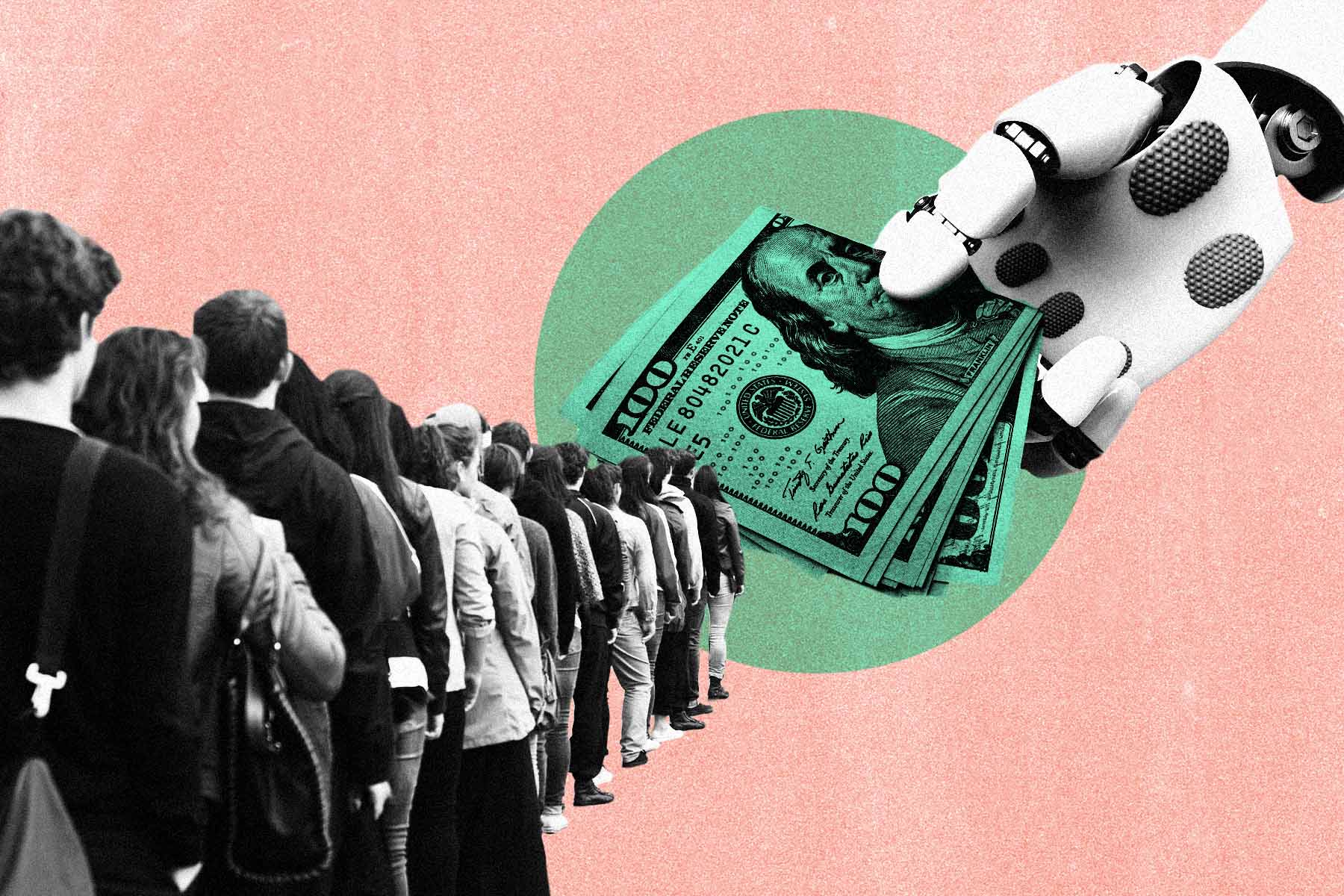
Sam Altman, CEO of OpenAI, has ideas about the future. One of them is about how you’ll make money. In short, you won’t necessarily have to, even if your job has been replaced by a powerful artificial intelligence tool. But what will be required for that purported freedom from the drudgery of work is living in a turbo-charged capitalist technocracy. “In the next five years, computer programs that can think will read legal documents and give medical advice,” Altman wrote in a 2021 post called “Moore’s Law for Everything.” In another ten, “they will do assembly-line work and maybe even become companions.” Beyond that time frame, he wrote, “they will do almost everything.” In a world where computers do almost everything, what will humans be up to?
Looking for work, maybe. A recent report from Goldman Sachs estimates that generative AI “could expose the equivalent of 300 million full-time jobs to automation.” And while both Goldman and Altman believe that a lot of new jobs will be created along the way, it’s uncertain how that will look. “With every great technological revolution in human history . . . it has been true that the jobs change a lot, some jobs even go away—and I’m sure we’ll see a lot of that here,” Altman told ABC News in March. Altman has imagined a solution to that problem for good reason: his company might create it.