
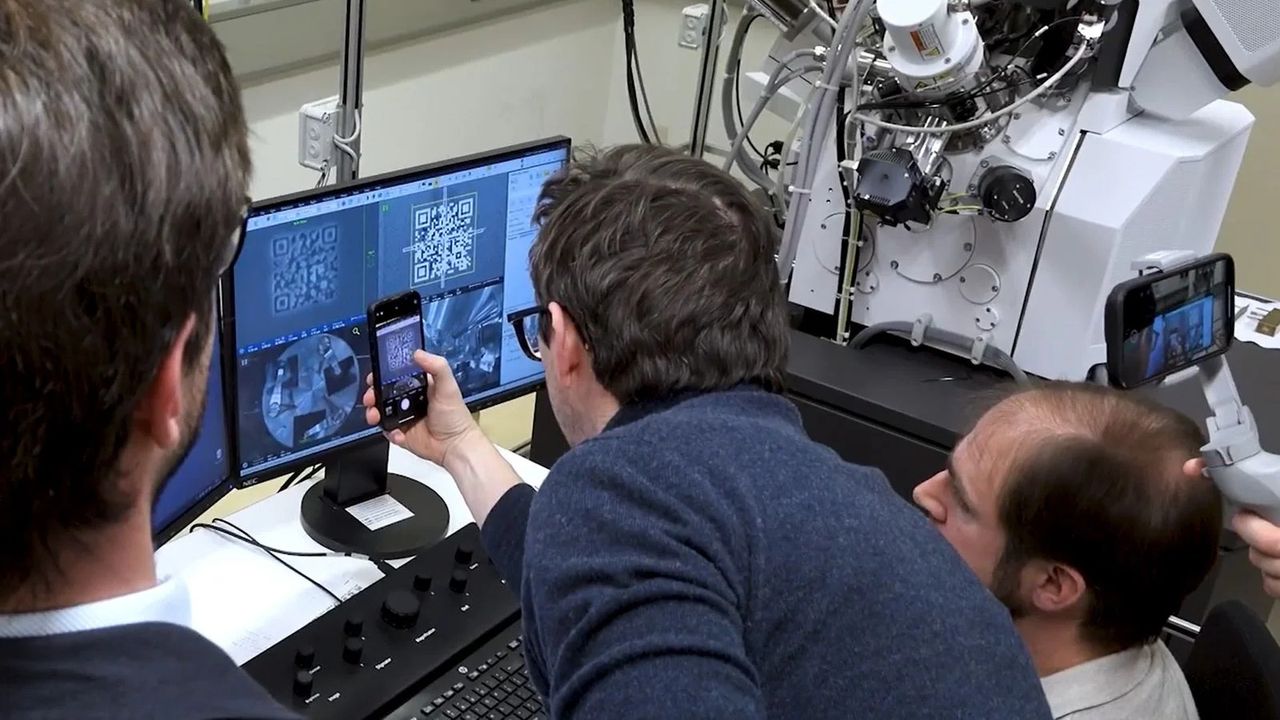
Scientists have created the smallest QR code in the world, measuring just 3.07 × 10⁻⁹ square inches (1.98 square micrometers). It can preserve data for thousands of years and it's so small that you need an electron microscope to see it.Each pixel of the QR code is just 49 nanometers across, even smaller than a bacterium, ensuring its place as a Guinness World Record. It was created by etching its grid into a thin ceramic film with a focused ion beam. It's about 37% the size of the previous world record holder and about 0.0000004% the size of a standard 0.8-square-inch (2 cm2) QR code. The code is too small for even an optical microscope to visualize because the pixels are smaller than the wavelength of visible light and the light waves won't be scattered by its minute details. Only an electron microscope, which fires electron beams with a wavelength in the picometer scale (10-11 inches), can resolve it.












