

The Mercedes team has completely dominated the first three race weekends of the 2026 Formula 1 season. The Silver Arrows won all three grands prix, plus the sprint in China – though it was not always straightforward. Ferrari, in particular, was often able to apply pressure at the start of races, producing several close on-track battles.
However, a look at the data paints a clear picture: the season appears much closer than it actually is. Mercedes’ dominance is currently being underestimated. Weak starts are often the only reason rivals get within striking distance – but even then, they ultimately lack the tools to truly challenge.
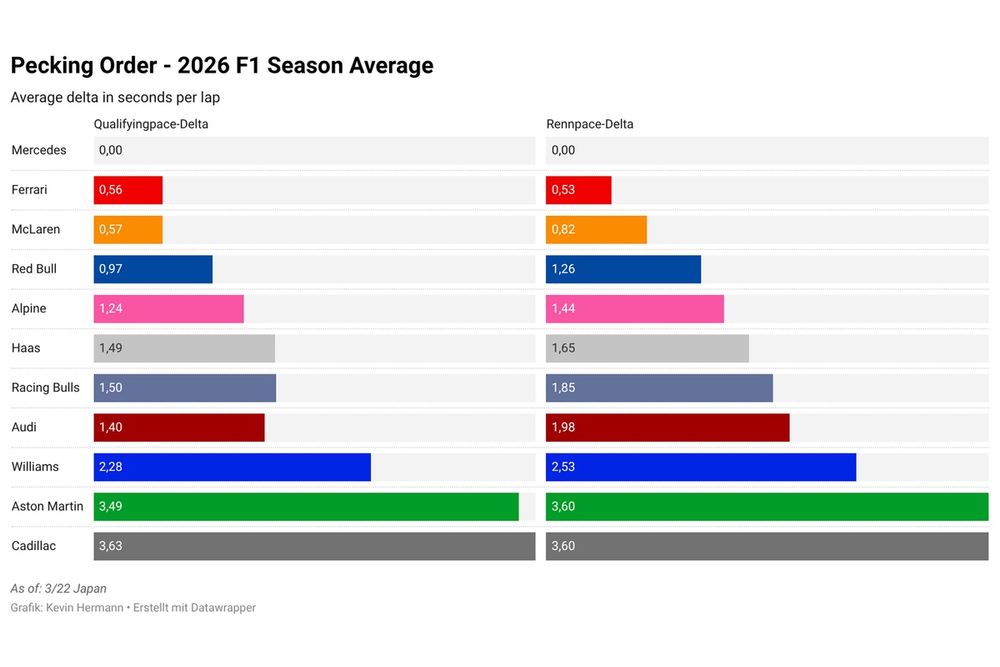
After the opening three race weekends, Ferrari is the closest pursuer. Yet the average deficit stands at 0.56 seconds in qualifying and 0.53 seconds per lap in race trim. This puts Ferrari at virtually the same gap to the front as last year.

Mercedes pace in 2026: The biggest dominance in a decade
A look at the past underlines just how extraordinary this advantage is. In 2025, McLaren had the dominant car but was on average only 0.19 seconds ahead of Red Bull.
Likewise in 2023, when Max Verstappen won 19 out of 22 races, Red Bull’s average qualifying advantage over Ferrari was just 0.19 seconds. Only in 2020 do we see comparable margins: back then, Mercedes outpaced Red Bull by an average of 0.55 seconds.
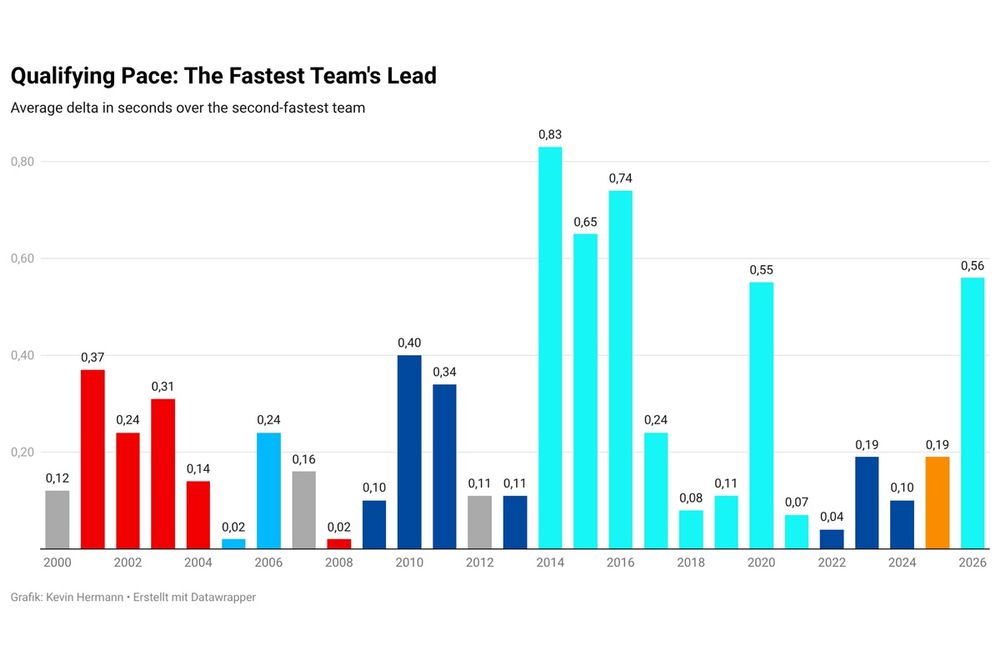
Even more striking is a comparison with 2016: Mercedes also dominated that season, leading Red Bull by an average of 0.74 seconds in qualifying. That marks the last time a team held a larger advantage than Mercedes does today.
Mercedes’ most dominant phase, however, began with the introduction of the hybrid era. In 2014, the team’s average advantage over second-placed Red Bull stood at 0.83 seconds – the largest dominance by any team since the turn of the millennium.
Even the most successful eras of other teams do not match these figures. Neither Red Bull during the Sebastian Vettel era from 2010 to 2013, nor Ferrari during the Michael Schumacher era, achieved comparable margins.
Ferrari’s biggest advantage came in 2001, at 0.37 seconds over McLaren. Red Bull’s best figure dates back to 2010, with a 0.4-second advantage over Ferrari in qualifying. By comparison, Mercedes in 2026 is operating at a historic level.
A repeat of the hybrid era?
The data suggests that Mercedes’ current dominance is reaching historic proportions – even if it has not always been obvious in the opening races. Close battles and poor starts have distorted the overall picture.

In clean air, Mercedes is currently almost unbeatable. Ferrari, McLaren, and Red Bull lack the means to apply sustained pressure – they are effectively fighting with blunt tools. The key question, therefore, is: how quickly can the competition catch up?
A look back shows that at the start of the hybrid era, it took four years before any team could seriously challenge Mercedes. Only in 2018 did Ferrari reduce the average gap to just 0.08 seconds.
However, the circumstances today are somewhat different: while the current advantage is significant, it is smaller than in 2014. In addition, the regulations – particularly the ADUO framework – allow for faster convergence, especially on the engine side. Nevertheless, all signs currently point to the 2026 World Championship being decided through Mercedes.