Jules Grange Gastinel, Doctorant du CNRS, rattaché à l’Université d'Aix-Marseille, affilié au Centre d’études et de documentation économiques, juridiques et sociales (CEDEJ) et à l’Institut de recherches et d’études sur les mondes arabes et musulmans (IREMAM), Aix-Marseille Université (AMU)
Dans le viseur des houthistes : le gouvernement yéménite internationalement reconnu, mais aussi la famille Al-Saoud qui dirige l’Arabie saoudite et contrôle les Lieux saints de l’islam.
Texte intégral (2968 mots)
Depuis quelques semaines, la guerre civile yéménite connaît une brutale remontée en intensité. Les houthistes, qui contrôlent déjà la capitale Sanaa et l’essentiel du nord-ouest du pays, ont lancé une offensive vers l’ouest et le sud, s’emparant notamment de la ville porturaire de Mokha et de positions stratégiques autour du détroit de Bab el-Mandeb.
L’offensive marque une nouvelle étape dans un conflit qui remonte à la prise de Sanaa par les houthistes en septembre 2014. Le mouvement, issu du nord du Yémen, avait profité de l’effondrement politique consécutif au « printemps arabe » de 2011 pour étendre son contrôle. Après la prise du palais présidentiel et la fuite du président Abd Rabbo Mansour Hadi, une coalition menée par l’Arabie saoudite était intervenue militairement en mars 2015. Malgré des années de guerre et une trêve signée en 2022, les houthistes ont conservé leur bastion du Nord et considérablement développé leurs capacités politiques et militaires. Leur récente percée met en difficulté un camp anti-houthiste profondément fragmenté et ravive la menace sur les routes maritimes de la mer Rouge ainsi que sur les intérêts saoudiens.
Entretien avec Jules Grange Gastinel, spécialiste de la région.
The Conversation : Les offensives lancées par les houthistes début septembre ont-elles véritablement changé la donne au Yémen ?
Jules Grange Gastinel : Oui, mais pas exactement là où on le dit. Dès la mi-juillet, on avait vu les premiers mouvements de troupes et les lignes de front avaient bougé ; la reprise des affrontements s’est intensifiée en août avant les grandes offensives de début septembre.
Leur principal effet n’est pas de donner soudainement aux houthistes – le nom officiel de l’organisation est Ansar Allah – le contrôle de la mer Rouge : ils avaient déjà la capacité d’influencer le trafic maritime. Le changement majeur concerne plutôt le rapport de force à l’intérieur du Yémen. Les avancées houthistes affaiblissent encore le gouvernement internationalement reconnu et leur ouvrent potentiellement la voie vers des villes comme Aden ou, à terme, Marib, où leur offensive de 2020-2021 avait échoué.
Il faut aussi tenir compte du contexte régional. Le retrait des Émirats, survenu fin 2025, a laissé les Saoudiens isolés dans leur soutien au camp anti-houthiste. Fin 2025, le Conseil de transition du Sud (CTS, appuyé par Abou Dhabi) avait lancé une offensive contre les forces du gouvernement yéménite internationalement reconnu (le Conseil présidentiel de direction, PLC, proche de Riyad) et pris des territoires que ce dernier contrôlait, dans l’Est du pays. La réaction des Saoudiens a alors abouti au départ des Émiriens et à la reprise par le PLC des territoires perdus.
Cette confrontation a révélé la profonde fragmentation des adversaires des houthistes. Pour dire les choses schématiquement, le PLC souhaite reprendre l’ensemble du territoire du Yémen tandis que le CTS aspire à un État indépendant du Yémen du Sud.
La désunion demeure donc un problème central, alors que le CTS continue de bénéficier d’un certain soutien populaire à Aden. Les houthistes ont su mettre à profit cette scission pour réaliser leurs dernières avancées.
Qui contrôle réellement le Yémen aujourd’hui ?
J. G. G. : La carte est trompeuse si l’on se contente de regarder les superficies : certes, les houthistes ne contrôlent qu’environ 30 % du territoire, principalement dans le Nord-Ouest, mais cette zone concentre entre 70 et 80 % de la population, soit quelque 30 millions de personnes ! Dans le reste du pays, le territoire est en théorie sous l’autorité du PLC mais celui-ci rassemble une multitude d’acteurs qui ne disposent ni d’un commandement réellement unifié ni d’une administration pleinement fonctionnelle.
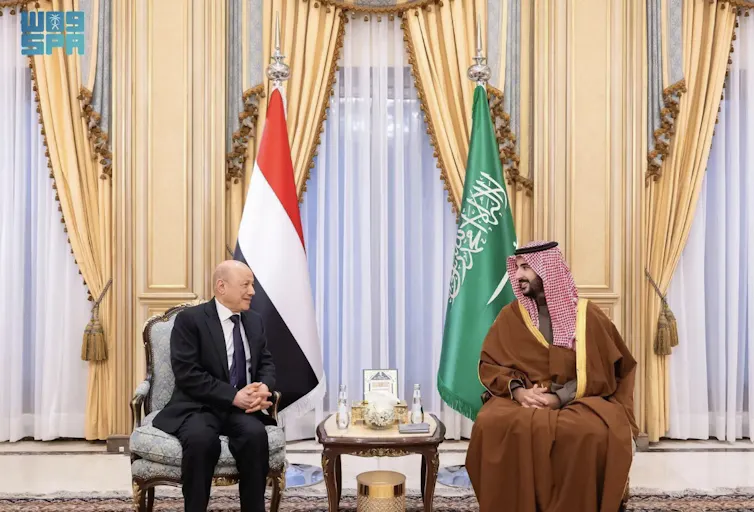
Le président du PLC, Rachad al-Alimi, est basé à Riyad. Son gouvernement fonctionne largement depuis l’extérieur du pays, tandis que les houthistes ont conservé, à Sanaa, une partie des anciennes structures administratives de l’État yéménite.
Le président Rachad Al-Alimi, à gauche, rencontre le ministre saoudien de la défense le prince Khalid bin Salman bin Abdulaziz, à Riyad, le 14 janvier 2026.Agence de presse saoudienne (SPA)
Dans le Sud, Aden joue le rôle de capitale temporaire, mais les administrations et les différents pouvoirs locaux coopèrent difficilement. C’est l’une des grandes faiblesses du camp anti-houthiste : il dispose de territoires, mais pas d’un appareil politique et militaire comparable à celui de ses adversaires.
Justement, quels sont les moyens des houthistes ?
J. G. G. : Les chiffres sont difficiles à établir, mais les forces d’Ansar Allah ont été profondément réorganisées après les échecs de 2020-2021 et pendant la trêve avec les Saoudiens appliquée à partir de 2022. Elles comptent au minimum plus de 100 000 combattants selon les estimations, probablement davantage si l’on inclut les combattants très jeunes et ceux qui ne sont pas officiellement revendiqués.
Quant à leur armement, c’est une erreur commune de croire qu’il est intégralement fourni par l’Iran. En réalité, une grande partie provient des stocks de l’ancien État yéménite dont les houthistes se sont emparés à partir de 2014. Ils ont également coopté des militaires et des forces de sécurité.
L’Iran joue surtout un rôle stratégique, tactique et technique : il offre aux houthistes transfert de savoir-faire, conseils et coopération, notamment pour la fabrication et l’emploi de drones, plutôt qu’approvisionnement massif en arsenal.
Enfin, l’avantage des houthistes par rapport au PLC tient aussi à l’unité de leur commandement. Leur pouvoir est extrêmement centralisé autour du chef du mouvement Abdel Malek al-Houthi, alors que le camp adverse reste composé de commandements et de forces aux intérêts divergents.
« Yémen : les Houthis, maîtres du jeu ? », France 24, 14 septembre 2026.
Comment les houthistes financent-ils leur pouvoir ?
J. G. G. : Il faut, là encore, se méfier de l’image d’un mouvement qui serait entièrement financé par Téhéran. Le territoire qu’ils contrôlent est économiquement très faible et ne produit pas suffisamment pour assurer seul son fonctionnement. Une partie des ressources provient des transferts de la diaspora yéménite. L’autre grande source est le contrôle et le détournement de l’aide humanitaire – n’oublions pas que le pays est le théâtre de l’une des pires crises humanitaires de la planète, qui fait rage dans les zones houthistes comme dans le reste du pays.
Partout, les services publics restent extrêmement dégradés et les ONG assurent une grande partie des politiques sanitaires et sociales. Les fonctionnaires sont payés de manière irrégulière et avec des revenus très inférieurs à ceux d’avant-guerre.
Quel est leur objectif politique ?
J. G. G. : Leur projet n’est pas celui d’une simple partition entre un Nord houthiste et un Sud indépendant. Je l’ai dit : ils veulent prendre l’ensemble du Yémen.
Mais leur action a également une dimension régionale. Le mouvement conteste historiquement certaines frontières avec l’Arabie saoudite et tient un discours extrêmement hostile à la famille Al-Saoud. Les lieux saints de l’islam occupent une place particulière dans cette rhétorique. Les houthistes entretiennent notamment l’idée que la famille régnante saoudienne ne serait pas légitime à exercer son autorité sur La Mecque et Médine.
Quelle est exactement la relation entre les houthistes et l’Iran ? Dans leur politique extérieure, sont-ils un simple « proxy » de Téhéran qui agit quand les Iraniens lui ordonnent d’agir ?
J. G. G. : Cette présentation est trop simplificatrice. Les houthistes se revendiquent de « l’axe de la résistance » et entretiennent avec l’Iran des relations politiques, sécuritaires et militaires étroites. Il existe des échanges directs et réguliers entre responsables houthistes et iraniens, y compris entre services de renseignement. Mais cela ne signifie pas que les décisions houthistes sont prises à Téhéran.
Je parlerais plutôt d’un partenariat d’intérêts. Les deux acteurs poursuivent des objectifs qui peuvent converger, mais ils ont aussi leurs propres agendas. Les houthistes tiennent particulièrement à leur autonomie et refusent d’être décrits comme de simples supplétifs de l’Iran. C’est précisément ce qui permet de comprendre certaines de leurs initiatives récentes : elles correspondent à leurs intérêts propres, même lorsqu’elles servent parallèlement les intérêts régionaux de Téhéran.
Pourquoi l’Arabie saoudite semble-t-elle aussi vulnérable face aux houthistes ?
J. G. G. : Les houthistes ont appris à jouer avec les lignes rouges et à utiliser les frappes contre le territoire saoudien comme un instrument de négociation. Entre 2018 et 2022, ils avaient déjà ciblé des infrastructures pétrolières et militaires dans le sud du royaume. Cette stratégie avait contribué à pousser Riyad vers la négociation et la trêve de 2022, tout en laissant aux houthistes le temps de réorganiser leurs forces.
La situation actuelle prolonge cette logique. Les frappes récentes montrent leur capacité à atteindre des cibles très éloignées de leur zone de contrôle, tandis que Riyad souffre d’un déficit de renseignement sur le mouvement. Et une intervention militaire massive des Saoudiens et de leurs alliés en territoire houthiste est d’autant plus improbable que la Turquie et le Pakistan, malgré leurs nouveaux engagements sécuritaires avec l’Arabie saoudite, ne semblent pas vouloir s’enliser dans le conflit yéménite.
Comment les houthistes ont-ils réussi à gagner une telle audience internationale ?
J. G. G. : Leur positionnement sur la Palestine a joué un rôle déterminant. En s’attaquant à Israël et en présentant leurs opérations comme une contribution à la défense des Palestiniens, ils ont su monopoliser une partie importante du capital symbolique lié à la « résistance ». Le phénomène est d’autant plus efficace que le conflit yéménite est complexe et mal connu : à l’extérieur du pays, beaucoup de gens connaissent les houthistes essentiellement à travers leur confrontation avec Israël ou l’Arabie saoudite.
C’est une véritable réussite de communication politique. Les houthistes peuvent ainsi apparaître, notamment auprès d’une partie de la gauche internationale, comme des rebelles ou des résistants, alors que leur gouvernance intérieure est beaucoup plus autoritaire et religieusement conservatrice. Il existe donc un contraste très fort entre leur discours international, centré sur la résistance et la solidarité avec la Palestine, et leur politique intérieure.
À quoi ressemble la société dans les territoires contrôlés par les houthistes ?
J. G. G. : Le système est extrêmement répressif, notamment à l’égard des femmes. Les autorités ont développé des structures chargées d’encadrer la famille et les affaires sociales, avec une forte intervention dans la vie privée. Le port du voile est imposé et il existe des structures de contrôle et de renseignement spécifiquement féminines. La représentation des femmes dans les plus hautes sphères politiques est devenue marginale.
La répression touche également les journalistes et les opposants. Ce volet intérieur est important pour comprendre le mouvement : l’appareil houthiste est à la fois très centralisé, très autoritaire et profondément marqué par un projet politico-religieux qui contraste avec l’image de mouvement de résistance qu’il cherche à projeter à l’extérieur.
Au fond, comment résumeriez-vous la situation du Yémen aujourd’hui ?
J. G. G. : Douze ans après leur entrée à Sanaa, les houthistes fonctionnent dans le nord comme un État, même s’ils ne sont pas reconnus comme tel. C’est un État très autoritaire, aux moyens économiques limités, qui dépend d’une forme de perfusion internationale et dont la population vit dans une situation humanitaire extrêmement difficile.
La formule qui me paraît la plus juste est celle de « guerre civile internationalisée ». Tous les acteurs du conflit ont des soutiens étrangers. C’est précisément cette combinaison entre une guerre civile, des acteurs locaux très autonomes et des puissances régionales qui explique la complexité et la dangerosité de la situation actuelle.
Propos recueillis par Grégory Rayko.
Jules Grange Gastinel ne travaille pas, ne conseille pas, ne possède pas de parts, ne reçoit pas de fonds d'une organisation qui pourrait tirer profit de cet article, et n'a déclaré aucune autre affiliation que son organisme de recherche.
David Smadja, Professeur des Universités - Praticien hospitalier, Hopital Europeen Georges Pompidou, Université Paris Cité
On sait aujourd’hui que la santé se construit tout au long de la vie. Malheureusement, notre organisation administrative actuelle, héritée du XXᵉ siècle, n’est pas adaptée aux enjeux de prévention.
Texte intégral (2002 mots)
L’ESSENTIEL
Les recherches les plus récentes nous ont appris que la santé se construit bien avant l’entrée dans le système de soin.
Les comportements favorables à la santé s’acquièrent dans des endroits et des secteurs très divers : dans les familles, à l’école, dans les clubs sportifs, dans les collectivités, etc.
Notre organisation institutionnelle doit être transformée pour tenir compte de l’évolution des connaissances scientifiques.
Jamais la prévention n’a autant été invoquée dans le débat public. Pourtant, notre système de santé continue d’intervenir principalement lorsque la maladie est déjà installée. Ce paradoxe est l’illustration de l’un des grands défis sanitaires du XXIᵉ siècle.
Pendant plus d’un demi-siècle, notre politique de santé s’est construite autour d’une ambition qui a profondément transformé la société française : garantir à chacun l’accès aux soins. Hôpitaux, médecine de ville, Assurance maladie, innovations thérapeutiques… Ce modèle a permis des progrès considérables et contribué à l’allongement de l’espérance de vie.
Le véritable défi du XXIᵉ siècle n’est plus seulement de soigner les maladies, mais de protéger et développer le capital santé dès les premières années de la vie.
Malheureusement, aujourd’hui, les politiques de santé, d’éducation, de jeunesse, de sport et de numérique demeurent largement organisées en silos. Cette fragmentation ne correspond plus aux déterminants contemporains de la santé, et nuit à l’efficacité de la prévention à destination des plus jeunes, qui devraient pourtant être au centre des préoccupations.
Des maladies évitables
Aujourd’hui, les principales menaces pour notre santé trouvent autant leur origine dans nos conditions de vie que dans les maladies elles-mêmes. Santé mentale, alimentation, activité physique, sommeil, exposition aux écrans ou inégalités sociales façonnent durablement notre état de santé.
L’Organisation mondiale de la santé (OMS) rappelle que les maladies non transmissibles sont responsables d’environ 75 % des décès dans le monde. Pour mémoire, ces maladies, également appelées maladies chroniques, se caractérisent généralement par leur longue durée. Les principales d’entre elles sont les maladies cardiovasculaires (telles que les crises cardiaques et les accidents vasculaires, les cancers, les maladies respiratoires chroniques, comme l’asthme et la bronchopneumopathie chronique obstructive, ou BPCO), ainsi que le diabète.
Si ces maladies résultent d’une combinaison de facteurs génétiques, physiologiques, environnementaux et comportementaux, on considère néanmoins qu’aujourd’hui, la plupart de leurs facteurs de risque sont évitables.
Or, si les maladies non transmissibles trouvent en grande partie leur origine bien avant leur apparition, alors la prévention devient notre premier traitement. Un constat qui s’applique aussi à la santé mentale, particulièrement dégradée chez les plus jeunes.
En 2025, l’OMS estimait qu’un adolescent sur sept souffrait d’un trouble mental. Toujours selon cette organisation internationale, la moitié des troubles psychiques apparaissent avant l’âge de 14 ans, et près des trois quarts avant 25 ans.
En France, le rapport Terram & Institut Montaigne consacré à la santé mentale des jeunes souligne lui aussi l’urgence d’une réponse publique plus ambitieuse. Pourtant, comme dans le cas des maladies non transmissibles, les interventions arrivent encore très, voire trop tard.
Les trajectoires de santé se construisent dès la jeunesse
Nous continuons pourtant à intervenir trop tard. C’est probablement le principal paradoxe de notre système : s’il est remarquablement organisé pour réparer les dégâts causés par la maladie, il l’est beaucoup moins pour construire durablement la santé. L’OCDE rappelle que les dépenses consacrées à la prévention représentent une part très limitée des dépenses de santé.
Les interventions se mettent le plus souvent en place lorsque les troubles psychiques ou les conséquences du harcèlement sont déjà installés. Or, ces vulnérabilités ne relèvent pas seulement de la médecine. Elles concernent tout autant l’école, le sport, le numérique, l’environnement social et la qualité de l’information. Un constat qui vaut aussi pour d’autres affections, telles que l’obésité, les addictions, etc.
Or, la jeunesse n’est pas seulement une période de la vie. Elle est le moment où se construisent les trajectoires de santé.
Modifier notre approche de la santé
Pendant longtemps, nous avons pensé que le système de santé produisait la santé.
En réalité, il produit principalement des soins. La santé, elle, se construit largement ailleurs, et bien avant l’entrée dans le système de soins.
Elle se construit dans les familles, à l’école, dans les clubs sportifs, dans les collectivités, dans nos choix alimentaires, dans notre rapport au numérique, dans les compétences psychosociales que développent les enfants…
La médecine curative demeure certes indispensable. Mais elle ne peut plus constituer l’unique horizon de notre politique de santé. Prévenir ne consiste plus seulement à dépister ou à vacciner. Prévenir, c’est agir suffisamment tôt pour éviter que les vulnérabilités ne deviennent pas des maladies.
Si les maladies chroniques se construisent progressivement au cours de la vie, alors la prévention doit agir bien avant leur apparition.
Prévenir, ce n’est pas non plus médicaliser. C’est sans doute le principal malentendu. Faire de la prévention ne signifie pas transformer chaque enfant en patient. Au contraire, la prévention consiste à agir sur les déterminants de la santé. Elle commence dans les lieux où les enfants grandissent et apprennent. L’école en est l’un des principaux.
Prévenir, c’est aussi donner aux jeunes les moyens de comprendre leur environnement et d’y évoluer de manière éclairée. Elle implique une véritable éducation à la santé et aux médias afin de mieux faire face à la désinformation.
Le défi n’est plus seulement de mieux soigner les maladies. Il est de mieux organiser la santé.
Changer l’organisation de la santé
On sait aujourd’hui que les déterminants de la santé sont transversaux. Ils traversent les politiques éducatives, sportives, sociales, environnementales et numériques.
Or, notre organisation administrative, héritée du XXᵉ siècle, n’est pas adaptée pour relever ce défi. La santé dépend d’un ministère. La jeunesse d’un autre. Le sport d’un troisième. L’éducation d’un quatrième. Le numérique d’un cinquième. Cette fragmentation ne correspond plus à ce que nous connaissons aujourd’hui des déterminants contemporains de la santé.
Les connaissances scientifiques ont évolué ; l’organisation de l’État doit évoluer elle aussi. Sa transformation pourrait passer par la création d’un ministère de la santé, des préventions, de la jeunesse et des sports, capable de mieux coordonner les politiques qui agissent sur les déterminants de la santé.
Mais la prévention doit dépasser le seul champ sanitaire. La santé doit cesser d’être considérée comme la seule affaire du système de soins : elle doit devenir un critère de décision des politiques économiques, industrielles, environnementales et scientifiques. Les déterminants commerciaux, tout comme les pollutions, montrent combien les choix économiques et industriels peuvent peser sur la santé des populations.
Cette exigence concerne également le système de soins lui-même. L’hôpital traite les conséquences des expositions environnementales, tout en contribuant à l’empreinte écologique collective. Nous avons pour cette raison proposé un label « Hôpital de santé environnementale », afin d’intégrer santé environnementale, pertinence des soins et transition écologique au fonctionnement hospitalier.
La grande réussite sanitaire du siècle dernier a été de garantir l’accès aux soins. La grande ambition du XXIᵉ siècle doit être de garantir à chacun les conditions pour rester en bonne santé. Il s’agit de déplacer le centre de gravité de notre politique de santé : des maladies vers leurs déterminants, du soin vers la prévention, de la réparation vers l’anticipation.
La prévention ne doit plus être « juste » une politique sanitaire. Cela doit devenir une politique de société, au service d’un projet collectif. À ce titre, faire de la jeunesse le premier investissement de notre politique de santé, c’est bel et bien choisir d’agir avant la maladie plutôt qu’après.
David Smadja est membre du Think tank Le Laboratoire de la République. Mon équipe de recherche a reçu durant ses 5 dernières années des financements de l'ANR, l'ANRS MIE, de la fondation air liquide et du consortium EU-Response pour travailler sur les thématiques de COVID-19 et de COVID Long.
Michael FitzGerald, Doctoral Researcher in Law, European University Institute
Understanding the technological shift from a literary to a post-literary society is crucial for rethinking AI’s place in learning environments.
Texte intégral (2063 mots)
Policymakers are sounding the alarm about AI and social media in schools, as PISA’s latest report confirmed that student performance in reading continues to decline. French Education minister Édouard Geffray lamented the “cognitive destruction” of a generation, while his Spanish counterpart, Milagros Tolón, recommended a focused effort to improve reading because “reading is the foundation of everything”.
The Economist’s editorial board called it a “slow-moving catastrophe”, emphasising that “while machines are getting brighter (… ) teens are getting dimmer”, and pinned blame on the weak, “radical” leftists in university education departments. Meanwhile, the “radical left” is taking meaningful action. On September 2, shortly before the publication of the PISA scores, New York Mayor Zohran Mamdani announced a ban on student-facing generative Artificial Intelligence (AI) use in New York City public schools from pre-school through eighth grade (approx. 4-14 years of age), to be complemented by “twice-yearly AI critical thinking modules for high schoolers, limited AI pilots for a small number of high school classrooms and age-appropriate screen time restrictions”.
Mamdani’s policies are well intentioned. They offer a valuable symbol of resistance against a rapacious commodification of children’s attention, and they test a model which might be replicated beyond New York. Any measures which attempt to create space for young children to learn in an environment free of powerful and highly addictive AI technologies should be celebrated. But such policies address symptoms rather than confront the nature and causes of the decline in reading. This is because they arise from a superficial, reactive, and often patronising, public discourse, which has failed to honestly or accurately account for the scope of the transformation our society is experiencing: a technological shift from a literary to a post-literary society, in which AI is just one recent development, and through which all of our learning habits and capabilities are being remodelled, ministers and schoolchildren alike.
A media theory from the mid-twentieth century, developed by the classicist Eric Havelock and, perhaps most penetratingly, the Jesuit priest and literature professor, Walter J. Ong, can help us to design regulation in a way that is sensitive to the technological context in which AI has emerged: a context of transformation from a society which privileges one medium of knowledge production, communication and preservation, towards another. For the past hundred years, our society has shifted from a predominantly literary culture towards an increasingly oral and auditory one: from a culture which privileges interiority, reflection, and craft, towards one which values live communication, interactivity, and a certain ‘unfiltered’ and authentic immediacy. Understanding this context will help us to produce regulations which are more appropriately designed to attune institutions like the school to the technological context beyond their doors rather than attempt to hermetically seal them off.
AI is a machine for the de-sanctification of text. If we reconsider PISA in this light, the scores can be construed not as evidence of teenagers’ ‘dimness’ but of the acuity of their perception: perhaps these students have intuited that something has shifted irrevocably about the position of reading and writing in our culture. What if the students know something profound has changed about the world that they will live in that their teachers and ministers have either failed to understand or are unwilling to admit?
The foundation of everything
After a summer that welcomed a renewed interest in Homer, following the release of Christopher Nolan’s The Odyssey, it is worth remembering that the poems which form the foundation of the Western literary canon – the Iliad and the Odyssey – were composed, performed, transmitted, and preserved by people who could not read. As such, we might question whether reading ought to be considered the “foundation of everything”, as Minister Tolón suggests, or whether there is not a deeper substrate, on which reading itself depends, that we are missing in the controversy over our society’s changing relationship to the written word.
The classicist, Eric Havelock, in his 1963 Preface to Plato, argues that the birth of philosophy in Ancient Greece came about due to an innovation in the society’s methods for storing knowledge. Every human society relies on technologies to store information for reuse. Before Homer, Greek culture was stored in oral memory, but between Homer and Plato, the storage method changed with the invention of the technology of writing. The ascendancy of the written word brought about a crisis in Greek culture, which, according to Havelock, saw the replacement of an “orally memorised tradition” by a “quite different system of instruction and education”, and “saw the Homeric state of mind give way to the Platonic”.
Walter J. Ong, in his 1982 Orality and Literacy, describes how the gradual rise of this Platonic written culture, and its displacement of rhetoric (literally ‘speech arts’) from the centre of academic education, had a profound effect on the ‘mentality’ of learning in literate societies. Ong argued that writing reshaped consciousness by defining the ‘interior self’ against which “the objective world is set”. One product of this interiorisation, for Ong, was the emergence of the educational phenomenon of ‘study’ conceived as a reflective, solitary activity. Ong underlines that humans in oral cultures “learn a great deal and possess and practise great wisdom, but they do not ‘study’”. They learn relationally, he explains, by “discipleship, which is a kind of apprenticeship, by listening (…) not by study in the strict sense”.
Ong’s description of oral learning culture bears a similarity to the rhythms and immediacy through which knowledge is acquired, shared, and memetically elaborated on the Internet. Writing in the 1980s, Ong saw that the emergence of electronic technology (radio, television, and telephone) brought a new age of ‘secondary orality’. This new oral culture, which has evolved through Internet and digital technology, bore “striking resemblances to the old”. It unsettled the static quality of words, reemphasised dialogue and “agonistic” exchange, bringing a renewed “concentration on the present moment”.
The Gutenberg parenthesis
Throughout the period of literary culture – what Danish professor of literature Lars Ole Sauerberg has called the “Gutenberg Parenthesis”, a 500-year “blip” from the invention of print until roughly the turn of the millennium – text retained an almost sacred authority through its fixity and scarcity.
In the age of AI, text has become unfixed and maximally unscarce – chatbots produce unmanageably large quantities, and that text has come to resemble oral discourse. It is fluid and unreliable. On the Internet, dates and facts must be checked and triple checked. Spurious claims abound and must be interrogated.
Text, in literate societies, was “basically unresponsive”: if you ask someone to explain their position, Ong related, you get an explanation, but “if you ask a text, you get back nothing except the same, often stupid, words which called for your question in the first place”. In the new age of AI-mediated digital orality, the text explains itself. Or at least it appears to.
The PISA tests were designed in 2000 as the literary age – in which facility with text was the privileged sign of attainment – was reaching its apotheosis and giving way to the forces that would shape the new digital orality. The mind that could pay unbroken attention to a text, which contained a truth that would not change, and would not answer back, was the mind that our schools, our universities and our examination and assessment structures were built to produce and to measure. More fundamentally, this was the mind that our societies were organised to reward and incentivise. But even if we may wish to return the genie to the bottle, the world in which we live is thoroughly given over to a new logic of success and a new aesthetic of achievement.
Refusing the gift horse
Technology is not an enemy at the gates, but a gift horse that, bidden or unbidden, detected or undetected, is already within. It is already in the process of reshaping every major social institution.
Even if Mamdani’s policy keeps AI out of the physical classroom, the new reality that is imposed by the return to orality will continue to shape the incentives through which those classrooms function, by defining what kind of mind is valued and rewarded in the world outside.
It can take a long time for a society to understand that the technological context which made sense of its forms and rituals has changed.
In the Phaedrus, Socrates tells the story of the Egyptian king Thamus who refused the gift of writing because it would “create forgetfulness” and give “not truth, but only the semblance of truth”: students with writing, “will be hearers of many things and will have learned nothing”. But Thamus’s refusal – preserved in Plato’s written dialogue – was, like Mamdani’s, enveloped in the form of the medium it tried to refuse.
Mamdani’s moratorium may well be worth having. But the conversation around it should be less patronising, and the students themselves have to do more of the talking, because they may have grasped what their ministers have not: that we are testing them for a world which no longer exists. And if they are getting dimmer, we should have the humility to admit that we are getting dimmer too.
A weekly e-mail in English featuring expertise from scholars and researchers. It provides an introduction to the diversity of research coming out of the continent and considers some of the key issues facing European countries. Get the newsletter!
Michael FitzGerald ne travaille pas, ne conseille pas, ne possède pas de parts, ne reçoit pas de fonds d'une organisation qui pourrait tirer profit de cet article, et n'a déclaré aucune autre affiliation que son organisme de recherche.